NEC Laboratories America

Projects | Domain Adaptive Semantic Segmentation Using Weak Labels

PROJECTS

Domain Adaptive Semantic Segmentation Using Weak Labels

We propose a novel framework for domain adaptation in semantic segmentation with image-level weak labels in the target domain. The weak labels may be obtained based on a model prediction for unsupervised domain adaptation (UDA), or from a human annotator in a new weakly supervised domain adaptation (WDA) paradigm for semantic segmentation. Using weak labels is both practical and useful, since (i) collecting image-level target annotations is comparably cheap in WDA and incurs no cost in UDA, and (ii) it opens up the opportunity for category-wise domain alignment.

Collaborators: Sujoy Paul, Yi-Hsuan Tsai, Amit K. Roy-Chowdhury, Manmohan Chandraker

Domain Adaptive Semantic Segmentation Using Weak Labels

Project Data

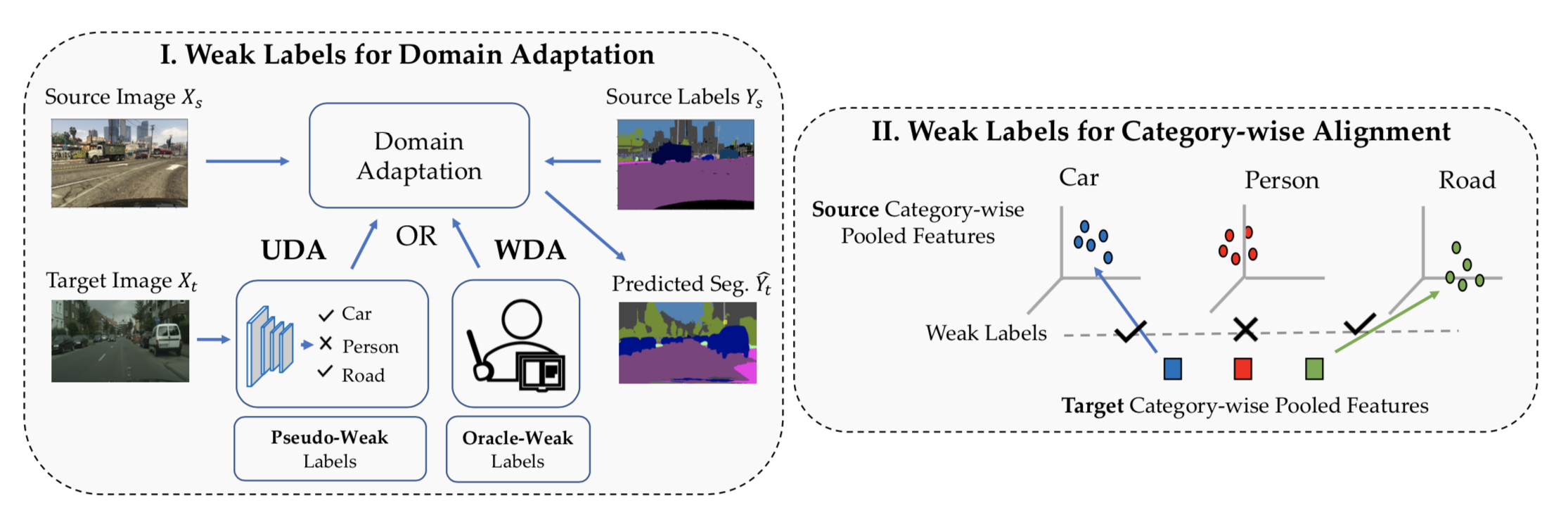
Our work introduces two key ideas to adapt semantic segmentation models across domains. I: Using image-level weak annotations for domain adaptation, either estimated, i.e., pseudo-weak labels (Unsupervised Domain Adaptation, UDA) or acquired from a human oracle (Weakly-supervised Domain Adaptation, WDA). II: We utilize weak labels to improve the category-wise feature alignment between the source and target domains. Learning semantic segmentation models requires a huge amount of pixel-wise labeling. However, labeled data may only be available abundantly in a domain different from the desired target domain, which only has minimal or no annotations. In this work, we propose a novel framework for domain adaptation in semantic segmentation with image-level weak labels in the target domain. The weak labels may be obtained based on a model prediction for unsupervised domain adaptation (UDA), or from a human annotator in a new weakly-supervised domain adaptation (WDA) paradigm for semantic segmentation. Using weak labels is both practical and useful, since (i) collecting image-level target annotations is comparably cheap in WDA and incurs no cost in UDA, and (ii) it opens the opportunity for category-wise domain alignment. Our framework uses weak labels to enable the interplay between feature alignment and pseudo-labeling, improving both in the process of domain adaptation. Specifically, we develop a weak-label classification module to enforce the network to attend to certain categories, and then use such training signals to guide the proposed category-wise alignment method. In experiments, we show considerable improvements with respect to the existing state-of-the-arts in UDA and present a new benchmark in the WDA setting.

Main Results

result

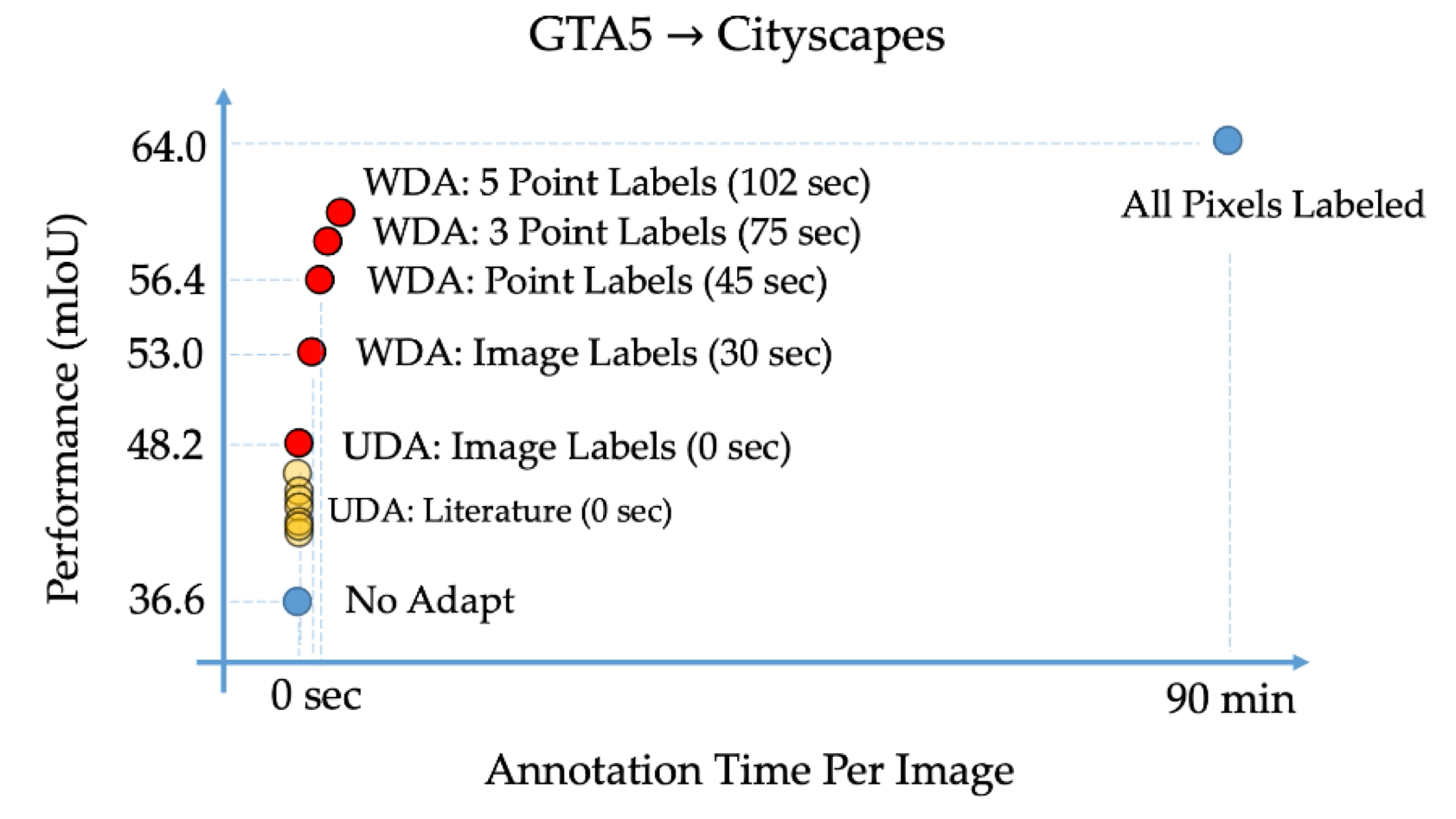
Performance comparison on GTA5-to-Cityscapes with different levels of supervision on target images: no target labels (“No Adapt” and “UDA”), weak image labels (30 seconds), one point labels (45 seconds), and fully-supervised setting with all pixels labeled (“All Pixels Labeled”).

Domain Adaptive Semantic Segmentation Using Weak Labels Paper

1 UC Riverside 2 NEC Laboratories America 3 UC San Diego

In European Conference on Computer Vision (ECCV) 2020
[Download Paper] [PDF at Arxiv]

Abstract

Learning semantic segmentation models requires a huge amount of pixel-wise labeling. However, labeled data may only be available abundantly in a domain di↵erent from the desired target domain, which only has minimal or no annotations. In this work, we propose a novel framework for domain adaptation in semantic segmentation with image-level weak labels in the target domain. The weak labels may be obtained based on a model prediction for unsupervised domain adaptation (UDA), or from a human annotator in a new weakly-supervised domain adaptation (WDA) paradigm for semantic segmentation. Using weak labels is both practical and useful, since (i) collecting image-level target annotations is comparably cheap in WDA and incurs no cost in UDA, and (ii) it opens the opportunity for category-wise domain alignment. Our framework uses weak labels to enable the interplay between feature alignment and pseudo-labeling, improving both in the process of domain adaptation. Specifically, we develop a weak-label classification module to enforce the network to attend to certain categories, and then use such training signals to guide the proposed category-wise alignment method. In experiments, we show considerable improvements with respect to the existing state-of-the-arts in UDA and present a new benchmark in the WDA setting.
Domain Adaptive Semantic Segmentation Using Weak Labels

Short Summarization

Video Results on GTA5-to-Cityscapes (Sequence 1)

Video Results on GTA5-to-Cityscapes (Sequence 2)

Video Results on GTA5-to-Cityscapes (Sequence 3)

Domain Adaptation Publications

Position Really Matters: Towards a Holistic Approach for Prompt Tuning

Prompt tuning is highly effective in efficiently extracting knowledge from foundation models, encompassing both language, vision, and vision-language models. However, the efficacy of employing fixed soft prompts with a predetermined position for concatenation with inputs for all instances, irrespective

Text-guided Device-realistic Sound Generation for Fiber-based Sound Event Classification

Recent advancements in unique acoustic sensing devices and large-scale audio recognition models have unlocked new possibilities for environmental sound monitoring and detection. However, applying pretrained models to non-conventional acoustic sensors results in performance degradation due to domain shifts,

POND: Multi-Source Time Series Domain Adaptation with Information-Aware Prompt Tuning

Time series domain adaptation stands as a pivotal and intricate challenge with diverse applications, including but not limited to human activity recognition, sleep stage classification, and machine fault diagnosis. Despite the numerous domain adaptation techniques proposed to tackle this complex problem,

Source-Free Domain Adaptive Fundus Image Segmentation with Class-Balanced Mean Teacher

This paper studies source-free domain adaptive fundus image segmentation which aims to adapt a pretrained fundus segmentation model to a target domain using unlabeled images. This is a challenging task because it is highly risky to adapt a model only using unlabeled data. Most existing methods tackle

Towards Realizing the Value of Labeled Target Samples: a Two-Stage Approach for Semi-Supervised Domain Adaptation

Semi-Supervised Domain Adaptation (SSDA) is a recently emerging research topic that extends from the widely-investigated Unsupervised Domain Adaptation (UDA) by further having a few target samples labeled, i.e., the model is trained with labeled source samples, unlabeled target samples as well as a few

Adversarial Alignment for Source Free Object Detection

Source-free object detection (SFOD) aims to transfer a detector pre-trained on a label-rich source domain to an unlabeled target domain without seeing source data. While most existing SFOD methods generate pseudo labels via a source-pretrained model to guide training, these pseudo labels usually contain

Learning Cross-Modal Contrastive Features for Video Domain Adaptation

Learning transferable and domain adaptive feature representations from videos is important for video-relevant tasks such as action recognition. Existing video domain adaptation methods mainly rely on adversarial feature alignment, which has been derived from the RGB image space. However, video data is

Domain Adaptive Semantic Segmentation using Weak Labels

We propose a novel framework for domain adaptation in semantic segmentation with image-level weak labels in the target domain. The weak labels may be obtained based on a model prediction for unsupervised domain adaptation (UDA), or from a human oracle in a new weakly-supervised domain adaptation (WDA)

Shuffle and Attend: Video Domain Adaptation

We address the problem of domain adaptation in videos for the task of human action recognition. Inspired by image-based domain adaptation, we can perform video adaptation by aligning the features of frames or clips of source and target videos. However, equally aligning all clips is sub-optimal as not

Active Adversarial Domain Adaptation

We propose an active learning approach for transferring representations across domains. Our approach, active adversarial domain adaptation (AADA), explores a duality between two related problems: adversarial domain alignment and importance sampling for adapting models across domains. The former uses

Unsupervised and Semi-Supervised Domain Adaptation for Action Recognition from Drones

We address the problem of human action classification in drone videos. Due to the high cost of capturing and labeling large-scale drone videos with diverse actions, we present unsupervised and semi-supervised domain adaptation approaches that leverage both the existing fully annotated action recognition

Domain Adaptation for Structured Output via Discriminative Patch Representations

Predicting structured outputs such as semantic segmentation relies on expensive per-pixel annotations to learn supervised models like convolutional neural networks. However, models trained on one data domain may not generalize well to other domains without annotations for model finetuning. To avoid the

Unsupervised Domain Adaptation for Distance Metric Learning

Unsupervised domain adaptation is a promising avenue to enhance the performance of deep neural networks on a target domain, using labels only from a source domain. However, the two predominant methods, domain discrepancy reduction learning and semi-supervised learning, are not readily applicable when