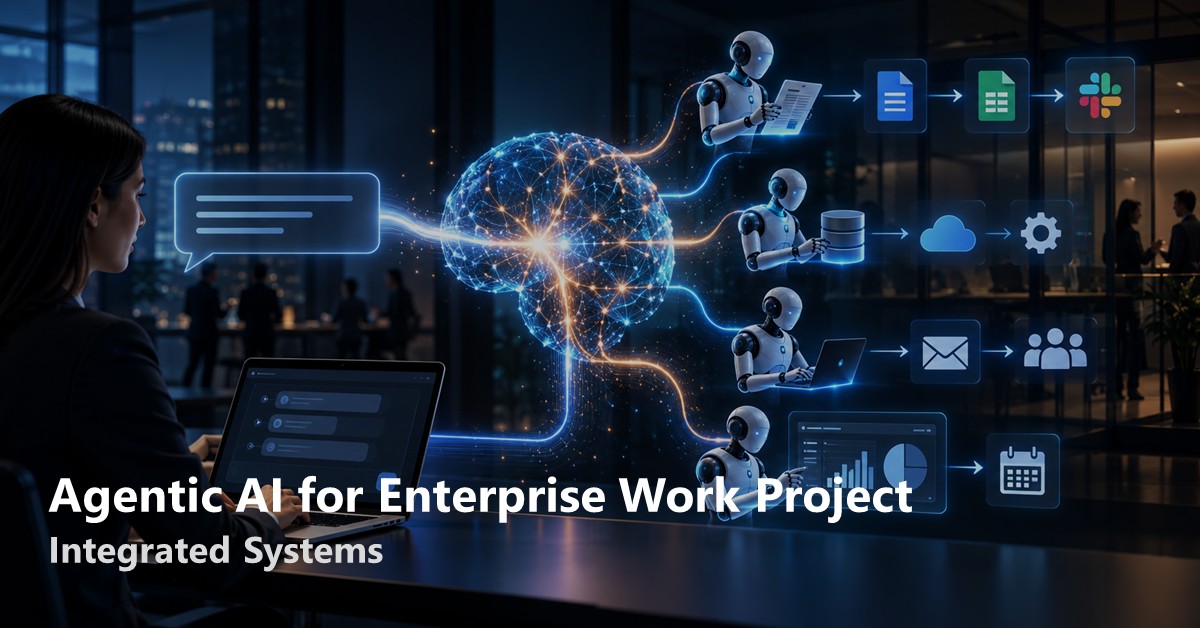
Instead of relying on scarce engineering resources to automate each process, business users will be able to create and adapt agents themselves. That fundamentally changes the economics of enterprise automation and dramatically expands the range of work that can be automated.
We are building toward an enterprise where a non-technical user simply describes the outcome they want. AI agents then plan the work, select and use the right tools and internal systems, draw on the organization’s knowledge and people, and execute reliably at production scale. The result is a powerful shift: the natural-language description of a workflow becomes the workflow itself.
The barrier is no longer capability. It is reliability. And reliability breaks down at two levels that are often treated separately: reasoning and systems. At the reasoning level, an LLM can produce a plausible plan but drift during execution. It may invent steps, skip important preconditions, or choose the wrong tool from a catalog of hundreds with similar descriptions. These mistakes may be acceptable in a chat assistant. They are not acceptable in a business process involving money, sensitive data, or compliance.
At the systems level, agents create different challenges. Their execution generates bursty, unpredictable sequences of function calls, with cost and latency patterns that traditional schedulers were not designed to handle. An agent fleet that works well in a demo can quickly become too expensive or too slow at production scale.
Our approach addresses both problems. We make execution trustworthy by constraining the model rather than simply asking it to reason better. RunAgent interprets natural-language plans within explicit constraints that define what execution can and cannot do. TacTool treats tool selection as a reasoning problem, helping agents choose the right action rather than simply matching against a catalog. XPF brings these capabilities together behind a natural-language authoring interface, allowing users to create agents that execute real business workflows. SlideCraft and TalentScout ground those agents in the artifacts, knowledge, and tacit expertise that organizations already possess. Bifröst addresses the other half of the problem: making agent execution efficient at scale. It treats function invocation as a distributed-systems challenge, using peer-to-peer load balancing to manage the unpredictable workloads generated by fleets of agents.
Our AI systems address the two requirements for enterprise agentic AI: agents must execute correctly, and they must do so reliably and economically at scale.