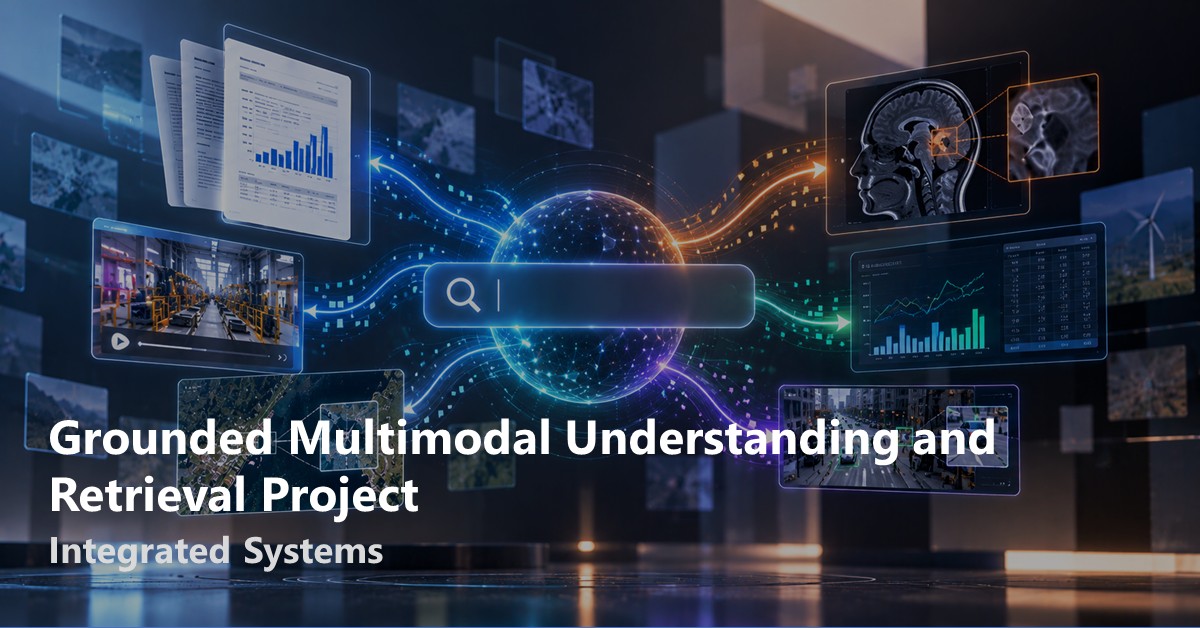
Much of an organization’s most valuable information is not plain text. It lives in charts and tables, years of video, satellite imagery, radiology studies, maintenance records, and continuously generated data streams. Generative AI has made it possible to ask natural-language questions of this information, and retrieval-augmented generation (RAG) has become the standard architecture for connecting models to proprietary data. But today’s RAG systems were largely built for text documents. They struggle when the evidence is visual, temporal, spatial, or spread across multiple modalities.
This limitation matters most in industries where the stakes are highest. Finance, law, healthcare, defense, and industrial operations hold enormous amounts of multimodal data, and they cannot rely on answers without evidence. In these settings, the product is not just the answer; it is the provenance behind it. A system that produces a convincing response but cannot show exactly where that response came from has limited commercial value.
We are building toward a retrieval and reasoning layer that works across documents, video, imagery, and data streams. Users should be able to ask open-ended questions in their own language, rather than conforming to a predefined taxonomy, and receive answers grounded directly in the underlying evidence. The goal is to make an organization’s entire body of knowledge searchable enough to use, efficient enough to query continuously, and traceable enough to trust and defend.
Three barriers stand between today’s multimodal RAG systems and reliable enterprise deployment: grounding, cost, and scale. First, correctness is difficult to measure. In multimodal retrieval, there is no established way to determine whether a retrieved image, video segment, or other piece of evidence actually supports a generated claim. As a result, hallucinations can be difficult to detect and grounding is often assumed rather than measured. Second, the economics work against enterprise-scale deployment. Enterprise context can be enormous, while LLM APIs are typically priced by the amount of context they process. A naive system therefore spends much of its cost sending information the model does not actually need. Third, video and live streams break the traditional indexing model. Converting an entire video archive into text before anyone asks a question is prohibitively expensive, while a live stream cannot be fully indexed in advance at all. Retrieval must instead happen incrementally, as questions are asked and new information arrives.
Our approach makes grounding, efficiency, and incremental retrieval first-class design constraints. RAG-check provides a methodology for evaluating multimodal RAG, turning grounding into something that can be measured rather than assumed. Our work on re-ranking retrieved context improves the quality and relevance of the evidence that reaches the model in the first place. We attack cost by reducing context rather than simply paying to process it. LeanContext and query-aware data reduction identify the information relevant to a particular question before it is sent to the model, while EcoDoc applies the same principle to multimodal document pipelines.
For video and streaming data, iRAG replaces exhaustive up-front indexing with an incremental approach that processes content as queries demand it. ViTA makes video-to-text conversion efficient enough for practical deployment, while StreamingRAG extends retrieval and reasoning to live multimodal streams. Finally, we address open-vocabulary grounding in specialist domains where predefined labels and taxonomies are especially limiting. Open-SAT uses LLM guidance to improve free-form retrieval from satellite imagery. Our work on visual alignment grounds generated radiology text in what is actually visible in medical images, while knowledge-enhanced prompt learning helps models bridge the commonsense gaps that emerge when reasoning about the open world.
Our AI systems move multimodal RAG from simply generating plausible answers toward something enterprises can actually depend on: retrieval that is measurable in its grounding, economical in its use of context, scalable to massive and continuous data, and flexible enough to answer questions in the language users naturally use.