Christopher White
President of NEC Labs America
Corporate Senior Vice President at NEC Corporation
Managing Director of Research & Development at NEC Corporation
President of NEC Labs America
Corporate Senior Vice President at NEC Corporation
Managing Director of Research & Development at NEC Corporation



Christopher White serves as Corporate Senior Vice President and Managing Director of Research & Development at NEC Corporation since March 2026, where he leads NEC’s worldwide R&D strategy across its global network of laboratories in Japan, the United States, Europe, Asia Pacific, China, and Israel. He has also been the President at NEC Laboratories America, Inc. since March 2020, where he leads a team of world-class researchers focusing on diverse topics from sensing to networking to machine learning-based understanding.
Chris has extensive expertise in scientific computing, hierarchical simulation techniques, quantum chemistry, optical networks, optical devices, and acoustic scattering. His research interests include the development of computational models and methods for the simulation and control of interesting physical and digital systems. This has included work ranging from linear-scaling quantum chemistry simulations to the design of new optical devices, to the global control of transparent optical mesh networks, and to understanding and facilitating the propagation of ideas in organizations. In addition to managing a team of world-class researchers, his current work focuses on creating assisted thinking tools that leverage structural similarity in data with the goal of augmenting human intelligence.
Prior to his role at NEC Laboratories America, Inc., he spent 22 years working at Nokia Bell Labs, where he led the Algorithms, Analytics, Augmented Intelligence and Devices (AAAID) research lab.
Chris has a Ph.D. in Theoretical Quantum Chemistry from the University of California, Berkeley, and a B.S. and M.S. in Chemistry from Carnegie Mellon University, with a concentration in Computer Science.
 https://www.nec-labs.com/wp-content/uploads/2024/07/The-Evolution-of-Disciplines-From-Experimental-Roots-to-Theoretical-Frameworks-Blog-Post.jpg
628
1200
Christopher White
https://www.nec-labs.com/wp-content/uploads/2025/08/NEC-Laboratories-America-Logo-Aug-2025-2.jpg
Christopher White2024-07-29 11:10:202026-06-26 10:54:20The Evolution of Disciplines: From Experimental Roots to Theoretical Frameworks
https://www.nec-labs.com/wp-content/uploads/2024/07/The-Evolution-of-Disciplines-From-Experimental-Roots-to-Theoretical-Frameworks-Blog-Post.jpg
628
1200
Christopher White
https://www.nec-labs.com/wp-content/uploads/2025/08/NEC-Laboratories-America-Logo-Aug-2025-2.jpg
Christopher White2024-07-29 11:10:202026-06-26 10:54:20The Evolution of Disciplines: From Experimental Roots to Theoretical Frameworks https://www.nec-labs.com/wp-content/uploads/2023/09/Industrial-Labs-to-Drive-Disruptive-Innovation-for-the-Fourth-Industrial-Revolution-Blog-Post.jpg
628
1200
NEC Labs America
https://www.nec-labs.com/wp-content/uploads/2025/08/NEC-Laboratories-America-Logo-Aug-2025-2.jpg
NEC Labs America2023-09-06 14:13:252026-06-26 11:08:59Industrial Labs to Drive Disruptive Innovation for the Fourth Industrial Revolution
https://www.nec-labs.com/wp-content/uploads/2023/09/Industrial-Labs-to-Drive-Disruptive-Innovation-for-the-Fourth-Industrial-Revolution-Blog-Post.jpg
628
1200
NEC Labs America
https://www.nec-labs.com/wp-content/uploads/2025/08/NEC-Laboratories-America-Logo-Aug-2025-2.jpg
NEC Labs America2023-09-06 14:13:252026-06-26 11:08:59Industrial Labs to Drive Disruptive Innovation for the Fourth Industrial Revolution https://www.nec-labs.com/wp-content/uploads/2023/11/The-Industrial-Lab-Advantage-Delivering-on-the-Expectations-of-AI.jpg
628
1200
NEC Labs America
https://www.nec-labs.com/wp-content/uploads/2025/08/NEC-Laboratories-America-Logo-Aug-2025-2.jpg
NEC Labs America2023-11-10 12:15:032026-06-26 10:49:16The Industrial Lab Advantage: Delivering on the Expectations of AI | Future of Work News
https://www.nec-labs.com/wp-content/uploads/2023/11/The-Industrial-Lab-Advantage-Delivering-on-the-Expectations-of-AI.jpg
628
1200
NEC Labs America
https://www.nec-labs.com/wp-content/uploads/2025/08/NEC-Laboratories-America-Logo-Aug-2025-2.jpg
NEC Labs America2023-11-10 12:15:032026-06-26 10:49:16The Industrial Lab Advantage: Delivering on the Expectations of AI | Future of Work News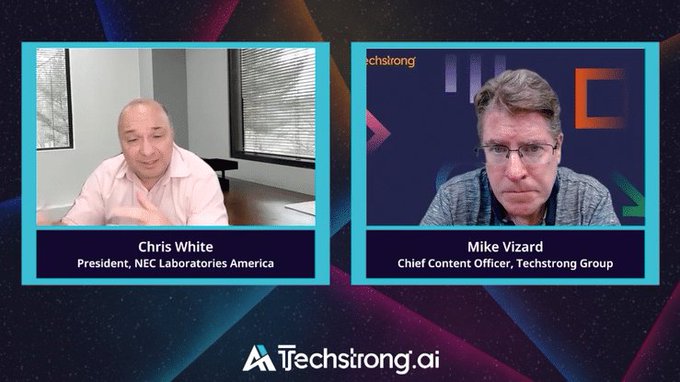 https://www.nec-labs.com/wp-content/uploads/2023/09/Chris-White-Interviewed-By-Mike-Vizard-on-Techstrong.AI_.jpg
382
680
NEC Labs America
https://www.nec-labs.com/wp-content/uploads/2025/08/NEC-Laboratories-America-Logo-Aug-2025-2.jpg
NEC Labs America2023-09-30 12:08:332026-06-26 10:53:06Chris White Interviewed By Mike Vizard on Techstrong.AI
https://www.nec-labs.com/wp-content/uploads/2023/09/Chris-White-Interviewed-By-Mike-Vizard-on-Techstrong.AI_.jpg
382
680
NEC Labs America
https://www.nec-labs.com/wp-content/uploads/2025/08/NEC-Laboratories-America-Logo-Aug-2025-2.jpg
NEC Labs America2023-09-30 12:08:332026-06-26 10:53:06Chris White Interviewed By Mike Vizard on Techstrong.AI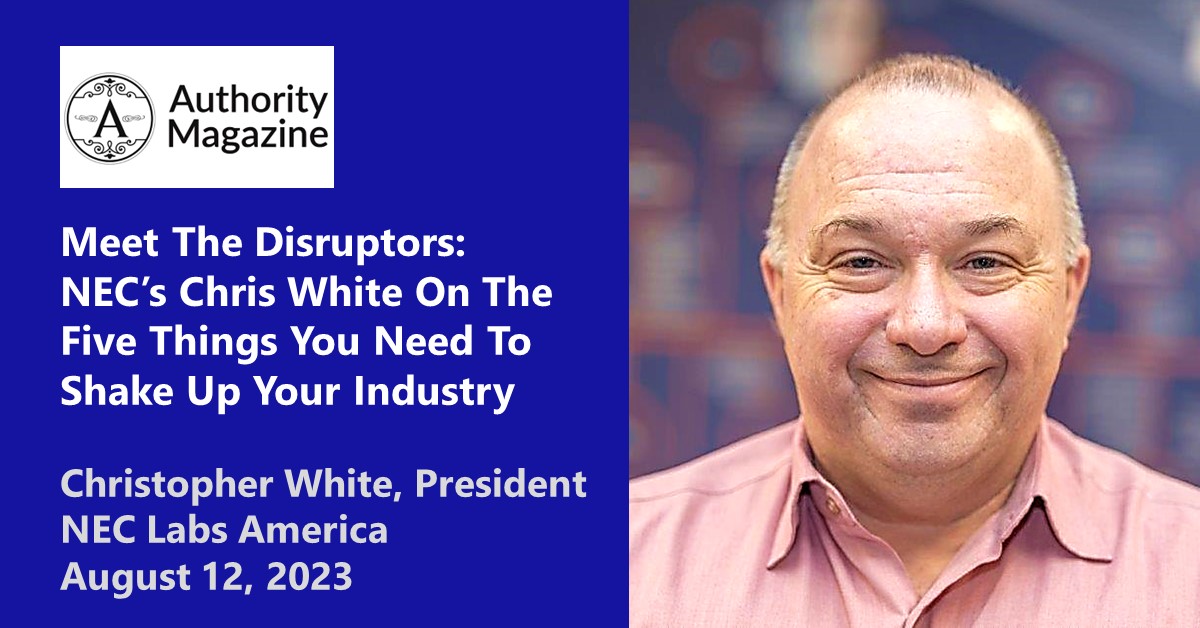 https://www.nec-labs.com/wp-content/uploads/2023/09/Meet-The-Disruptors-NECs-Chris-White-On-The-Five-Things-You-Need-To-Shake-Up-Your-Industry-Authority-Magazine.jpg
628
1200
NEC Labs America
https://www.nec-labs.com/wp-content/uploads/2025/08/NEC-Laboratories-America-Logo-Aug-2025-2.jpg
NEC Labs America2023-08-12 09:00:102026-06-26 10:53:59Meet The Disruptors: NEC’s Chris White On The Five Things You Need To Shake Up Your Industry | Authority Magazine
https://www.nec-labs.com/wp-content/uploads/2023/09/Meet-The-Disruptors-NECs-Chris-White-On-The-Five-Things-You-Need-To-Shake-Up-Your-Industry-Authority-Magazine.jpg
628
1200
NEC Labs America
https://www.nec-labs.com/wp-content/uploads/2025/08/NEC-Laboratories-America-Logo-Aug-2025-2.jpg
NEC Labs America2023-08-12 09:00:102026-06-26 10:53:59Meet The Disruptors: NEC’s Chris White On The Five Things You Need To Shake Up Your Industry | Authority MagazineChris spoke on the role of research in innovation and going to market in a keynote address from the CS3 VALIDATE Accelerator Demo Day in April 2025. He reflected on how industrial research bridges the gap between groundbreaking innovation and real-world application.
Meet Chris and our NEC Laboratories America leadership team, which has created an environment for our researchers to uncover essential knowledge and create innovative solutions for society in collaboration with industry, academia, and governments.
Chris and others discuss our organization which is the US-based center for NEC Corporation’s global network of corporate research laboratories. We collaborate with industry, academia and governments to provide disruptive solutions to complex problems.
Chis discusses the exciting employment and internship opportunities at our organization, including data science, system security, machine learning, media analytics, optical networking and sensing, and more.
Chris talks with with Telecom Review North America to shed a light on the strategic value and advantage of NEC’s industrial arm over traditional corporate R&D, and how industrial research contributes in pursuing innovative solutions to real-world problems.
Large language models (LLMs) have significantly advanced the field of natural language processing (NLP), providing a highly useful, task-agnostic foundation for a wide range of applications. However, directly applying LLMs to solve sophisticated problems in specific domains meets many hurdles, caused