NEC Laboratories America

Time Series Sensor Data Analysis | Projects

Time Series Sensor Data Analysis

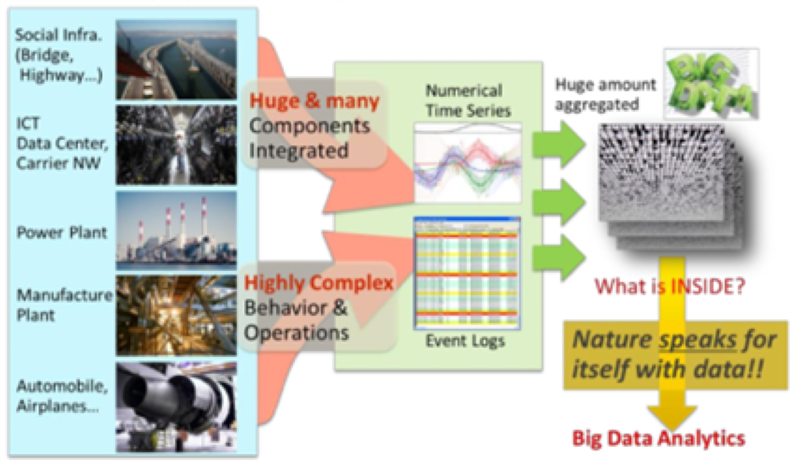
With ubiquitous sensing and networking capability, traditional complex physical systems have been undergoing revolutionary changes in their ICT capabilities. They are now equipped with a large number of sensors distributed across different parts of the system, which collect a tremendous amount of data from system operation.

This project aims to develop innovative analytic engines to model the big data from these systems and extract information that helps customers optimize their business operations. Time series analysis, graph mining, heterogeneous data mining, etc., are core technologies that support industrial demands.

In addition to new engine development, we are also focusing on building new solutions for different industries (e.g., energy, chemical, steel, social infrastructures, etc.), which can directly solve customers’ core business problems and transform how we live and work. Smart cities, smart power grids and intelligent homes are all examples of applications that harness the power of big data from complex systems.

Team Members: Wenchao Yu, Haifeng Chen

Publication Tags: time series, time series data, time series analysis

Time Series Sensor Data Analysis

Time Series Publications

TimeXL: Explainable Multi-modal Time Series Prediction with LLM-in-the-Loop

Time series analysis provides essential insights for real-world system dynamics and informs downstream decision-making, yet most existing methods often overlook the rich contextual signals present in auxiliary modalities. To bridge this gap, we introduce TimeXL, a multi-modal prediction framework that

ICeTEA: Mixture of Detectors for Metric-Log Anomaly Detection

Anomaly detection is essential for identifying unusual system behaviors and has wide-ranging applications, from fraud detection to system monitoring. In web servers, anomalies are typically detected using two types of data: metrics (numerical indicators of performance) and logs (records of system events).

TSLA: Unified Time Series and Language Model

Real-world time series data often require analysis or interpretation from domain experts. Some tasks, like time series question answering, involve both time series and natural language questions, posing challenges for single-modality language models to understand their interaction. To this end, we present

POND: Multi-Source Time Series Domain Adaptation with Information-Aware Prompt Tuning

Time series domain adaptation stands as a pivotal and intricate challenge with diverse applications, including but not limited to human activity recognition, sleep stage classification, and machine fault diagnosis. Despite the numerous domain adaptation techniques proposed to tackle this complex problem,

Introducing Our New Project: Time Series Language Model for Explainable AI

Our new project, Time Series Language Model for Explainable AI, represents a significant leap forward in the field of forecasting and explainable AI. By combining advanced forecasting techniques with explainable AI, we are paving the way for a future where data-driven insights are not only accurate but

Parametric Augmentation for Time Series Contrastive Learning

Modern techniques like contrastive learning have been effectively used in many areas, including computer vision, natural language processing, and graph-structured data. Creating positive examples that assist the model in learning robust and discriminative representations is a crucial stage in contrastive

Prompt-based Domain Discrimination for Multi-source Time Series Domain Adaptation

Time series domain adaptation stands as a pivotal and intricate challenge with diverse applications, including but not limited to human activity recognition, sleep stage classification, and machine fault diagnosis. Despite the numerous domain adaptation techniques proposed to tackle this complex problem,

AutoTCL: Automated Time Series Contrastive Learning with Adaptive Augmentations

Read AutoTCL: Automated Time Series Contrastive Learning with Adaptive Augmentations publication. Modern techniques like contrastive learning have been effectively used in many areas, including computer vision, natural language processing, and graph-structured data. Creating positive examples that assist

NEC Labs America’s Time Series Data Research Drives Space Systems Innovation

With decreasing hardware costs and increasing demand for autonomic management, many of today’s physical systems are equipped with an extensive network of sensors, generating a considerable amount of time series data daily. A highly valuable source of information, time series data is used by businesses

Towards Learning Disentangled Representations for Time Series

Promising progress has been made toward learning efficient time series representations in recent years, but the learned representations often lack interpretability and do not encode semantic meanings by the complex interactions of many latent factors. Learning representations that disentangle these latent

Time Series Prediction and Classification using Silicon Photonic Neuron with Self-Connection

We experimentally demonstrated the real-time operation of a photonic neuron with a self-connection, a prerequisite for integrated recurrent neural networks (RNNs). After studying two applications, we propose a photonics-assisted platform for time series prediction and classification.

Ordinal Quadruplet: Retrieval of Missing Labels in Ordinal Time Series

In this paper, we propose an ordered time series classification framework that is robust against missing classes in the training data, i.e., during testing we can prescribe classes that are missing during training. This framework relies on two main components: (1) our newly proposed ordinal quadruplet

Deep Multi-Instance Contrastive Learning with Dual Attention for Anomaly Precursor Detection

Prognostics or early detection of incipient faults by leveraging the monitoring time series data in complex systems is valuable to automatic system management and predictive maintenance. However, this task is challenging. First, learning the multi-dimensional heterogeneous time series data with various

Deep Unsupervised Binary Coding Networks for Multivariate Time Series Retrieval

Multivariate time series data are becoming increasingly ubiquitous in varies real-world applications such as smart city, power plant monitoring, wearable devices, etc. Given the current time series segment, how to retrieve similar segments within the historical data in an efficient and effective manner

Tensorized LSTM with Adaptive Shared Memory for Learning Trends in Multivariate Time Series

The problem of learning and forecasting underlying trends in time series data arises in a variety of applications, such as traffic management, energy optimization, etc. In literature, a trend in time series is characterized by the slope and duration, and its prediction is then to forecast the two values

Energy Predictive Models with Limited Data using Transfer Learning

In this paper, we consider the problem of developing predictive models with limited data for energy assets such as electricity loads, PV power generations, etc. We specifically investigate the cases where the amount of historical data is not sufficient to effectively train the prediction model. We first

Battery Degradation Temporal Modeling Using LSTM Networks

Accurate modeling of battery capacity degradation is an important component for both battery manufacturers and energy management systems. In this paper, we develop a battery degradation model using deep learning algorithms. The model is trained with the real data collected from battery storage solutions

Conditioning Neural Networks: A Case Study of Electrical Load Forecasting

Machine learning tasks typically involve minimizing a loss function that measures the distance of the model output and the ground-truth. In some applications, in addition to the usual loss function, the output must also satisfy certain requirements for further processing. We call such requirements model