NEC Laboratories America

Self-Optimizing Video Analytics Pipelines | Projects

Organizations increasingly need to understand what is happening in places people cannot continuously watch: a road at night, a loading dock, a hospital corridor, or a factory floor.

Cameras were supposed to solve this problem, and in one sense they have, because they are now among the most widely deployed sensors in the world.

But cameras have created a new problem: far more video than any organization can watch. The footage only becomes useful if machines can reliably interpret it.

The standard approach is to apply modern computer vision models to camera feeds and assume that strong benchmark performance will translate into the real world. In practice, it often does not work. A model’s accuracy on a benchmark and its accuracy on a street at dusk in the rain can be very different. The model itself is only part of the reason. Everything between the physical scene and the model affects the final result: camera settings, image quality, encoding, network conditions, available compute, and scheduling decisions. A strong model running on a poorly configured pipeline can still produce poor analytics. For industries deploying video analytics at scale (like public safety, transportation, retail, healthcare, and manufacturing), this gap determines whether a system is trusted and ultimately adopted. Systems may be purchased based on benchmark accuracy, but their long-term value depends on the accuracy they deliver in the field. Yet vendors have limited ability to control that performance once conditions change.

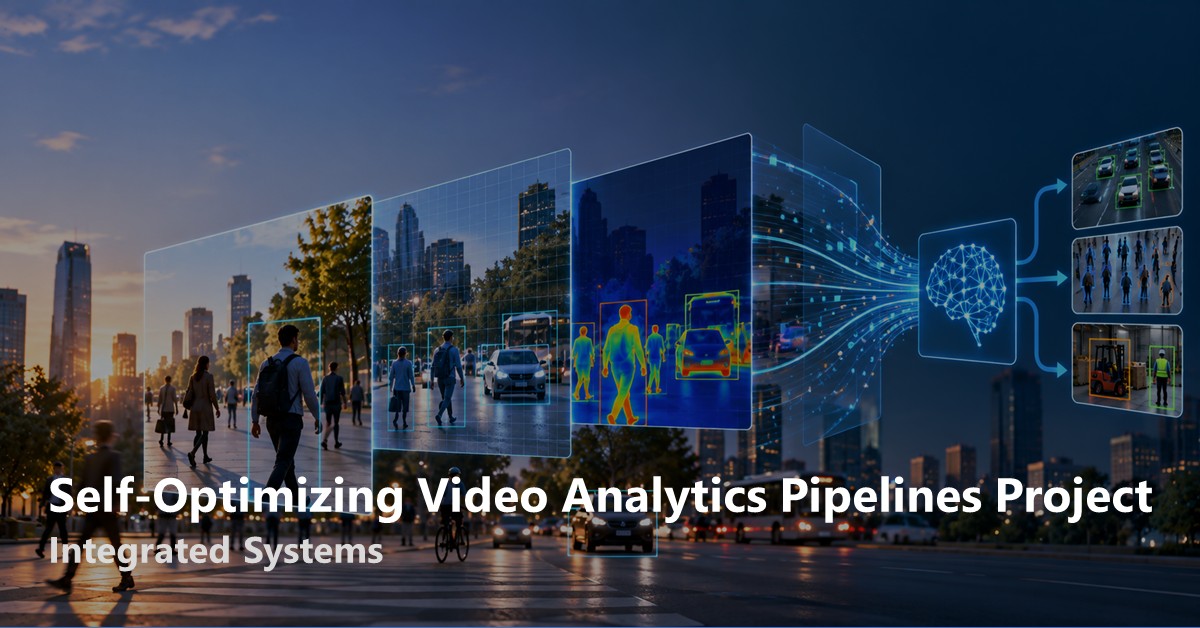
We are building a self-optimizing video analytics pipeline. Rather than treating cameras, networks, compute, and AI models as independent components, the system manages them as a single end-to-end pipeline. It observes its own analytics performance, identifies where quality is being lost, and continuously adjusts camera settings, resource allocation, and scheduling as conditions change. The goal is video analytics that maintains its own quality in the real world, while adapting to changing scenes, workloads, networks, and resources without requiring a human to constantly retune the system.

The central research challenge is that real-world accuracy cannot be directly observed at runtime. A live video stream comes without ground truth, so the system cannot simply measure its accuracy and correct itself when performance declines. The problem starts at the camera. Camera parameters were designed primarily to produce images that look good to people, not images that make objects and features easy for AI models to recognize. As a result, the settings a camera selects automatically can be poorly suited for analytics—and model retraining alone cannot fix information that was lost before the video ever reached the model. The causes of performance degradation are also deeply interconnected. Video is not a sequence of independent images: scenes evolve over time, resource allocations that work well under one condition become inefficient as the scene changes, and multiple analytics pipelines compete for shared compute and network capacity. Maintaining accuracy therefore requires continuously adapting the entire camera-to-insight pipeline.

Our approach is to build proxies for quality and closed-loop controls where ground truth is unavailable. AQuA provides a lightweight estimate of whether a frame is useful for analytics without first running the full model, while our work on understanding fluctuations in video analytics accuracy identifies the underlying causes of performance variation rather than treating them as random noise. With those signals in place, CAMTUNER and APT close the control loop around the camera itself. They use reinforcement learning to adjust camera parameters in real time based on perceptual and analytics-driven objectives rather than human visual preferences. Elixir extends this idea to streams shared by multiple analytics tasks, optimizing data quality across several applications at once.

The next set of control loops optimizes the infrastructure around the model. Magic-Pipe continuously adjusts pipeline configurations and resource allocation as conditions change. EdgeSync schedules edge-assisted analytics with awareness of contention on shared networks, while SimCache exploits similarity between scenes to avoid repeated vision-language inference on nearly identical content. Finally, TrafficLens and our work on few-shot video classification broaden what these pipelines can understand. TrafficLens extends analytics across multiple cameras, while few-shot classification enables recognition of new classes even when very little labeled training data is available.

Our AI systems move video analytics from a fixed pipeline that degrades as the real-world changes to a closed-loop system that observes, adapts, and continuously optimizes itself, from the camera capturing the scene to the infrastructure and models producing the final insight.

Read Related Publications

SimCache: Similarity Caching for Efficient VLM-based Scene Understanding

Scene understanding systems analyze visual contexts by detecting objects, their attributes, and the interactions among them to provide a holistic interpretation. Understanding a scene requires analyzing multiple salient regions within a single video frame. Recently, Vision-Language Models (VLMs) have

CAMTUNER: Adaptive Video Analytics Pipelines via Real-time Automated Camera Parameter Tuning

In Video Analytics Pipelines (VAP), Analytics Units (AUs) such as object detection and face recognition operating on remote servers rely heavily on surveillance cameras to capture high-quality video streams to achieve high accuracy. Modern network cameras offer an array of parameters that directly influence

EdgeSync: Efficient Edge-Assisted Video Analytics via Network Contention-Aware Scheduling

With the advancement of 5G, edge-assisted video analytics has become increasingly popular, driven by the technology’s ability to support low-latency, high-bandwidth applications. However, in scenarios where multiple clients competing for network resources, network contention poses a significant challenge.

TrafficLens: Multi-Camera Traffic Video Analysis Using LLMs

Traffic cameras are essential in urban areas, playing a crucial role in intelligent transportation systems. Multiple cameras at intersections enhance law enforcement capabilities, traffic management, and pedestrian safety. However, efficiently managing and analyzing multi-camera feeds poses challenges

Elixir: A System To Enhance Data Quality For Multiple Analytics On A Video Stream

IoT sensors, especially video cameras, are ubiquitously deployed around the world to perform a variety of computer vision tasks in several verticals including retail, health- care, safety and security, transportation, manufacturing, etc. To amortize their high deployment effort and cost, it is desirable

APT: Adaptive Perceptual quality based camera Tuning using reinforcement learning

Cameras are increasingly being deployed in cities, enterprises and roads world-wide to enable many applications in public safety, intelligent transportation, retail, healthcare and manufacturing. Often, after initial deployment of the cameras, the environmental conditions and the scenes around these

Enhancing Video Analytics Accuracy via Real-time Automated Camera Parameter Tuning

In Video Analytics Pipelines (VAP), Analytics Units (AUs) such as object detection and face recognition running on remote servers critically rely on surveillance cameras to capture high-quality video streams in order to achieve high accuracy. Modern IP cameras come with a large number of camera parameters

Why is the video analytics accuracy fluctuating, and what can we do about it?

It is a common practice to think of a video as a sequence of images (frames), and re-use deep neural network models that are trained only on images for similar analytics tasks on videos. In this paper, we show that this “leap of faith” that deep learning models that work well on images will also

Cosine Similarity based Few-Shot Video Classifier with Attention-based Aggregation

Meta learning algorithms for few-shot video recognition use complex, episodic training but they often fail to learn effective feature representations. In contrast, we propose a new and simpler few-shot video recognition method that does not use meta-learning, but its performance compares well with the

AQuA: Analytical Quality Assessment for Optimizing Video Analytics Systems

Millions of cameras at edge are being deployed to power a variety of different deep learning applications. However, the frames captured by these cameras are not always pristine – they can be distorted due to lighting issues, sensor noise, compression etc. Such distortions not only deteriorate visual

Magic-Pipe: Self-optimizing video analytics pipelines

Microservices-based video analytics pipelines routinely use multiple deep convolutional neural networks. We observe that the best allocation of resources to deep learning engines (or microservices) in a pipeline, and the best configuration of parameters for each engine vary over time, often at a timescale