
NEC Laboratories America
Link to: Media Analytics
MEDIA ANALYTICS
PROJECTS
Link to: MA People
PEOPLE
Link to: MA Publications
PUBLICATIONS
Link to: MA Patents
PATENTS
Peek-a-Boo: Occlusion Reasoning in Indoor Scenes With Plane Representations
Collaborators: Ziyu Jiang, Zhangyang Wang, Manmohan Chandraker
Peek-a-Boo Occlusion Reasoning in Indoor Scenes With Plane Representations Paper
1 Texas A&M University 2 NEC Laboratories America 3 UC San Diego
Oral in CVPR 2020
Abstract
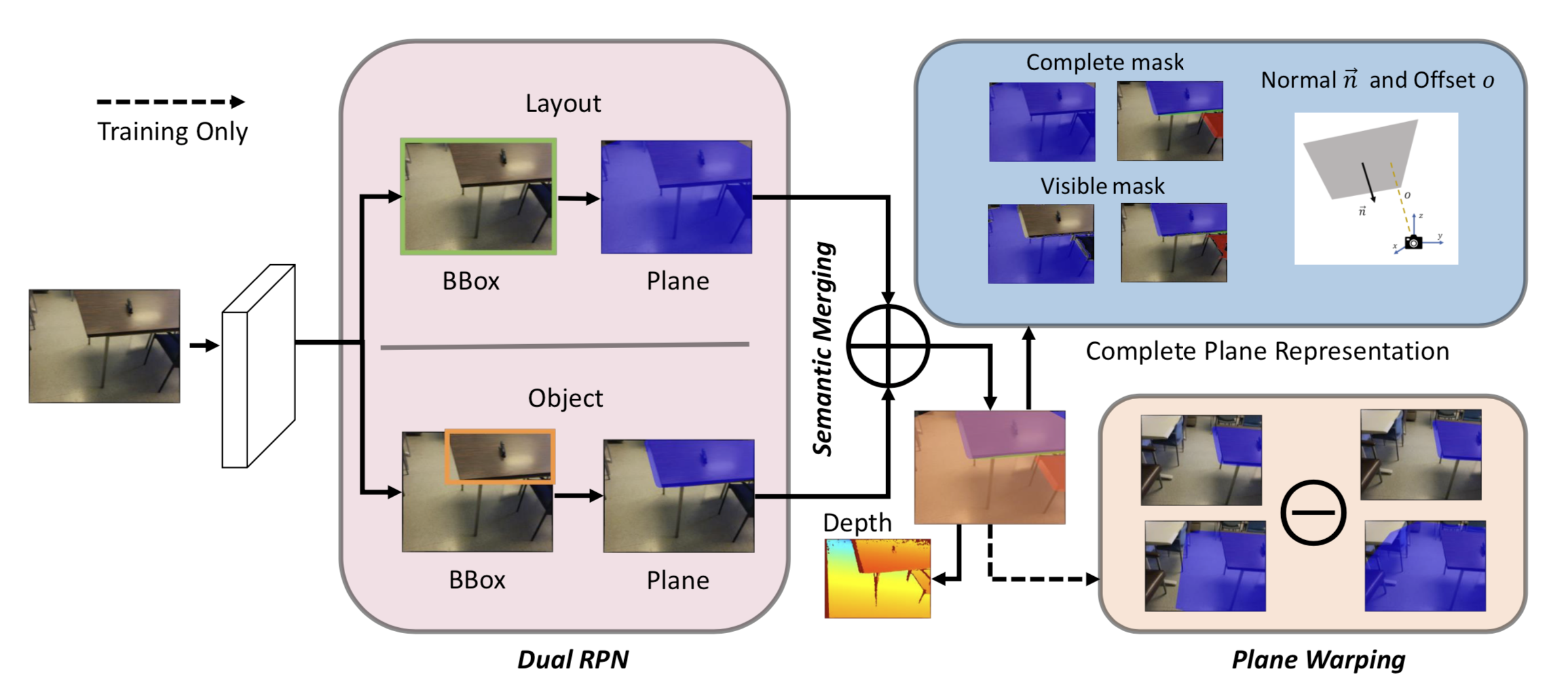
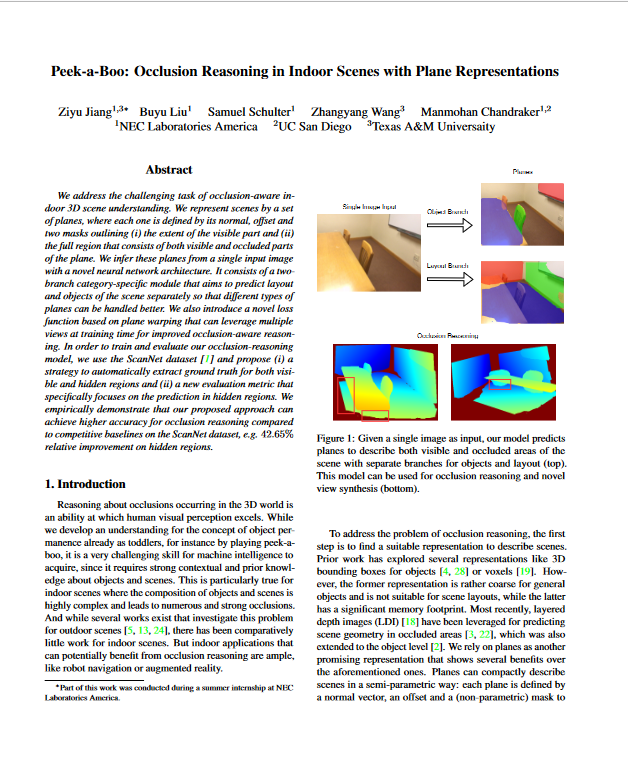
We address the challenging task of occlusion-aware indoor 3D scene understanding. We represent scenes by a set of planes, where each one is defined by its normal, offset and two masks outlining (i) the extent of the visible part and (ii) the full region that consists of both visible and occluded parts of the plane. We infer these planes from a single input image with a novel neural network architecture. It consists of a two-branch category-specific module that aims to predict the layout and objects of the scene separately so that different types of planes can be handled better. We also introduce a novel loss function based on plane warping that can leverage multiple views at training time for improved occlusion-aware reasoning. In order to train and evaluate our occlusion-reasoning model, we use the ScanNet dataset [ 1] and propose (i) a strategy to automatically extract ground truth for both visible and hidden regions and (ii) a new evaluation metric that specifically focuses on the prediction in hidden regions. We empirically demonstrate that our proposed approach can achieve higher accuracy for occlusion reasoning compared to competitive baselines on the ScanNet dataset, e.g. 42.65% relative improvement on hidden regions.
Dataset
Please download our plane annotations for Scannet here.
Presentations
Our presentation for CVPR 2020.