
NEC Laboratories America
Link to: Media Analytics
MEDIA ANALYTICS
PROJECTS
Link to: MA People
PEOPLE
Link to: MA Publications
PUBLICATIONS
Link to: MA Patents
PATENTS
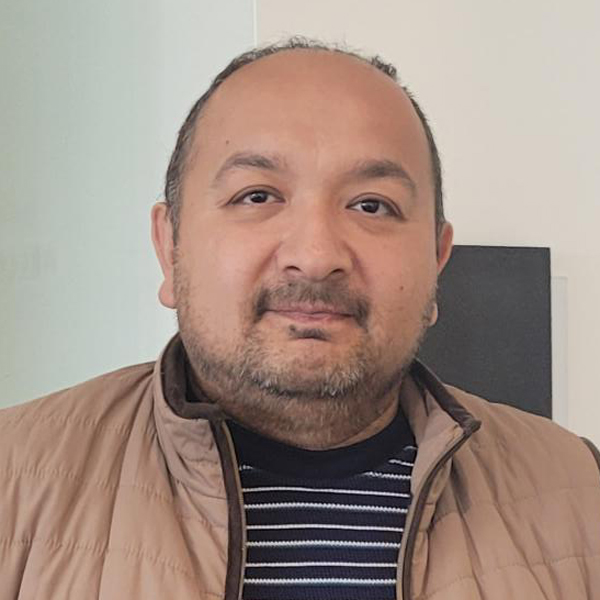
Turgun Kashgari
Senior Associate Researcher
Media Analytics

About
Turgun Kashgari is a Senior Associate Researcher in the Media Analytics Department at NEC Laboratories America. His work focuses on efficient deployment and optimization of deep learning models, large language models, and vision-language models on local GPUs, CPUs, and edge devices. He earned his M.S. in Computer Science from the University of Central Florida in 2017, specializing in computer vision, machine learning, and data mining, and his M.S. in Communication and Information Systems from Shanghai Jiao Tong University.
Over the past several years, Turgun has worked extensively on real-time AI deployment, model quantization, model optimization, knowledge distillation, and low-latency inference. His recent work focuses on LLM and VLM optimization, including weight quantization, KV-cache quantization and optimization, speculative decoding, disaggregated serving, vocabulary reduction, and efficient serving architectures. He has hands-on experience with major deployment frameworks such as TensorRT-LLM, vLLM, LMDeploy, llama.cpp, OpenVINO, and SGLang.
Turgun has also contributed significantly to autonomous driving projects, deploying perception models and LLM/VLM-based planning models directly on vehicle platforms. He is experienced with ROS2, Autoware Universe, real-time perception pipelines, edge AI systems, and scalable model-serving infrastructure. His work supports NEC Labs’ efforts to build reliable, efficient, and high-performance AI systems for autonomous driving, intelligent transportation, smart cities, enterprise automation, and other real-world applications.
Projects
Autonomous Driving
Overview: While autonomous cars are rapidly becoming a reality, it remains a challenge to scalably deploy them across geographies and conditions. Our full-stack autonomy solutions include perception, prediction, planning, simulation and DevOps that leverage the latest advances in generative AI, neural rendering, large language models, diffusion models and transformers.
Prediction and Planning
Overview: Our methods such as DESIRE, SMART and DAC achieve various capabilities such as diversity, scene consistency, constant-time inference and multimodality that adheres to lane geometries and driving rules.
Robust and Unbiased Face Recognition
Overview: Our face recognition methods achieve high accuracy on competitive public benchmarks through the use of universal representation learning techniques that leverage very large-scale datasets, with robustness to variations such as occlusions, blur, lighting or accessories.
Robustness and Fairness
Overview: Our techniques from unsupervised and semi-supervised learning, such as domain adaptation and domain generalization, allow robust and responsible AI solutions across multiple applications such as image classification, face recognition, facial anti-spoofing, object detection and semantic segmentation.