
NEC Laboratories America

Projects | Autonomous Driving

PROJECTS

Autonomous Driving

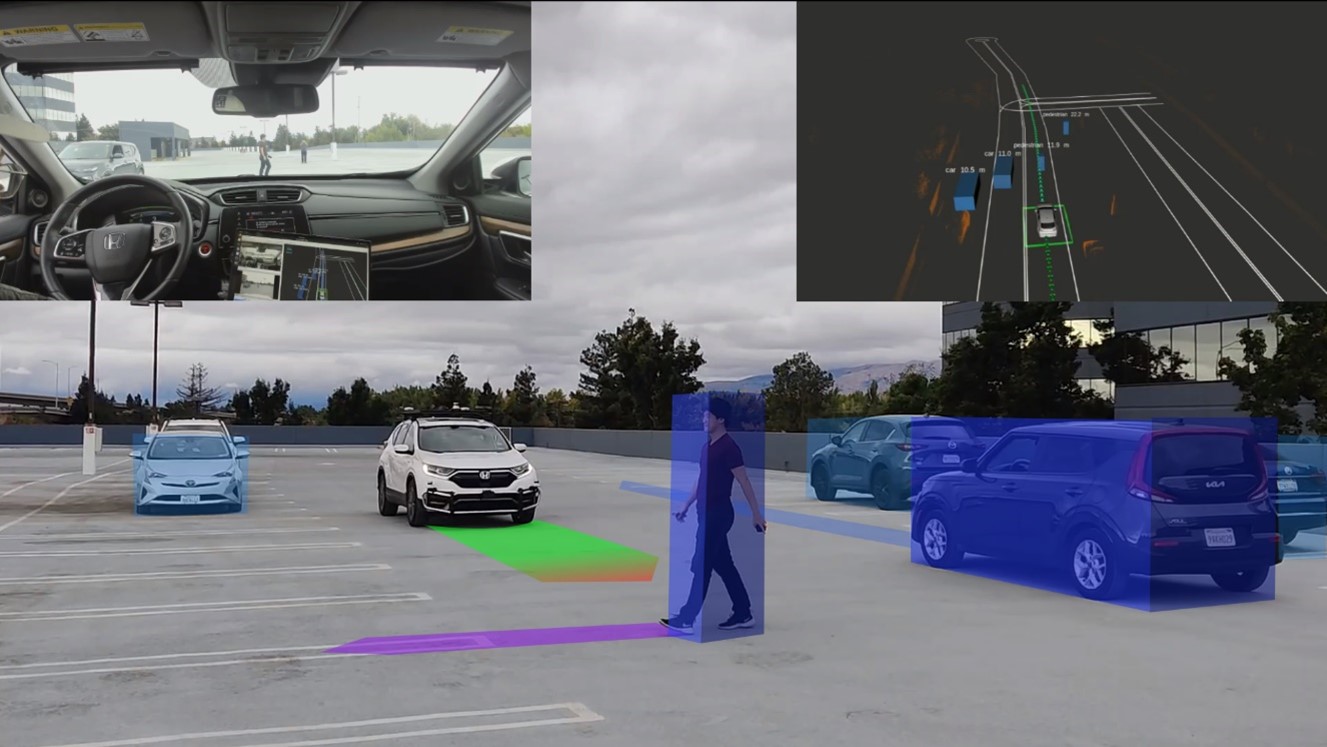
While autonomous cars are rapidly becoming a reality, it remains a challenge to scalably deploy them across geographies and conditions. Our full-stack autonomy solutions include perception, prediction, planning, simulation and devops that leverage latest advances in generative AI, neural rendering, large language models, diffusion models and transformers. These solutions are deployed on an autonomous car platform with a multi-sensor suite including cameras, Lidars, radars and GNSS units.

Team Members: Abhishek Aich, Adarsh Modh, Francesco Pittaluga, Turgun Kashgari, Ziyu Jiang, and Zaid Tasneem.

Publication Tags (project tag): iris car, iris sim, autonomous driving, autonomous vehicles

Autonomous Driving Project
Autonomous Driving (IRIS-Car)

Featured Publications

Safe-Sim: Safety-Critical Closed-Loop Traffic Simulation with Diffusion-Controllable Adversaries

Evaluating the performance of autonomous vehicle planning algorithms necessitates simulating long-tail safety-critical traffic scenarios. However, traditional methods for generating such scenarios often fall short in terms of controllability and realism; they also neglect the dynamics of agent interactions.

AIDE: An Automatic Data Engine for Object Detection in Autonomous Driving

Autonomous vehicle (AV) systems rely on robust perception models as a cornerstone of safety assurance. However, objects encountered on the road exhibit a long-tailed distribution, with rare or unseen categories posing challenges to a deployed perception model. This necessitates an expensive process of

Instantaneous Perception of Moving Objects in 3D

The perception of 3D motion of surrounding traffic participants is crucial for driving safety. While existing works primarily focus on general large motions, we contend that the instantaneous detection and quantification of subtle motions is equally important as they indicate the nuances in driving behavior

LidaRF: Delving into Lidar for Neural Radiance Field on Street Scenes

Photorealistic simulation plays a crucial role in applications such as autonomous driving, where advances in neural radiance fields (NeRFs) may allow better scalability through the automatic creation of digital 3D assets. However, reconstruction quality suffers on street scenes due to largely collinear

Long-HOT: A Modular Hierarchical Approach for Long-Horizon Object Transport

We aim to address key challenges in long-horizon embodied exploration and navigation by proposing a long-horizon object transport task called Long-HOT and a novel modular framework for temporally extended navigation. Agents in Long-HOT need to efficiently find and pick up target objects that are scattered

LLM-ASSIST: Enhancing Closed-Loop Planning with Language-Based Reasoning

Although planning is a crucial component of the autonomous driving stack, researchers have yet to develop robust planning algorithms that are capable of safely handling the diverse range of possible driving scenarios. Learning-based planners suffer from overfitting and poor long-tail performance. On

NeurOCS: Neural NOCS Supervision for Monocular 3D Object Localization

Monocular 3D object localization in driving scenes is a crucial task, but challenging due to its ill-posed nature. Estimating 3D coordinates for each pixel on the object surface holds great potential as it provides dense 2D-3D geometric constraints for the underlying PnP problem. However, high-quality

Weakly But Deeply Supervised Occlusion-Reasoned Parametric Road Layouts

We propose an end-to-end network that takes a single perspective RGB image of a complex road scene as input, to produce occlusion-reasoned layouts in perspective space as well as a parametric bird’s-eye-view (BEV) space. In contrast to prior works that require dense supervision such as semantic labels

Divide-and-Conquer for Lane-Aware Diverse Trajectory Prediction

Trajectory prediction is a safety-critical tool for autonomous vehicles to plan and execute actions. Our work addresses two key challenges in trajectory prediction, learning multimodal outputs, and better predictions by imposing constraints using driving knowledge. Recent methods have achieved strong

SMART: Simultaneous Multi-Agent Recurrent Trajectory Prediction

We propose advances that address two key challenges in future trajectory prediction: (i) multimodality in both training data and predictions and (ii) constant time inference regardless of number of agents. Existing trajectory predictions are fundamentally limited by lack of diversity in training data,

A Dataset for High-Level 3D Scene Understanding of Complex Road Scenes in the Top-View

We introduce a novel dataset for high-level 3D scene understanding of complex road scenes. Our annotations extend the existing datasets KITTI [5] and nuScenes [1] with semantically and geometrically meaningful attributes like the number of lanes or the existence of, and distance to, intersections, sidewalks

A Parametric Top-View Representation of Complex Road Scenes

In this paper, we address the problem of inferring the layout of complex road scenes given a single camera as input. To achieve that, we first propose a novel parameterized model of road layouts in a top-view representation, which is not only intuitive for human visualization but also provides an interpretable

Learning To Simulate

Simulation is a useful tool in situations where training data for machine learning models is costly to annotate or even hard to acquire. In this work, we propose a reinforcement learning-based method for automatically adjusting the parameters of any (non-differentiable) simulator, thereby controlling