NEC Laboratories America

Projects | Prediction and Planning

PROJECTS

Prediction and Planning

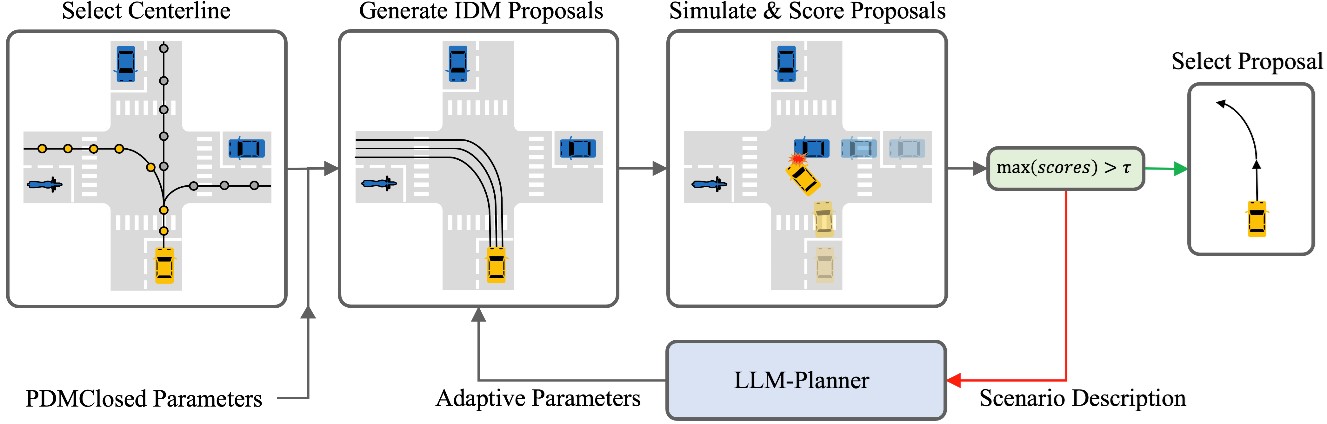
We are pioneers in the development of generative models that predict long-horizon future trajectories of dynamic objects, with probabilistic outcomes that account for diverse future actions with the same past. Our methods, such as DESIRE, SMART and DAC achieve various capabilities such as diversity, scene consistency, constant-time inference and multimodality that adhere to lane geometries and driving rules. These methods form the input to planners in autonomous vehicles, where our LLM-ASSIST approach enhances the ability of a deployed rule-based planner to navigate complex scenes with a high degree of safety and comfort, utilizing the external reasoning of an LLM together with grounding in the physical parameters of the motion planner.

Team Member: Francesco Pittaluga, Adarsh Modh, Turgun Kashgari

Publication Tags: autonomous driving, machine learning, large language models

Prediction and Planning Project
Prediction and Planning (LLM Assist)

Featured Publications

Divide-and-Conquer for Lane-Aware Diverse Trajectory Prediction

Trajectory prediction is a safety-critical tool for autonomous vehicles to plan and execute actions. Our work addresses two key challenges in trajectory prediction, learning multimodal outputs, and better predictions by imposing constraints using driving knowledge. Recent methods have achieved strong

SMART: Simultaneous Multi-Agent Recurrent Trajectory Prediction

We propose advances that address two key challenges in future trajectory prediction: (i) multimodality in both training data and predictions and (ii) constant time inference regardless of number of agents. Existing trajectory predictions are fundamentally limited by lack of diversity in training data,

R2P2: A Reparameterized Pushforward Policy for Diverse, Precise Generative Path Forecasting

We propose a method to forecast a vehicle’s ego-motion as a distribution over spatiotemporal paths, conditioned on features (e.g., from LIDAR and images) embedded in an overhead map. The method learns a policy inducing a distribution over simulated trajectories that is both diverse (produces most paths