NEC Laboratories America

Projects | DDA: Deep Document Analysis

DDA: Deep Document Analysis

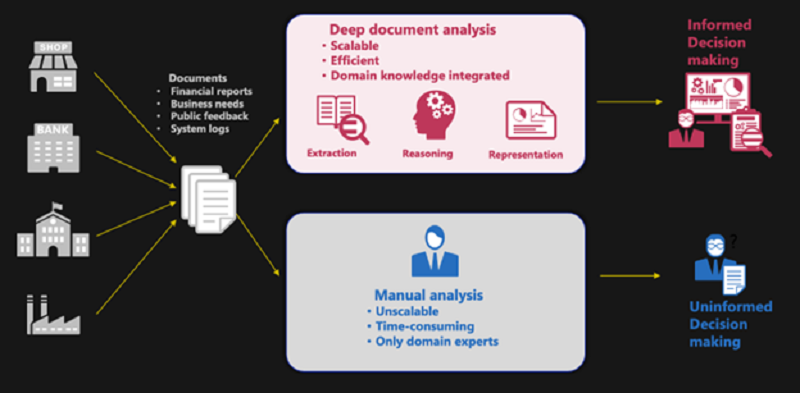
Unstructured data is growing at an unprecedented rate, valuable knowledge, including findings, observations, business demand, opportunities, is widely recorded as texts in documents. We are developing advanced analysis engines for mining text data in documents, aiming to discover valuable knowledge from large-scale documents and provide informed decision-making for users.

This project focuses on document knowledge discovery utilizing advanced natural language processing, deep learning, and machine learning techniques. It builds innovative analytic engines to model the large amount of document data generated from various scenarios. The engines provide interpretable knowledge with low-resource requirements in different languages and domains, further helping customers understand and optimize the decision-making process.

Deep Document Analysis and Large Language Models

In addition, this project focuses on advancing the state-of-the-art in NLP for document understanding. Toward this goal, efforts have been put into tasks like information extraction, language modeling, domain adaptation, intention detection, and contrastive augmentation. We also focus on providing solutions to different industries (e.g., financial, business, security, and systems) that can help customers with operation management and decision-making optimization. Some examples are document-based business matching, business process optimization, threat intelligence discovery, and log-based system management.

Team Members: Yanchi Liu, Xujiang Zhao, Wei Cheng, Haifeng Chen

Keyword Tags: dda, deep document, language models, large language model

Large Language Model Publications

Representation Interventions Enable Lifelong Knowledge Memory Control in LLMs

Large language models (LLMs) often produce incorrect or outdated content after being employed. Efficient and accurate knowledge up-dates without costly retraining are a major challenge. This problem is particularly challenging in lifelong settings, where complex, unstructured knowledge must coexist without

Mind the Gap in Cultural Alignment: Task-Aware Culture Management for Large Language Models

Large language models (LLMs) are increasingly deployed in culturally sensitive real-world tasks. However, existing cultural alignment ap-roaches fail to align LLMs’ broad cultural values with the specific goals of downstream tasks and suffer from cross-culture interference. We propose CultureManager,

LOKA: Conflict-Aware LLM Knowledge Update with Adaptive Knowledge Memory

Large Language Models (LLMs) have achieved remarkable success in natural language processing by encoding extensive knowledge, but their utility relies on timely updates as human knowledge keeps evolving. In this paper, we investigate the problem of LLM knowledge updates, which requires simultaneously

NEC Labs America Attends ACL 2026 San Diego July 2-7, 2026

NEC Laboratories America heads to ACL 2026 in San Diego, California, July 2–7, to present accepted papers spanning knowledge updating and memory control in large language models, task-aware cultural alignment, uncertainty-aware reasoning, and adaptive chain-of-thought optimization, representing some

Open SAT: How We Taught AI to Search Satellite Images Like a Search Engine

Satellite imagery is vast, high-resolution, and rich with information, but finding specific objects within it using natural language has remained a stubborn challenge. Open-SAT, developed by researchers at NEC Laboratories America and North South University, tackles this problem without retraining any

NEC Labs America Attends CVPR 2026 in Denver, CO June 3-7, 2026

NEC Labs America headed to Denver for CVPR 2026, one of the most prestigious gatherings in computer vision, machine learning, and pattern recognition. The IEEE/CVF Conference on Computer Vision and Pattern Recognition brought innovators from around the world to share breakthroughs.

How Rule-Driven Routing Makes Retrieval-Augmented Generation Smarter

Most retrieval-augmented generation systems stop at documents, ignoring the relational databases that power finance, healthcare, and research. Our researchers built a rule-driven framework that learns which source to query for each question, delivering better answers at lower computational cost.

Agentic Placement of Microservices on the Computing Continuum

Deploying microservices across the computing continuum (edge–cloud) requires placement decisions that adapt to workload variation and heterogeneous infrastructure, yet existing solutions often rely on static policies or opaque heuristics. We present Bellona a system for reliable and auditable Large

Decoding Time Series with LLMs: A Multi-Agent Framework for Cross-Domain Annotation

Time series data is ubiquitous across various domains, including manufacturing, finance, and healthcare. High-quality annotations are essential for effectively understanding time series and facilitating downstream tasks. However, obtaining such annotations is challenging, particularly in mission-critical

Celebrating the Women of NEC Laboratories America

NEC Laboratories America celebrates Women’s History Month and International Women’s Day by recognizing the women researchers, engineers, and interns whose work in artificial intelligence, optical networking, cybersecurity, and data science is helping shape the future of technology.

TacTool: Tactical Tool usage in Agentic AI Systems

Large language models (LLMs) are becoming the centerpiece in the design and deployment of Agentic artificial intelligence (AI) systems. AI agents typically have (a) reasoning ability to analyze and think through the given task, (b) context/memory to remember things in the short-term and long-term, and

Uni-LoRA: One Vector is All You Need

Low-Rank Adaptation (LoRA) has become the de facto parameter-efficient fine-tuning (PEFT) method for large language models (LLMs) by constraining weight updates to low-rank matrices. Recent works such as Tied-LoRA, VeRA, and VB-LoRA push efficiency further by introducing additional constraints to reduce

TalentScout: Multimodal AI-Driven Expert Finding in Organizations

Identifying subject-matter experts within organizations remains a challenging task due to the scale, heterogeneity, and unstructured nature of enterprise knowledge assets. We present TalentScout, an AI-driven expert identification system that constructs a unified, skill-centric knowledge graph by ingesting

SlideCraft: Context-aware Slides Generation Agent

Creating effective slide presentations requires adapting both content and structure to match the communication context e.g. whether the presentation is for summarizing to executives, or reporting progress to research supervisors. In research and enterprise environments, this need for context-sensitive

Domain Specialization as the Key to Make Large Language Models Disruptive: A Comprehensive Survey

Large language models (LLMs) have significantly advanced the field of natural language processing (NLP), providing a highly useful, task-agnostic foundation for a wide range of applications. However, directly applying LLMs to solve sophisticated problems in specific domains meets many hurdles, caused

Exploring Multi-Modal Data with Tool-Augmented LLM Agents for Precise Causal Discovery

Causal discovery is an imperative foundation for decision-making across domains, such as smart health, AI for drug discovery and AIOps. Traditional statistical causal discovery methods, while well-established, predominantly rely on observational data and often overlook the semantic cues inherent in cause-and-effect

EcoDoc: A Cost-Efficient Multimodal Document Processing System for Enterprises Using LLMs

Enterprises are increasingly adopting Generative AI applications to extract insights from large volumes of multimodal documents in domains such as finance, law, healthcare, and industry. These documents contain structured and unstructured data (images, charts, handwritten texts, etc.) requiring robust

XPF: Agentic AI System for Business Workflow Automation

In this paper, we propose a novel agentic AI system called XPF, which enables users to create “agents” using just natural language, where each agent is capable of executing complex, real-world business workflows in an accurate and reliable manner. XPF provides an interface to develop and iterate over

Latency-driven Execution of LLM-generated Application Code on the Computing Continuum

Latency-critical applications demand quick responses. Ideally, detailed insights are preferable for the best decision making and response actions. However, in situations when detailed insights cannot be provided quickly, even basic information goes a long way in tackling the situation effectively. For

MixLLM: Dynamic Routing in Mixed Large Language Models

Large Language Models (LLMs) exhibit potential artificial generic intelligence recently, however, their usage is costly with high response latency. Given mixed LLMs with their own strengths and weaknesses, LLM routing aims to identify the most suitable model for each query in the stream to maximize response

TSLA: Unified Time Series and Language Model

Real-world time series data often require analysis or interpretation from domain experts. Some tasks, like time series question answering, involve both time series and natural language questions, posing challenges for single-modality language models to understand their interaction. To this end, we present

LLM-based Distributed Code Generation and Cost-Efficient Execution in the Cloud

The advancement of Generative Artificial Intelligence (AI), particularly Large Language Models (LLMs), is reshaping the software industry by automating code generation. Many LLM-driven distributed processing systems rely on serial code generation constrained by predefined libraries, limiting flexibility

G-Litter Marine Litter Dataset Augmentation with Diffusion Models and Large Language Models on GPU Acceleration

Marine litter detection is crucial for environmental monitoring, yet the imbalance in existing datasets limits model performance in identifying various types of waste accurately. This paper presents an efficient data augmentation pipeline that combines generative diffusion models (e.g., Stable Diffusion)

DiCE-M: Distributed Code Generation and Execution for Marine Applications – An Edge-Cloud Approach

Edge computing has emerged as a transformative technology that reduces application latency, improves cost efficiency, enhances security, and enables large-scale deployment of applications across various domains. In environmental monitoring, systems such as MegaSense[49], use low-cost sensors to gather

NEC Labs America Team Attends NeurIPS24 in Vancouver

NEC Labs America is proud to attend NeurIPS 2024 in Vancouver, Canada from December 10-15. Zachary Izzo will present Subgroup Discovery with the Cox Model, Shaobo Han will present VB-LoRA: Extreme Parameter Efficient Fine-Tuning with Vector Banks and Jonathan Warrell will present Discrete-Continuous

DiCE: Distributed Code generation and Execution

Generative artificial intelligence (GenAI), specifically, Large Language Models (LLMs), have shown tremendous potential in automating several tasks and improving human productivity. Recent works have shown them to be quite useful in writing and summarizing text (articles, blogs, poems, stories, songs,

TrafficLens: Multi-Camera Traffic Video Analysis Using LLMs

Traffic cameras are essential in urban areas, playing a crucial role in intelligent transportation systems. Multiple cameras at intersections enhance law enforcement capabilities, traffic management, and pedestrian safety. However, efficiently managing and analyzing multi-camera feeds poses challenges

Introducing Our New Project: Time Series Language Model for Explainable AI

Our new project, Time Series Language Model for Explainable AI, represents a significant leap forward in the field of forecasting and explainable AI. By combining advanced forecasting techniques with explainable AI, we are paving the way for a future where data-driven insights are not only accurate but

Agentic LLMs for AI Orchestration Project: Revolutionizing Complex Workflows

The development of Agentic LLMs for AI Orchestration represents a significant advancement in artificial intelligence. By seamlessly integrating computer vision, logic, and compute modules, our LLM is poised to revolutionize the way complex workflows are managed and executed. Supported by robust research

DFA-RAG: Conversational Semantic Router for Large Language Model with Definite Finite Automaton

This paper introduces the retrieval-augmented large language model with Definite Finite Automaton (DFA-RAG), a novel framework designed to enhance the capabilities of conversational agents using large language models (LLMs). Traditional LLMs face challenges in generating regulated and compliant responses

AIDE: An Automatic Data Engine for Object Detection in Autonomous Driving

Autonomous vehicle (AV) systems rely on robust perception models as a cornerstone of safety assurance. However, objects encountered on the road exhibit a long-tailed distribution, with rare or unseen categories posing challenges to a deployed perception model. This necessitates an expensive process of

ECO-LLM: LLM-based Edge Cloud Optimization

AI/ML techniques have been used to solve systems problems, but their applicability to customize solutions on-the-fly has been limited. Traditionally, any customization required manually changing the AI/ML model or modifying the code, configuration parameters, application settings, etc. This incurs too

Self-Consistent Decoding for More Factual Open Responses

Self-consistency has emerged as a powerful method for improving the accuracy of short answers generated by large language models. As previously defined, it only concerns the accuracy of a final answer parsed from generated text. In this work, we extend the idea to open response generation, by integrating

Improving Language-Based Object Detection by Explicit Generation of Negative Examples

The recent progress in language-based object detection with an open-vocabulary can be largely attributed to finding better ways of leveraging large-scale data with free-form text annotations. Training from image captions with grounded bounding boxes (ground truth or pseudo-labeled) enable the models

LLM-ASSIST: Enhancing Closed-Loop Planning with Language-Based Reasoning

Although planning is a crucial component of the autonomous driving stack, researchers have yet to develop robust planning algorithms that are capable of safely handling the diverse range of possible driving scenarios. Learning-based planners suffer from overfitting and poor long-tail performance. On

Beyond One Model Fits All: A Survey of Domain Specialization for Large Language Models

Large language models (LLMs) have significantly advanced the field of natural language processing (NLP), providing a highly useful, task agnostic foundation for a wide range of applications. The great promise of LLMs as general task solvers motivated people to extend their functionality largely beyond

Dynamic Prompting: A Unified Framework for Prompt Tuning

It has been demonstrated that prompt tuning is highly effective in efficiently eliciting knowledge from language models (LMs). However, the prompt tuning still lags behind fine tuning, especially when the LMs are small. P tuning v2 (Liu et al., 2021b) makes it comparable with finetuning by adding continuous