
The 64th Annual Meeting of the Association for Computational Linguistics (ACL 2026) takes place July 2–7 in San Diego, California, and NEC Laboratories America will be there with a strong research presence. ACL is the flagship annual conference of the Association for Computational Linguistics and one of the most selective venues in NLP and computational linguistics research.

This year’s program draws submissions from across academia and industry, making accepted papers a meaningful measure of research quality and relevance. Look for updates here as the conference approaches, including paper summaries and researcher insights from San Diego.
Presentations
Our researchers will present accepted papers across the main conference, with work spanning knowledge update and memory control in large language models, cultural alignment, uncertainty-aware reasoning, and adaptive chain-of-thought optimization.
LOKA: Conflict-Aware LLM Knowledge Update with Adaptive Knowledge Memory
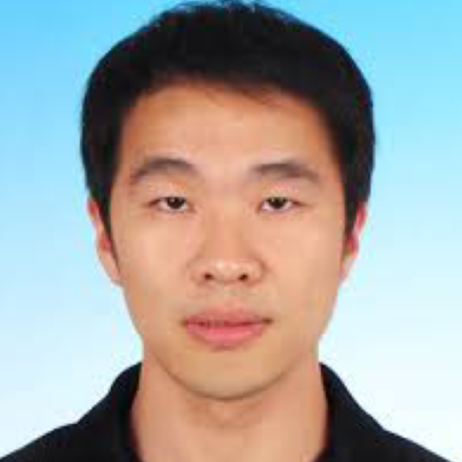
- Zhengzhang Chen, NEC Laboratories America (Presenting); Binchi Zhang, University of Virginia; Zaiyi Zheng, University of Virginia; Jundong Li, University of Virginia; Haifeng Chen, NEC Laboratories America
- Accepted Paper
- https://2026.aclweb.org/program/accepted_papers/
- https://aclanthology.org/2026.acl-long.760/
- Abstract: Large Language Models (LLMs) have achieved remarkable success in natural language processing by encoding extensive knowledge, but their utility relies on timely updates as human knowledge keeps evolving. In this paper, we investigate the problem of LLM knowledge updates, which requires simultaneously unlearning unwanted information and learning new knowledge. Existing approaches that tackle unlearning and learning separately encounter *task conflicts* and *knowledge management issues* when applied to comprehensive knowledge updates.In this paper, we validate our findings with theoretical analysis and empirical evidence, and propose LOKA, a conflict-aware framework for Large language mOdel Knowledge updAtes. During training, LOKA introduces an adaptive knowledge memory approach in which updated knowledge is allocated across multiple memory units. During inference, LOKA retrieves the most relevant memory unit from the knowledge memory and integrates it with the original LLM to apply updated knowledge, while a learning-based router controls the activation of the knowledge memory to improve knowledge utilization. Extensive experiments demonstrate the efficacy of LOKA in achieving accurate, flexible, and conflict-aware knowledge updates.
Uncertainty-Aware Test-Time Search for Optimization Problem Solving


- Linlin Yu, NEC Labs America Intern & Augusta University; Xujiang Zhao (Attending), NEC Laboratories America; Dong Li, Baylor University; Yanchi Liu (Attending), NEC Laboratories America; Wei Cheng, NEC Laboratories America; Zhengzhang Chen, NEC Laboratories America; Chen Zhao, Baylor University; Feng Chen, The University of Texas at Dallas; Haifeng Chen, NEC Laboratories America
- Accepted Paper
- https://2026.aclweb.org/program/accepted_papers/
- https://aclanthology.org/2026.acl-long.1975.pdf
- Abstract: Automatically solving optimization problems from natural language descriptions with both efficiency and reliability is highly desirable but remains challenging. Language model hallucinations and the limited availability of labeled datasets often result in misaligned formulations, code errors, and feasibility failures. We propose UMCTS, an Uncertainty-aware Monte Carlo Tree Search framework that combines the language understanding capability of large language models with the reliability of well-established solvers. UMCTS structures the solution process into four stages: global instruction, assumptions, mathematical formulation, and solver code generation. It employs Monte Carlo Tree Search with semantic-equivalence pruning, prior-guided exploration, and solver-based feasibility checks. An LLM judge provides numerical reward signals, qualitative error information, and uncertainty estimates. These signals are backpropagated to guide the search and flag unreliable outputs. Across six public benchmarks, UMCTS achieves state-of-the-art solution accuracy and improves efficiency by reducing token usage.
Mind the Gap in Cultural Alignment: Task-Aware Culture Management for Large Language Models
- Zhengzhang Chen, NEC Laboratories America (Presenting, Pictured); Binchi Zhang, University of Virginia (Presenting); Xujiang Zhao, NEC Laboratories America; Jundong Li, University of Virginia; Haifeng Chen, NEC Laboratories America
- Accepted Paper
- https://arxiv.org/abs/2602.22475
- Abstract: Large language models (LLMs) are increasingly deployed in culturally sensitive real-world tasks. However, existing cultural alignment approaches fail to align LLMs’ broad cultural values with the specific goals of downstream tasks and suffer from cross-culture interference. We propose CultureManager, a novel pipeline for task-specific cultural alignment. CultureManager synthesizes task-aware cultural data in line with target task formats, grounded in culturally relevant web search results. To prevent conflicts between cultural norms, it manages multi-culture knowledge learned in separate adapters with a culture router that selects the appropriate one to apply. Experiments across ten national cultures and culture-sensitive tasks show consistent improvements over prompt-based and fine-tuning baselines. Our results demonstrate the necessity of task adaptation and modular culture management for effective cultural alignment.
Stop When Enough: Adaptive Early-Stopping for Chain-of-Thought Reasoning
- Renliang Sun, NEC Labs America Intern & UCLA (Presenting); Wei Cheng, NEC Labs America; Dawei Li, Arizona State University; Haifeng Chen, NEC Labs America; Wei Wang, UCLA
- Accepted Paper
- Abstract: Chain-of-Thought (CoT) reasoning has driven recent gains of large language models (LLMs) on reasoning-intensive tasks by externalizing intermediate steps. However, excessive or redundant reasoning — so-called overthinking — can increase inference costs and lead LLMs toward incorrect conclusions. In this paper, we present REFRAIN (REFlective-Redundancy for Adaptive INference), a training-free framework that adaptively determines when to stop reasoning to mitigate overthinking. REFRAIN integrates a two-stage stop discriminator to identify reflective yet redundant reasoning and a sliding-window Upper Confidence Bound (SW-UCB) multi-armed bandit controller to dynamically adjust stopping thresholds according to problem difficulty without supervision or fine-tuning. Across four representative benchmarks and two model families, REFRAIN reduces token usage by 20-55% while maintaining or improving accuracy compared to standard CoT prompting. Extensive ablation and robustness analyses demonstrate its stability across models, scorers, and prompt variations. In summary, our findings highlight when-to-stop as a new and practical axis of test-time scaling — enabling models to reason not just more, but just enough.
Representation Interventions Enable Lifelong Knowledge Memory Control in LLMs
- Xuyuan Liu, NEC Laboratories America Intern and Dartmouth College (Presenting); Shengyu Chen, NEC Laboratories America; Xinshuai Dong, Carnegie Mellon University; Yanchi Liu, NEC Laboratories America; Xujiang Zhao, NEC Laboratories America; Haoyu Wang, NEC Laboratories America; Yujun Yan, Dartmouth College; Haifeng Chen, NEC Laboratories America; Zhengzhang Chen, NEC Laboratories America
- Accepted Paper
- Abstract: Large language models (LLMs) often produce incorrect or outdated content after being employed. Efficient and accurate knowledge updates without costly retraining are a major challenge. This problem is particularly challenging in lifelong settings, where complex, unstructured knowledge must coexist without interference. We introduce RILKE (Representation Intervention for Lifelong KnowledgE Control), a robust and scalable method that treats knowledge control as interventions within the model’s representation space. Leveraging representation-space expressiveness, we identify two key properties enabling RILKE to achieve fine-grained control over complex, unstructured knowledge while maintaining general utility with frozen base weights. During training, RILKE learns paraphrase-robust and edit-localized modules that limit each update to a low-dimensional subspace to minimize cross-edit interference. At inference, a query-adaptive router selects the appropriate module to guide the model’s generation. Across LLaMA and Qwen models, RILKE scales effectively to large-scale benchmarks, demonstrating high edit success and strong paraphrase generalization while preserving general utility with modest memory overhead. These results show RILKE is an effective and scalable solution for lifelong knowledge control in LLMs.
Read About Our Future and Past Events
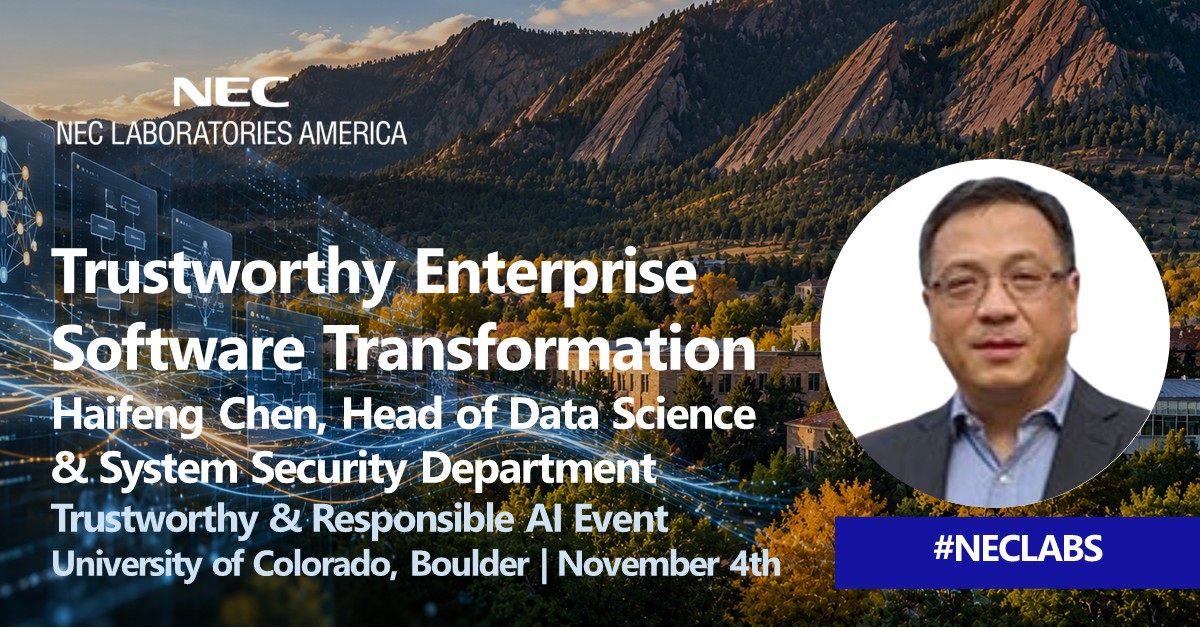 https://www.nec-labs.com/wp-content/uploads/2026/10/Haifeng-Boulder-Nov-4th-1.jpg
628
1200
NEC Labs America
https://www.nec-labs.com/wp-content/uploads/2025/08/NEC-Laboratories-America-Logo-Aug-2025-2.jpg
NEC Labs America2026-10-19 14:47:082026-10-20 00:29:36Haifeng Chen Speaks at the Trustworthy & Responsible AI Event at CU Boulder on November 4th
https://www.nec-labs.com/wp-content/uploads/2026/10/Haifeng-Boulder-Nov-4th-1.jpg
628
1200
NEC Labs America
https://www.nec-labs.com/wp-content/uploads/2025/08/NEC-Laboratories-America-Logo-Aug-2025-2.jpg
NEC Labs America2026-10-19 14:47:082026-10-20 00:29:36Haifeng Chen Speaks at the Trustworthy & Responsible AI Event at CU Boulder on November 4th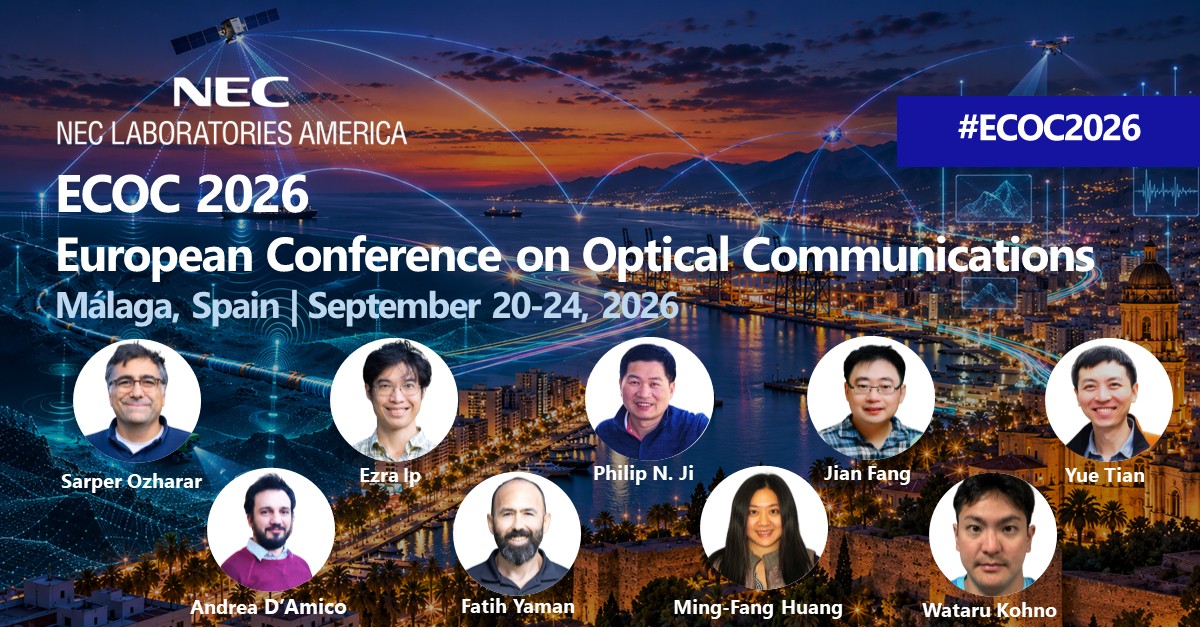 https://www.nec-labs.com/wp-content/uploads/2026/09/ECOC-2026.jpg
628
1200
NEC Labs America
https://www.nec-labs.com/wp-content/uploads/2025/08/NEC-Laboratories-America-Logo-Aug-2025-2.jpg
NEC Labs America2026-09-07 14:05:232026-09-07 14:51:52NEC Labs America Presents at ECOC 2026 in Málaga, Spain, September 20-24th
https://www.nec-labs.com/wp-content/uploads/2026/09/ECOC-2026.jpg
628
1200
NEC Labs America
https://www.nec-labs.com/wp-content/uploads/2025/08/NEC-Laboratories-America-Logo-Aug-2025-2.jpg
NEC Labs America2026-09-07 14:05:232026-09-07 14:51:52NEC Labs America Presents at ECOC 2026 in Málaga, Spain, September 20-24th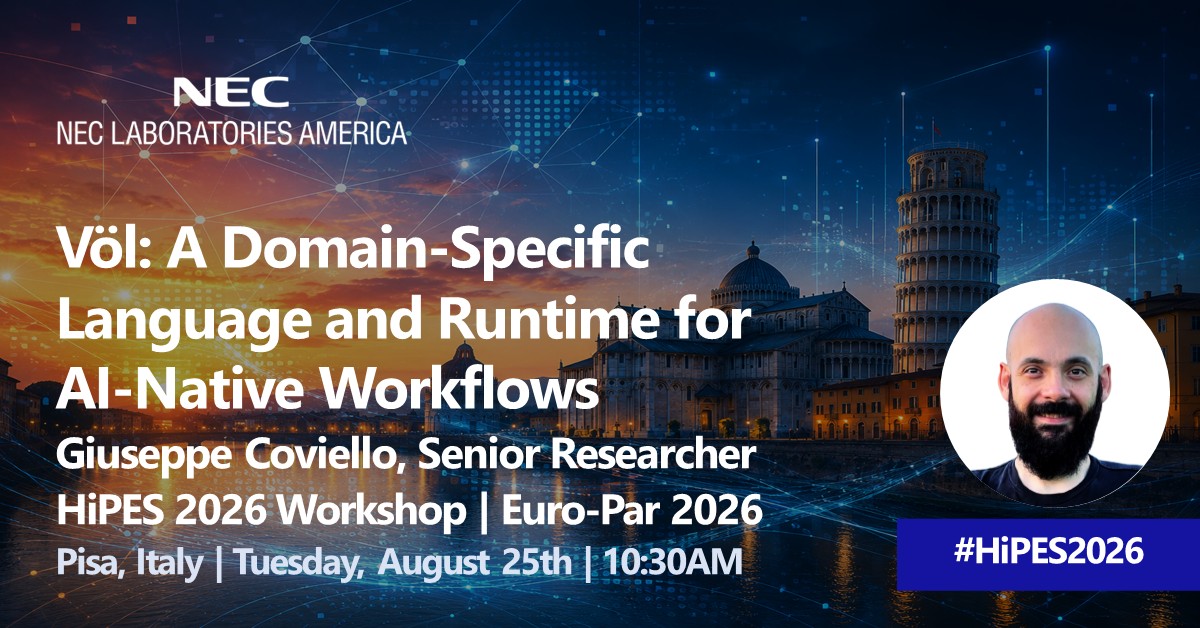 https://www.nec-labs.com/wp-content/uploads/2026/08/HIPES-2026-1.jpg
628
1200
NEC Labs America
https://www.nec-labs.com/wp-content/uploads/2025/08/NEC-Laboratories-America-Logo-Aug-2025-2.jpg
NEC Labs America2026-08-21 14:42:542026-08-21 19:32:50Giuseppe Coviello Presents at HiPES 2026 | Euro-Par in Pisa, Italy on August 25th
https://www.nec-labs.com/wp-content/uploads/2026/08/HIPES-2026-1.jpg
628
1200
NEC Labs America
https://www.nec-labs.com/wp-content/uploads/2025/08/NEC-Laboratories-America-Logo-Aug-2025-2.jpg
NEC Labs America2026-08-21 14:42:542026-08-21 19:32:50Giuseppe Coviello Presents at HiPES 2026 | Euro-Par in Pisa, Italy on August 25th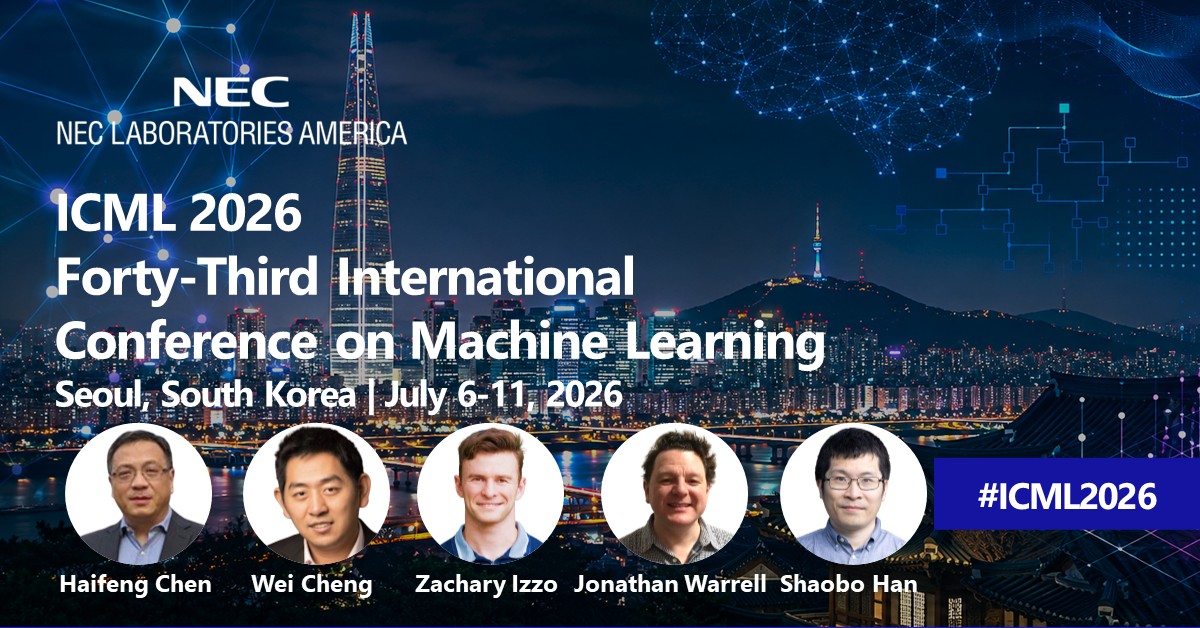 https://www.nec-labs.com/wp-content/uploads/2026/06/ICML-2026-SMM.jpg
628
1200
NEC Labs America
https://www.nec-labs.com/wp-content/uploads/2025/08/NEC-Laboratories-America-Logo-Aug-2025-2.jpg
NEC Labs America2026-06-24 16:27:442026-06-26 11:02:21NEC Labs America Attends ICML 2026 Seoul, South Korea July 6-11, 2026
https://www.nec-labs.com/wp-content/uploads/2026/06/ICML-2026-SMM.jpg
628
1200
NEC Labs America
https://www.nec-labs.com/wp-content/uploads/2025/08/NEC-Laboratories-America-Logo-Aug-2025-2.jpg
NEC Labs America2026-06-24 16:27:442026-06-26 11:02:21NEC Labs America Attends ICML 2026 Seoul, South Korea July 6-11, 2026
