
Influential NEC Researchers in the United States Who Helped Shape Modern Computing
NEC Laboratories America has long served as a hub for foundational research in artificial intelligence, machine learning, communications, and computing systems. Over the years, many researchers who spent part of their careers at NEC or collaborated with us went on to make lasting contributions across academia and industry, helping define technologies that now shape the modern digital world.
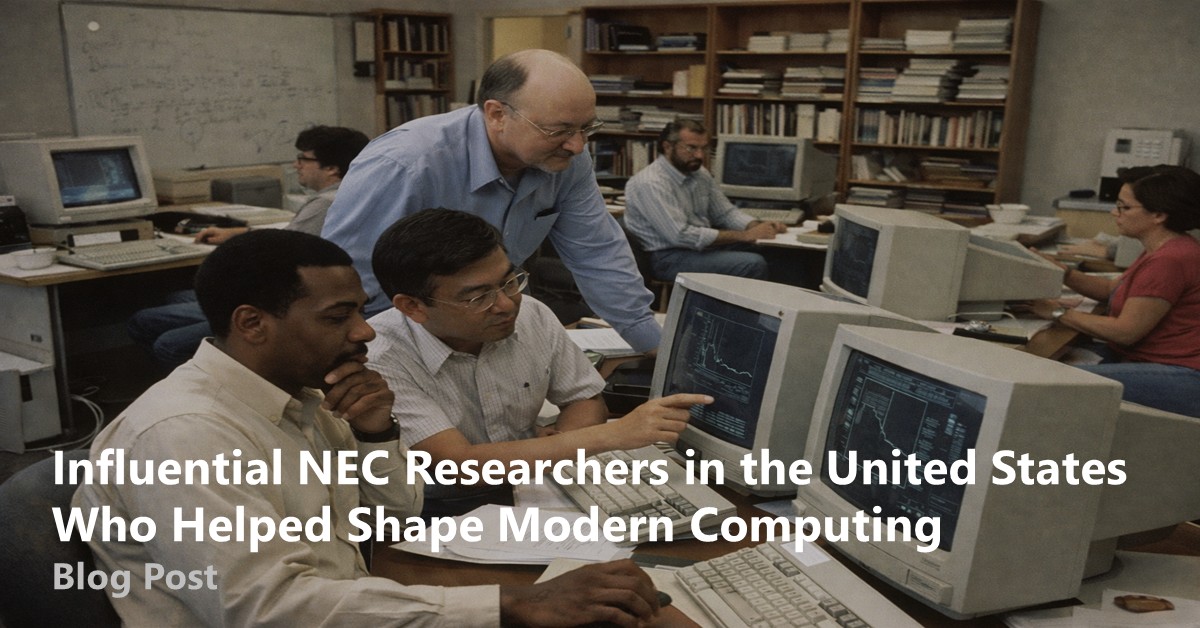
Showcasing these former researchers reflects NEC’s enduring research culture: one that values deep scientific inquiry, long-term innovation, and real-world application.
Yann LeCun: Foundations of Modern Deep Learning

Photo by Jérémy Barande – Executive master de l’Ecole polytechnique, CC BY-SA 2.0
- Yann LeCun served as a Fellow at the NEC Research Institute in Princeton from 2002-2003
Before becoming one of the most recognized figures in artificial intelligence, Yann LeCun worked at NEC Research Institute in the United States, where he continued developing early neural network architectures and machine learning techniques that would later become central to modern deep learning.
LeCun’s research on convolutional neural networks (CNNs) helped establish the foundation for today’s advances in computer vision, image recognition, and AI-driven perception systems. His work demonstrates how long-term research investments in neural computation eventually enabled breakthroughs that power modern AI applications across industries.
Léon Bottou: Large-Scale Machine Learning and Optimization

Photo by Xuthoria
- Employee 2002-2010
Léon Bottou worked as a research scientist at NEC Laboratories America from 2002 to 2010, focusing on scalable machine learning methods. His research advanced stochastic optimization techniques, particularly stochastic gradient descent, which became essential for training large neural networks efficiently.
By developing practical algorithms capable of handling massive datasets, he helped bridge the gap between theoretical machine learning and real-world implementation. His contributions continue to influence how modern AI systems are trained across research and industry.
Vladimir Vapnik: Statistical Learning Theory Pioneer
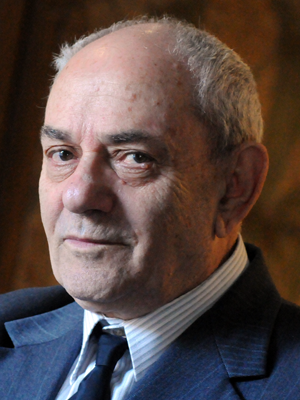
Photo by Columbia University
- Employee 2002 – 2003
Vladimir Vapnik joined NEC Laboratories in Princeton in 2002, bringing with him groundbreaking expertise in statistical learning theory. He is widely recognized as one of the creators of support vector machines, a major milestone in machine learning before the deep learning era. At NEC, he continued exploring the mathematical foundations that explain how learning algorithms generalize from data. His work helped establish many of the theoretical principles that still guide machine learning research today.
Corinna Cortes: Co-Inventor of Support Vector Machines

Photo: Google Scholar
- Employee, Researcher at NEC Research Institute (1990s)
Corinna Cortes was a researcher at NEC Research Institute during the 1990s, where she co-developed support vector machines alongside Vladimir Vapnik. Her work helped transform statistical learning theory into practical algorithms capable of solving real classification and prediction problems. Support vector machines were among the most influential machine learning methods before the rise of deep learning. Her contributions demonstrate NEC’s role in shaping foundational AI techniques that continue to influence research today.
Jason Weston: Early Neural Networks & Representation Learning

Photo: Google Scholar
- Employee, Research Scientist at NEC Labs America (early 2000s)
Jason Weston worked as a research scientist at NEC Labs America in the early 2000s, focusing on machine learning and neural network methods. His research explored representation learning and scalable algorithms for handling complex data, helping advance early approaches to modern AI systems. These ideas later became central to large-scale learning and deep learning research across the industry. His career reflects NEC’s role in supporting researchers who went on to shape contemporary AI development.
Alex Waibel: Speech Recognition and Multilingual AI
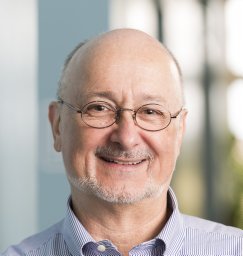
Photo: Google Scholar
- Collaborator with NEC Research Institute in the 1990’s
Dr. Alex Waibel conducted influential research at NEC focused on speech processing and multilingual communication technologies. His work helped advance automatic speech recognition and real-time translation systems, areas that remain central to today’s conversational AI and voice interfaces.
His research highlighted the importance of combining machine learning with linguistic modeling: an interdisciplinary approach that continues to influence modern AI systems.
Takeo Kanade: Computer Vision Pioneer

Photo: Kyoto University
- Collaborator
One of the most respected figures in computer vision, Dr. Takeo Kanade, collaborated closely with NEC research efforts and helped shape the field through groundbreaking work in robotics, perception, and visual intelligence. His contributions to motion analysis, autonomous systems, and machine perception laid foundations that continue to influence research in robotics and AI-enabled sensing systems today.
Tomaso Poggio: Computational Neuroscience and Machine Learning

Photo: Google Scholar
- Collaborator in the 1990’s
During the 1990s, Tomaso Poggio collaborated with NEC research efforts exploring learning theory and computational neuroscience. Dr. Tomaso Poggio’s collaborations with NEC research organizations contributed to advances at the intersection of neuroscience, learning theory, and computer vision. His work helped bridge the gap between biological inspiration and computational modeling, influencing how researchers think about learning systems and perception. This cross-disciplinary perspective: combining theory, mathematics, and engineering: remains a hallmark of modern AI research.
The Lasting Impact of NEC Research in the United States
What makes these researchers notable is not only their individual achievements but also the research environment that enabled their ideas to thrive. NEC’s U.S. research labs have long championed foundational, long-term research, giving scientists the freedom to explore ambitious ideas that push the boundaries of artificial intelligence, computing, and communications. Collaboration between academia and industry, combined with interdisciplinary thinking, has created a culture in which breakthrough concepts can move from theory to real-world impact.
Many ideas explored within NEC research settings have gone on to influence mainstream technologies, including deep learning, speech recognition, computer vision, and intelligent systems. This legacy reflects a research philosophy that values curiosity, rigor, and bold experimentation: the same qualities that continue to drive innovation today.
A Legacy That Continues to Shape the Future
The success of former NEC researchers demonstrates how foundational research can create lasting influence across generations of technology. As AI and advanced computing continue to evolve, the impact of these early contributions remains evident in today’s breakthroughs and emerging fields. NEC Laboratories America continues to build on this tradition by supporting researchers who want to tackle meaningful problems, collaborate with world-class colleagues, and translate deep science into practical innovation.
For researchers seeking to make a lasting impact, we offer an environment where long-term thinking, technical excellence, and real-world relevance converge. The next generation of breakthroughs will come from those willing to ask difficult questions, challenge assumptions, and explore new frontiers, and that journey starts here. Join us today.
Read More Blog Posts
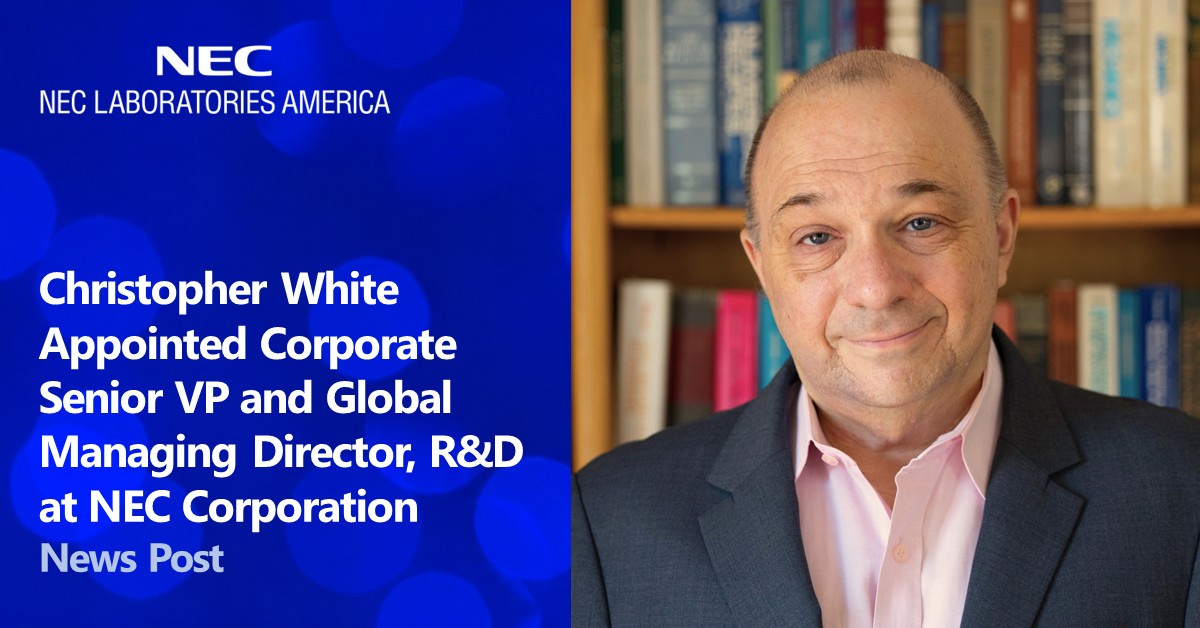 https://www.nec-labs.com/wp-content/uploads/2026/09/Chris-White-Promotion-SMM.jpg
628
1200
NEC Labs America
https://www.nec-labs.com/wp-content/uploads/2025/08/NEC-Laboratories-America-Logo-Aug-2025-2.jpg
NEC Labs America2026-09-23 19:54:142026-09-23 20:10:49Christopher White Appointed Corporate Senior Vice President and Global Managing Director, R&D at NEC Corporation
https://www.nec-labs.com/wp-content/uploads/2026/09/Chris-White-Promotion-SMM.jpg
628
1200
NEC Labs America
https://www.nec-labs.com/wp-content/uploads/2025/08/NEC-Laboratories-America-Logo-Aug-2025-2.jpg
NEC Labs America2026-09-23 19:54:142026-09-23 20:10:49Christopher White Appointed Corporate Senior Vice President and Global Managing Director, R&D at NEC Corporation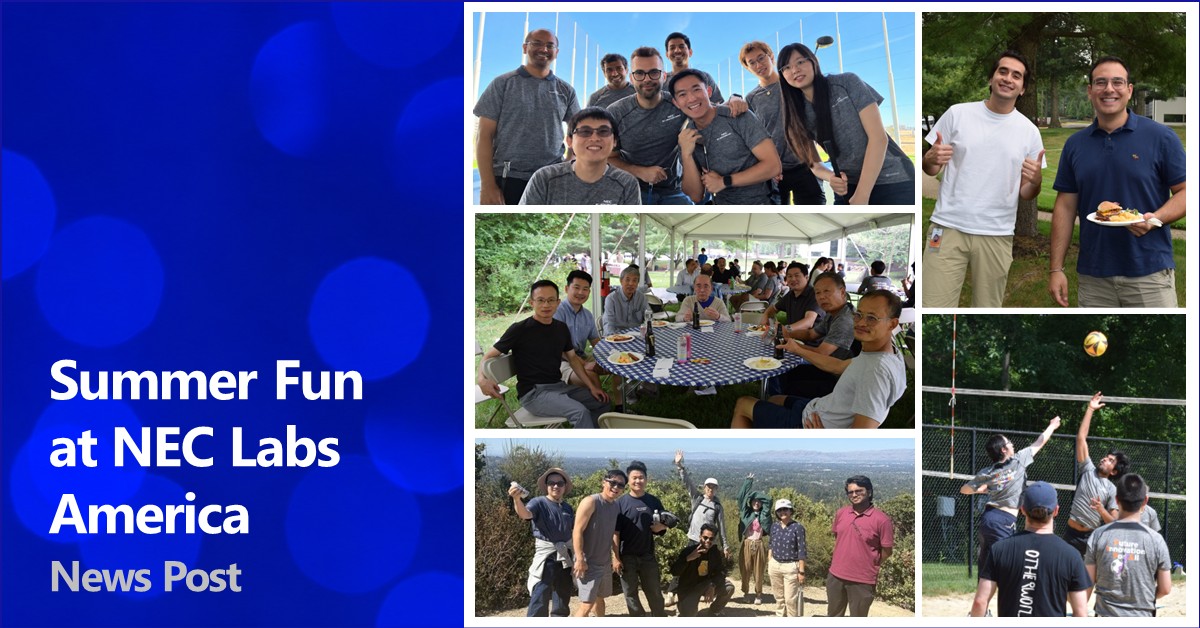 https://www.nec-labs.com/wp-content/uploads/2026/09/NEC-Labs-America-Summer-Fun.jpg
628
1200
NEC Labs America
https://www.nec-labs.com/wp-content/uploads/2025/08/NEC-Laboratories-America-Logo-Aug-2025-2.jpg
NEC Labs America2026-09-22 16:50:282026-10-01 12:18:48Summer Fun at NEC Labs America
https://www.nec-labs.com/wp-content/uploads/2026/09/NEC-Labs-America-Summer-Fun.jpg
628
1200
NEC Labs America
https://www.nec-labs.com/wp-content/uploads/2025/08/NEC-Laboratories-America-Logo-Aug-2025-2.jpg
NEC Labs America2026-09-22 16:50:282026-10-01 12:18:48Summer Fun at NEC Labs America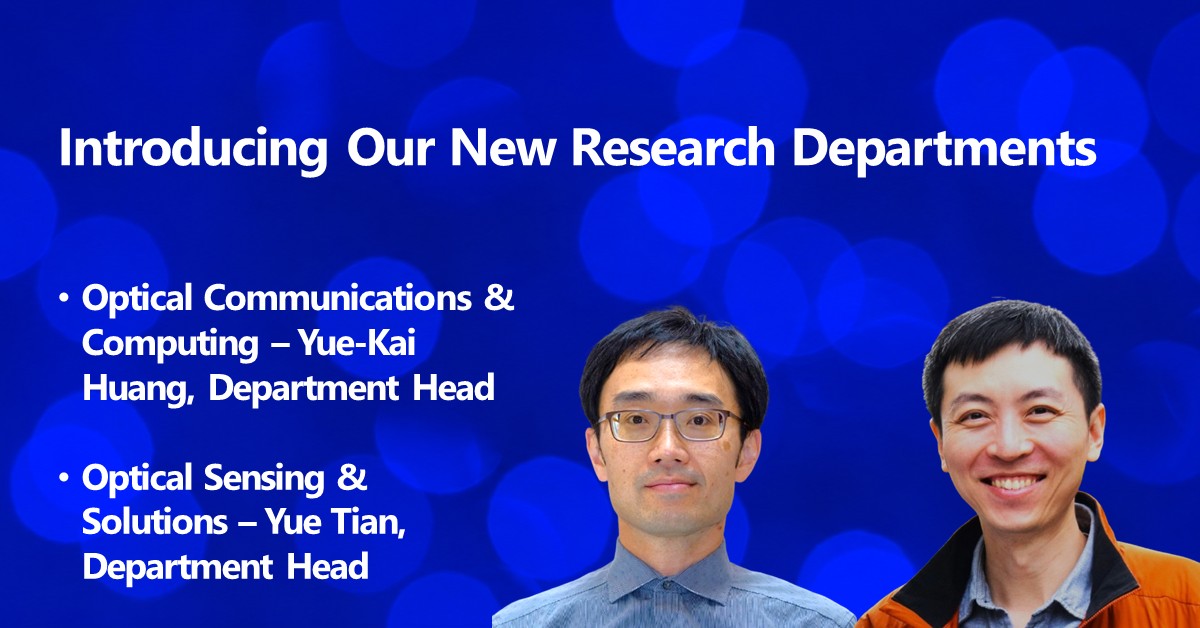 https://www.nec-labs.com/wp-content/uploads/2026/09/OCC-OSS-Blog-Post.jpg
628
1200
NEC Labs America
https://www.nec-labs.com/wp-content/uploads/2025/08/NEC-Laboratories-America-Logo-Aug-2025-2.jpg
NEC Labs America2026-09-01 07:00:042026-09-18 09:42:38NEC Laboratories America Forms Two New Departments: Optical Communications & Computing and Optical Sensing & Solutions
https://www.nec-labs.com/wp-content/uploads/2026/09/OCC-OSS-Blog-Post.jpg
628
1200
NEC Labs America
https://www.nec-labs.com/wp-content/uploads/2025/08/NEC-Laboratories-America-Logo-Aug-2025-2.jpg
NEC Labs America2026-09-01 07:00:042026-09-18 09:42:38NEC Laboratories America Forms Two New Departments: Optical Communications & Computing and Optical Sensing & Solutions https://www.nec-labs.com/wp-content/uploads/2026/08/NEC-Laboratories-America-Researchers-Win-a-2026-Edison-Patent-Award-for-Optical-Fiber-Innovation.jpg
628
1200
NEC Labs America
https://www.nec-labs.com/wp-content/uploads/2025/08/NEC-Laboratories-America-Logo-Aug-2025-2.jpg
NEC Labs America2026-08-20 09:14:182026-08-21 15:16:35NEC Laboratories America Researchers Win a 2026 Edison Patent Award for Optical Fiber Innovation
https://www.nec-labs.com/wp-content/uploads/2026/08/NEC-Laboratories-America-Researchers-Win-a-2026-Edison-Patent-Award-for-Optical-Fiber-Innovation.jpg
628
1200
NEC Labs America
https://www.nec-labs.com/wp-content/uploads/2025/08/NEC-Laboratories-America-Logo-Aug-2025-2.jpg
NEC Labs America2026-08-20 09:14:182026-08-21 15:16:35NEC Laboratories America Researchers Win a 2026 Edison Patent Award for Optical Fiber Innovation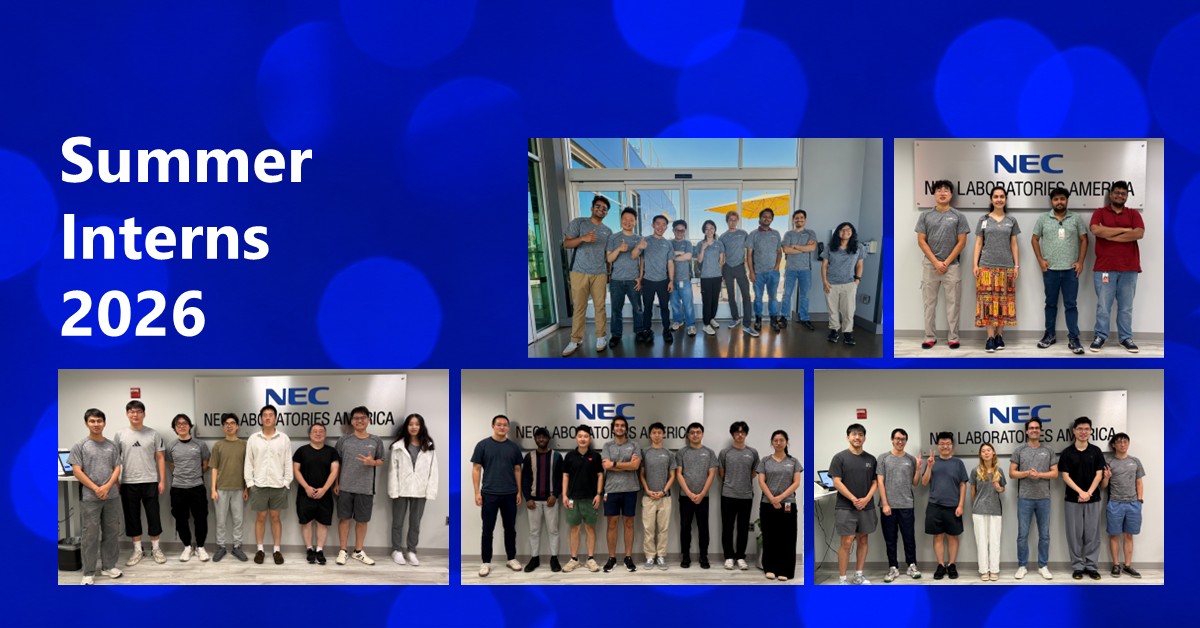 https://www.nec-labs.com/wp-content/uploads/2026/08/Summer-Interns-2026-1.jpg
628
1200
NEC Labs America
https://www.nec-labs.com/wp-content/uploads/2025/08/NEC-Laboratories-America-Logo-Aug-2025-2.jpg
NEC Labs America2026-08-18 12:59:042026-08-18 13:39:18Summer Interns 2026
https://www.nec-labs.com/wp-content/uploads/2026/08/Summer-Interns-2026-1.jpg
628
1200
NEC Labs America
https://www.nec-labs.com/wp-content/uploads/2025/08/NEC-Laboratories-America-Logo-Aug-2025-2.jpg
NEC Labs America2026-08-18 12:59:042026-08-18 13:39:18Summer Interns 2026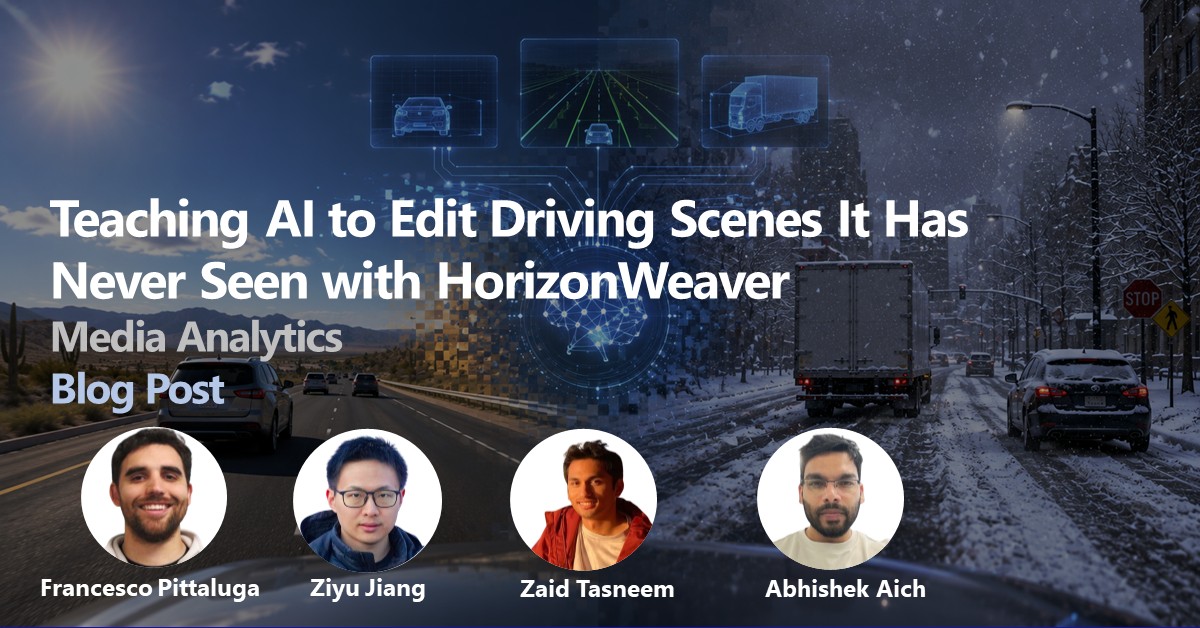 https://www.nec-labs.com/wp-content/uploads/2026/07/Teaching-AI-to-Edit-Driving-Scenes-It-Has-Never-Seen-with-HorizonWeaver-1.jpg
628
1200
NEC Labs America
https://www.nec-labs.com/wp-content/uploads/2025/08/NEC-Laboratories-America-Logo-Aug-2025-2.jpg
NEC Labs America2026-08-11 22:04:592026-08-11 22:05:56Teaching AI to Edit Driving Scenes It Has Never Seen with HorizonWeaver
https://www.nec-labs.com/wp-content/uploads/2026/07/Teaching-AI-to-Edit-Driving-Scenes-It-Has-Never-Seen-with-HorizonWeaver-1.jpg
628
1200
NEC Labs America
https://www.nec-labs.com/wp-content/uploads/2025/08/NEC-Laboratories-America-Logo-Aug-2025-2.jpg
NEC Labs America2026-08-11 22:04:592026-08-11 22:05:56Teaching AI to Edit Driving Scenes It Has Never Seen with HorizonWeaver