
NEC Labs America Attends ICML 2026 Seoul, South Korea July 6-11, 2026
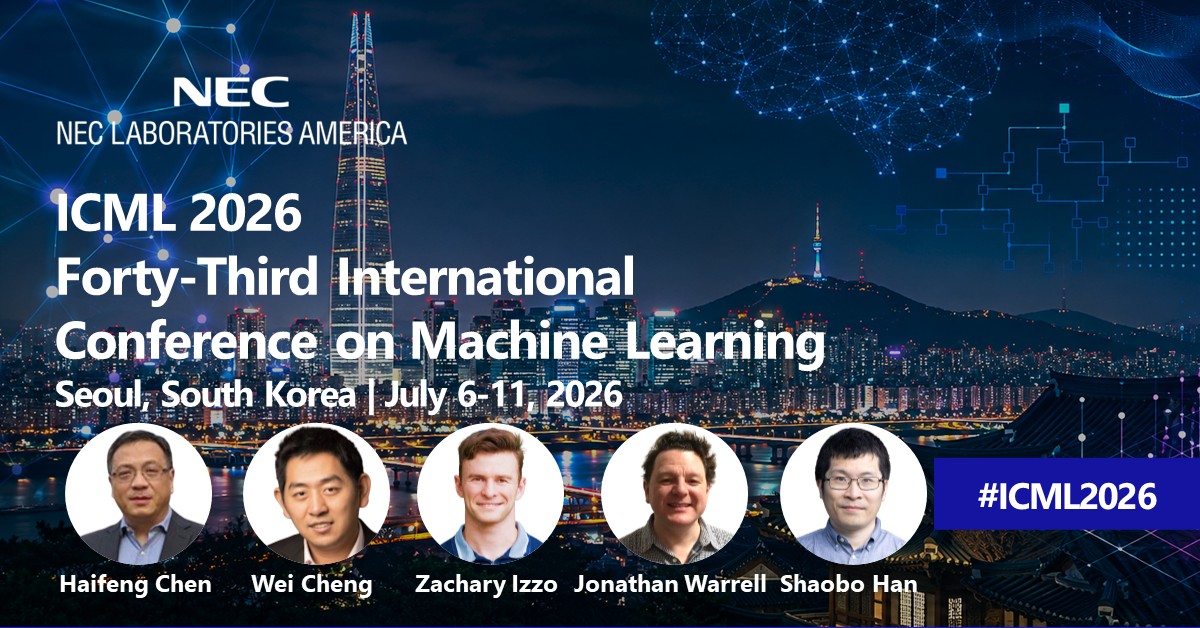
Presentations
The presentations span agentic AI and coding documentation, survival analysis and subgroup discovery, and compositional control of diffusion models. Together, they reflect the depth and range of research underway at our company.
Escaping Whack-a-Mole: Optimizing Documentation as Repo-Specific Playbooks for Coding Agents


- Wei Cheng and Haifeng Chen (presenting), Yutong Cheng, Wenchao Yu, Xujiang Zhao, Peng Gao
- Poster
- https://icml.cc/virtual/2026/poster/65992#
Abstract: As large language models increasingly serve as autonomous coding agents, code documentation must be optimized for agent comprehension rather than human readability. We frame agent-oriented documentation generation as a black-box optimization problem over the documentation space, where quality is measured solely by downstream code correctness. A central challenge for conventional LLM refinement methods is output coupling—program entities are interdependent, and refining the documentation of one entity can invalidate its callers, resulting in a persistent whack-a-mole phenomenon during inference-time scaling. We propose DocSearch, a dependency-guided bi-level search framework that systematically exploits test-time feedback. The outer level conducts a priority search over the program-entity dependency DAG, enforcing a callee-before-caller refinement order to prevent downstream interference. The inner level performs a beam search over documentation refinements, using diversified error message sampling from self-generated unit tests to better exploit diagnostic signals and escape local optima. We provide theoretical guarantees of monotonic progress, showing that our worthy condition prevents regression while enabling efficient exploration. On DevEval+, DocSearch achieves a 90.7% solve rate with GPT-4o, outperforming the strongest baseline by 32.6%. Cross-language experiments further demonstrate that optimized documentation transfers effectively to different target programming languages.
Subgroup Discovery with the Cox Model

- Zachary Izzo (Presenting), Iain Melvin
- Poster
- https://icml.cc/virtual/2026/poster/66422
Abstract: We study the problem of subgroup discovery for survival analysis, where the goal is to find an interpretable subset of the data on which a Cox model is highly accurate. We examine why existing quality functions are insufficient for this problem and introduce two technical innovations: the expected prediction entropy (EPE), a novel metric for evaluating survival models that predict hazard functions, and the conditional rank statistics (CRS), which quantifies individual point deviation from a subgroup’s survival time distribution. We study the EPE and CRS theoretically and show that they address problems with existing metrics. We then introduce seven algorithms for Cox subgroup discovery. Our main algorithm is based on the DDGroup framework of Izzo et al. (2023) and leverages both the EPE and CRS, allowing theoretical correctness guarantees in well-specified settings. Empirical evaluation on synthetic and real data confirms our theory, showing our methods recover ground-truth subgroups in well-specified cases and achieve better model fit than naively fitting the Cox model to the entire dataset. A case study using NASA jet engine simulation data demonstrates that discovered subgroups reveal known nonlinearities in the data and suggest design choices that are mirrored in practice.
Logical Guidance Rules for the Exact Composition of Diffusion Models

- Jonathan Warrell (Presenting), Francesco Alesiani, Tanja Bien, Henrik Christiansen, Matheus Vitor Ferreira Ferraz, Mathias Niepert
- Poster
- https://icml.cc/virtual/2026/poster/64380
Abstract: We propose LOGDIFF (Logical Guidance for the Exact Composition of Diffusion Models), a guidance framework for diffusion models that enables principled constrained generation with complex logical expressions at inference time. We study when exact score-based guidance for complex logical formulas can be obtained from guidance signals associated with atomic attributes and constraints. First, we derive an exact Boolean calculus that provides a sufficient condition for exact logical guidance. Specifically, if a formula admits a circuit representation in which conjunctions combine conditionally independent subformulas and disjunctions combine subformulas that are either conditionally independent or mutually exclusive, exact logical guidance is achievable. In this case, the guidance signal can be computed exactly from atomic scores and posterior probabilities using an efficient recursive algorithm. Moreover, we show that, for commonly encountered classes of distributions, any desired Boolean formula is compilable into such a circuit representation. Second, by combining atomic guidance scores with posterior probability estimates, we introduce a hybrid guidance approach that bridges classifierguidance and classifier-free guidance, applicable to both compositional logical guidance and standard conditional generation. We demonstrate the effectiveness of our framework on multiple image and protein structure generation tasks.
Attending

- Shaobo Han (Attending)
Read About Our Future and Past Events
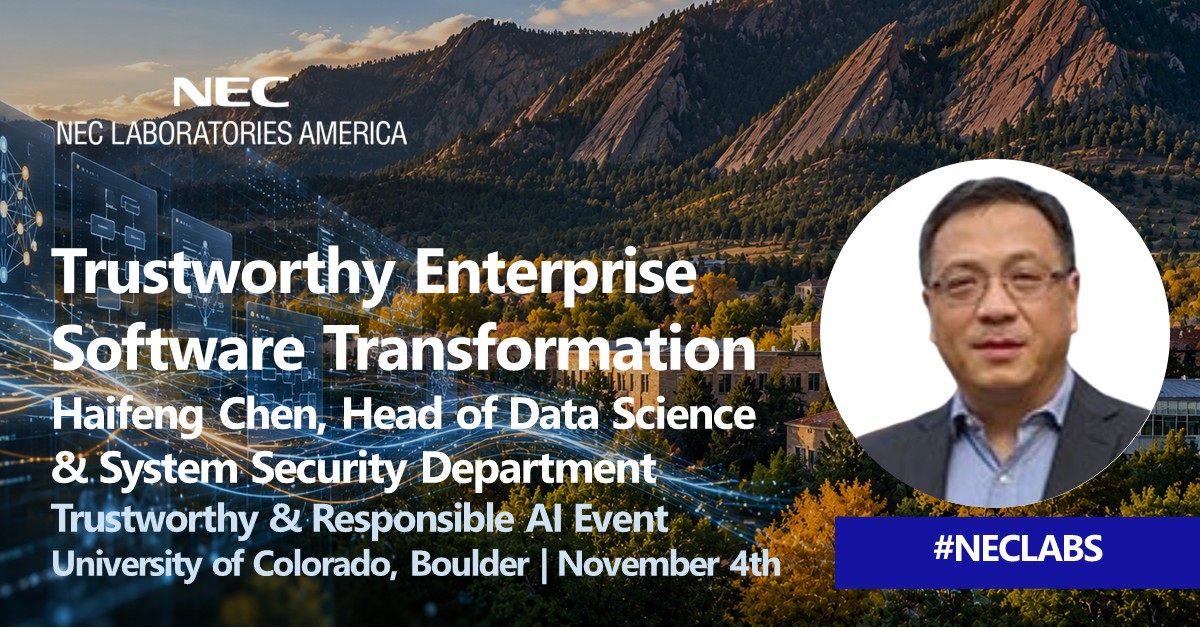 https://www.nec-labs.com/wp-content/uploads/2026/10/Haifeng-Boulder-Nov-4th-1.jpg
628
1200
NEC Labs America
https://www.nec-labs.com/wp-content/uploads/2025/08/NEC-Laboratories-America-Logo-Aug-2025-2.jpg
NEC Labs America2026-10-19 14:47:082026-10-20 00:29:36Haifeng Chen Speaks at the Trustworthy & Responsible AI Event at CU Boulder on November 4th
https://www.nec-labs.com/wp-content/uploads/2026/10/Haifeng-Boulder-Nov-4th-1.jpg
628
1200
NEC Labs America
https://www.nec-labs.com/wp-content/uploads/2025/08/NEC-Laboratories-America-Logo-Aug-2025-2.jpg
NEC Labs America2026-10-19 14:47:082026-10-20 00:29:36Haifeng Chen Speaks at the Trustworthy & Responsible AI Event at CU Boulder on November 4th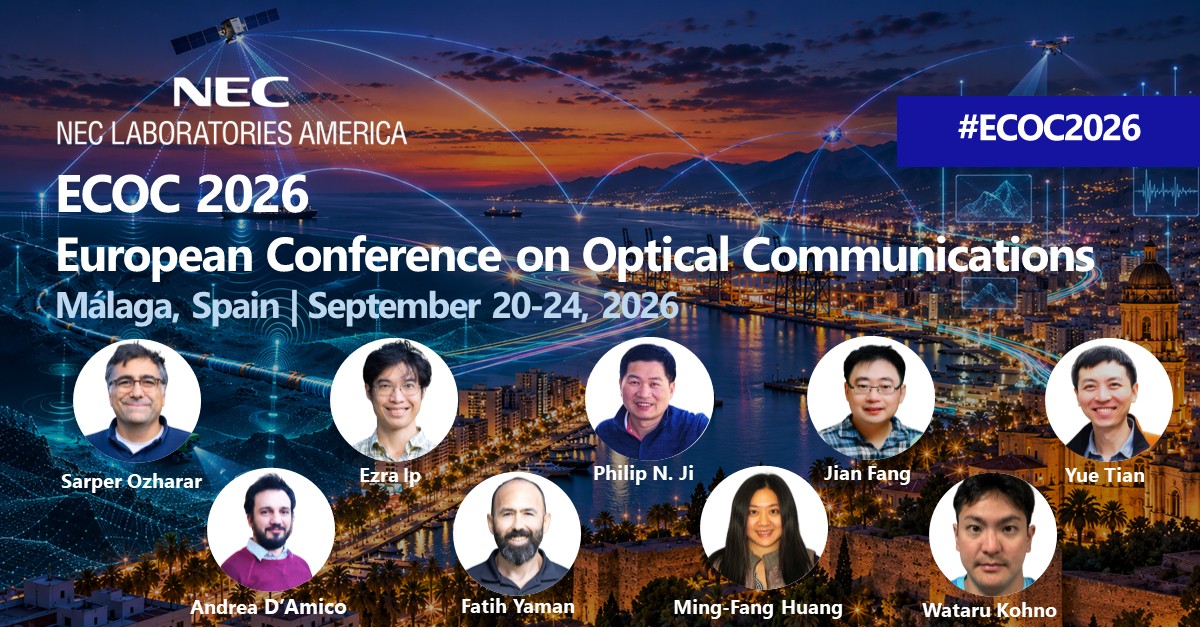 https://www.nec-labs.com/wp-content/uploads/2026/09/ECOC-2026.jpg
628
1200
NEC Labs America
https://www.nec-labs.com/wp-content/uploads/2025/08/NEC-Laboratories-America-Logo-Aug-2025-2.jpg
NEC Labs America2026-09-07 14:05:232026-09-07 14:51:52NEC Labs America Presents at ECOC 2026 in Málaga, Spain, September 20-24th
https://www.nec-labs.com/wp-content/uploads/2026/09/ECOC-2026.jpg
628
1200
NEC Labs America
https://www.nec-labs.com/wp-content/uploads/2025/08/NEC-Laboratories-America-Logo-Aug-2025-2.jpg
NEC Labs America2026-09-07 14:05:232026-09-07 14:51:52NEC Labs America Presents at ECOC 2026 in Málaga, Spain, September 20-24th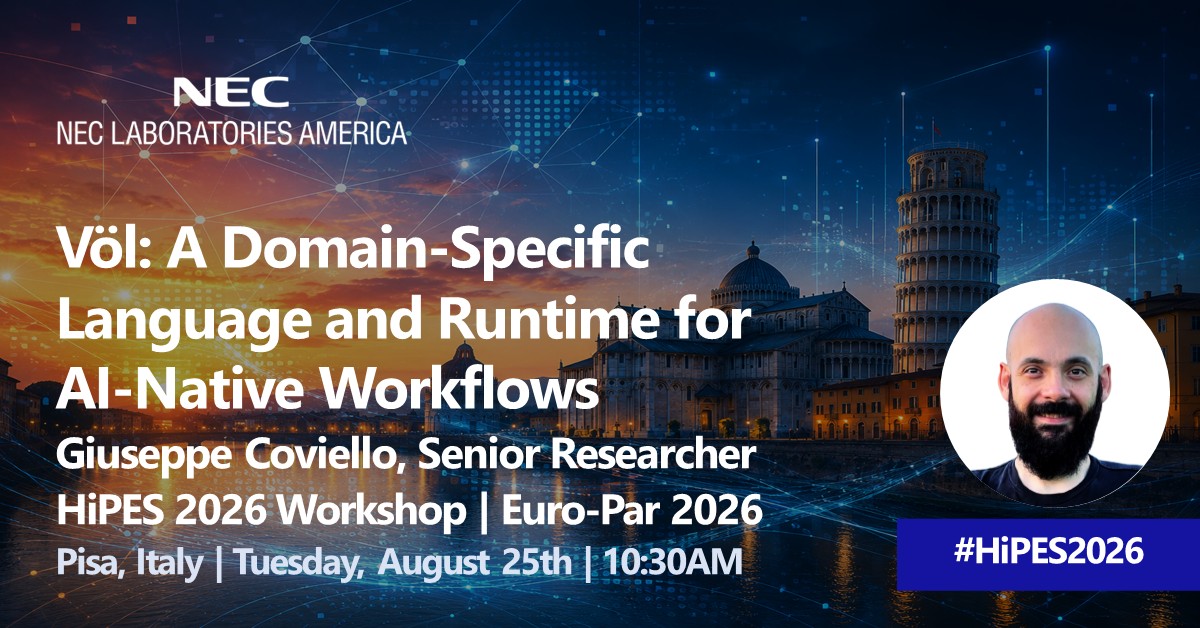 https://www.nec-labs.com/wp-content/uploads/2026/08/HIPES-2026-1.jpg
628
1200
NEC Labs America
https://www.nec-labs.com/wp-content/uploads/2025/08/NEC-Laboratories-America-Logo-Aug-2025-2.jpg
NEC Labs America2026-08-21 14:42:542026-08-21 19:32:50Giuseppe Coviello Presents at HiPES 2026 | Euro-Par in Pisa, Italy on August 25th
https://www.nec-labs.com/wp-content/uploads/2026/06/ICML-2026-SMM.jpg
628
1200
NEC Labs America
https://www.nec-labs.com/wp-content/uploads/2025/08/NEC-Laboratories-America-Logo-Aug-2025-2.jpg
NEC Labs America2026-06-24 16:27:442026-06-26 11:02:21NEC Labs America Attends ICML 2026 Seoul, South Korea July 6-11, 2026
https://www.nec-labs.com/wp-content/uploads/2026/08/HIPES-2026-1.jpg
628
1200
NEC Labs America
https://www.nec-labs.com/wp-content/uploads/2025/08/NEC-Laboratories-America-Logo-Aug-2025-2.jpg
NEC Labs America2026-08-21 14:42:542026-08-21 19:32:50Giuseppe Coviello Presents at HiPES 2026 | Euro-Par in Pisa, Italy on August 25th
https://www.nec-labs.com/wp-content/uploads/2026/06/ICML-2026-SMM.jpg
628
1200
NEC Labs America
https://www.nec-labs.com/wp-content/uploads/2025/08/NEC-Laboratories-America-Logo-Aug-2025-2.jpg
NEC Labs America2026-06-24 16:27:442026-06-26 11:02:21NEC Labs America Attends ICML 2026 Seoul, South Korea July 6-11, 2026