
A construction crew hits a buried telecommunications fiber line while digging near a highway, and by the time anyone notices, the fiber cable is severed, and thousands of customers lose service.
A traffic engineer wants to know how congested a stretch of road gets at 5 p.m. on a Tuesday, but the city government does not have any traffic cameras or sensors installed there.
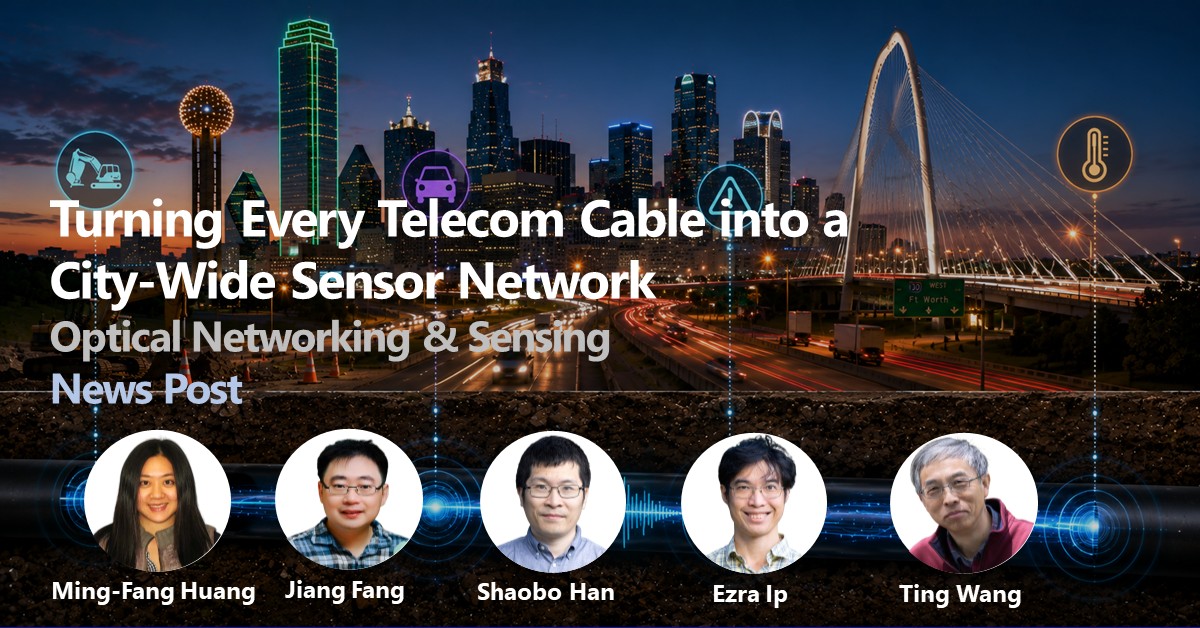
A network operator needs to know exactly which repeater span, out of dozens spread across a metro area, is experiencing a slow-building fault before it becomes an outage.
In each case, the answer may already be sitting underground: the fiber optic cable itself.
Introduction
This is the subject of “Leveraging Deployed Telecom Cables for Distributed Fiber Sensing Topologies and Applications,” published in the Journal of Optical Communications and Networking (Vol. 18, No. 4, April 2026). The paper was authored by Scott R. Kotrla, Principal Member of Technical Staff at Verizon, and Jeffrey A. Mundt, also of Verizon, together with Ming-Fang “Yvonne” Huang, Jian Fang, Shaobo Han, Jamie Lynn, Ezra Ip, and Ting Wang, all of NEC Laboratories America. The work reflects a collaboration between Verizon’s network engineering team and NEC Laboratories America’s optical communications research group, combining field access to live carrier infrastructure with sensing hardware and artificial intelligence (AI) expertise.
The Problem: Idle Fiber, Untapped Data
Telecom carriers have buried hundreds of thousands of miles of fiber optic cable to carry internet and phone traffic. That same glass, it turns out, is sensitive to vibration, temperature, and strain, meaning it can double as a distributed sensor stretching for miles. The technique, known as distributed fiber optic sensing (DFOS), has existed for years, but two practical limits have held it back.
The first is distance and compatibility. The most common method, called backscattering sensing, reads light that bounces backward through the fiber and works well for high-precision detection. Still, it cannot pass through the amplifiers and switching equipment (erbium-doped fiber amplifiers and reconfigurable optical add-drop multiplexers) that live telecom networks use to boost and route signals over long distances. That confines it to short, unamplified, often dark (unused) fibers, not the busy backbone links carriers operate.
The second limit is data overload. A single sensing fiber can generate enormous volumes of raw vibration data every second, far more than any human team could review, and building AI models to sort meaningful events from noise has typically required large amounts of manually labeled training data for every new fiber route. This slow and expensive process does not scale to a citywide network.
Combine Advanced Sensing with Self-Supervised AI
The authors address the distance problem by pairing two complementary sensing methods. Backscattering sensing, which reads reflected light, offers meter-level precision but cannot travel through amplified links. Forward transmission sensing, which reads light traveling in the same direction as ordinary data traffic, can pass through amplifiers and cover hundreds of kilometers. Still, it only narrows an event down to a rough stretch of fiber. The team’s hybrid approach uses forward transmission sensing to scan an entire route and flag the general area of a disturbance, then activates backscattering sensing only on that specific segment for precise, meter-level localization. It is like using a wide-angle camera to spot movement across a stadium, then zooming a second camera in on the exact seat.
To address the data and labeling problem, the researchers developed a technique called locally adaptive anomaly detection (LAAD), a self-supervised representation learning method. Instead of requiring engineers to label thousands of events on every new fiber route manually, LAAD first trains itself using location-indices as labels: predicting which location along the fiber a given signal patch came from. Because different spots along a cable have distinct, repeating vibration signatures, such as a manhole near a pump or a pole near a road, the model learns what “normal” looks like at each specific location without being told what any event is. Once trained this way, it needs far less labeled data to fine-tune for a specific downstream task like detecting cable strikes or classifying traffic.
Field Validated Across 500 Kilometers
The team tested all three sensing approaches on live carrier fiber across the Dallas-Fort Worth metropolitan area, spanning roughly 310 miles (500 kilometers) of monitored cable. In the backscattering trial, eleven sensing units deployed as a mesh network tracked cable damage over four years and, after full deployment with early warning alerts in 2024, cut the share of cable failures occurring inside monitored zones from 22% in 2023 to 9% in 2024.
In the forward transmission trial over an 80-kilometer field segment, the system detected and localized events as faint as footsteps on a manhole cover, with phase signals below 10 radians, a level of sensitivity that conventional forward transmission methods could not reliably resolve. The hybrid trial, run over a 249-kilometer, three-span link carrying live 400-gigabit-per-second data traffic, achieved a measurement resolution of 146 picoepsilon per square root hertz, a 32% sensitivity improvement over full link monitoring, while maintaining zero post-forward error correction bit errors on all 43 co-propagating data channels.
On the AI side, after self-training, LAAD classified 224 distinct fiber locations along a single route with 97.96% pretext task location-classification accuracy. The learned representation also supports cross-domain generalization: on two entirely new fiber routes, it achieved more than 97.66% downstream event-classification accuracy across a range of different classification models.
Real-World Applications
Telecom carriers, like Verizon, can use this approach to protect their own infrastructure, catching excavation and construction activity near buried cables before a backhoe causes an outage. City transportation departments and municipal planners could tap the same fiber for traffic density and road condition monitoring without installing new cameras or roadside sensors. Utility companies and infrastructure operators managing pipelines or transit corridors that run parallel to fiber routes could extend similar sensing for intrusion detection or structural monitoring, turning cable rights of way already in the ground into an added layer of situational awareness.
The fiber is already there, carrying traffic every day, so the real opportunity is in getting more value out of it without disrupting the network it was built for. What excites me about this work is that the sensing and the AI must be designed together. A method that only works in a quiet lab, or a model that only works on the one route it was trained on, will not survive contact with a live, noisy metro network.
— Ming-Fang Huang, NEC Laboratories America
Looking Ahead
The authors note that as DFOS deployments expand across more cities, countries, and cable types, the self-training approach behind LAAD offers a path to scale sensing intelligence without a proportional increase in manual labeling effort. Future work will likely extend the framework across a wider range of environments and sensing use cases beyond the traffic and cable safety applications tested here.
About The Authors
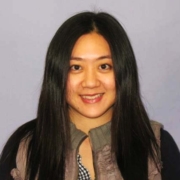
Ming-Fang “Yvonne” Huang is a Senior Researcher in our Optical Networking & Sensing Department, where she leads innovation at the intersection of photonics and intelligent systems. Dr. Huang’s work spans distributed fiber-optic sensing, high-capacity optical communications, and AI-driven signal processing technologies. She plays an active role in advancing next-generation network infrastructure and presenting research at major industry conferences.
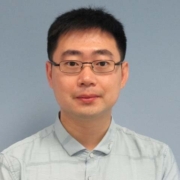
Jian Fang is a Senior Researcher in our Optical Networking and Sensing Department. He received his B.S. and M.S. from Shanghai Jiao Tong University, and his Ph.D. in Electrical and Electronic Engineering from the University of Melbourne. Dr. Fang’s research interests include distributed optical fiber sensing, specialty fibers and hybrid sensing systems, optical signal processing, and photonic sensing for industrial and environmental applications.
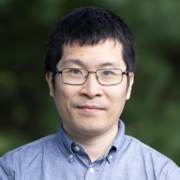
Shaobo Han is a Senior Researcher in our Machine Learning Department. He received his Ph.D. from Duke University and an M.Eng. degree in Signal and Information Processing from the University of Chinese Academy of Sciences. At NEC, Dr. Han builds sensing AI solutions, applying machine learning to massive fiber-optic waveform data to turn telecom infrastructure into a real-time acoustic sensor network.
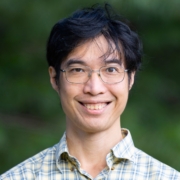
Ezra Ip is a Senior Researcher in our Optical Networking and Sensing Department. Ezra Ip received the B.E. degree from the University of Canterbury along with M.S. and Ph.D. degrees from Stanford University. Dr. Ip has published more than 100 journal articles and conference papers in the areas of high-capacity optical transmission, digital signal processing techniques, space-division multiplexing, and distributed fiber sensing.
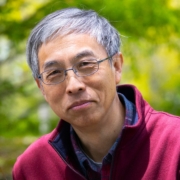
Publication to News Series
Our Publication-to-News Series highlights the real-world impact of our latest research, translating complex innovations into practical applications. From AI and machine learning to optical networking and intelligent systems, we showcase how our work goes beyond theory to address real-world challenges. Explore how cutting-edge research at NEC Laboratories America is driving measurable outcomes across industries.
 https://www.nec-labs.com/wp-content/uploads/2026/07/Teaching-AI-to-Edit-Driving-Scenes-It-Has-Never-Seen-with-HorizonWeaver-1.jpg
628
1200
NEC Labs America
https://www.nec-labs.com/wp-content/uploads/2025/08/NEC-Laboratories-America-Logo-Aug-2025-2.jpg
NEC Labs America2026-08-11 22:04:592026-08-11 22:05:56Teaching AI to Edit Driving Scenes It Has Never Seen with HorizonWeaver
https://www.nec-labs.com/wp-content/uploads/2026/07/Turning-Every-Telecom-Cable-into-a-City-Wide-Sensor-Network.jpg
628
1200
NEC Labs America
https://www.nec-labs.com/wp-content/uploads/2025/08/NEC-Laboratories-America-Logo-Aug-2025-2.jpg
NEC Labs America2026-07-28 09:50:322026-07-28 12:55:09Turning Every Telecom Cable into a City-Wide Sensor Network
https://www.nec-labs.com/wp-content/uploads/2026/07/Teaching-AI-to-Edit-Driving-Scenes-It-Has-Never-Seen-with-HorizonWeaver-1.jpg
628
1200
NEC Labs America
https://www.nec-labs.com/wp-content/uploads/2025/08/NEC-Laboratories-America-Logo-Aug-2025-2.jpg
NEC Labs America2026-08-11 22:04:592026-08-11 22:05:56Teaching AI to Edit Driving Scenes It Has Never Seen with HorizonWeaver
https://www.nec-labs.com/wp-content/uploads/2026/07/Turning-Every-Telecom-Cable-into-a-City-Wide-Sensor-Network.jpg
628
1200
NEC Labs America
https://www.nec-labs.com/wp-content/uploads/2025/08/NEC-Laboratories-America-Logo-Aug-2025-2.jpg
NEC Labs America2026-07-28 09:50:322026-07-28 12:55:09Turning Every Telecom Cable into a City-Wide Sensor Network https://www.nec-labs.com/wp-content/uploads/2026/07/When-Video-AI-Gets-Physics-Wrong-the-Consequences-Are-Real-1.jpg
628
1200
NEC Labs America
https://www.nec-labs.com/wp-content/uploads/2025/08/NEC-Laboratories-America-Logo-Aug-2025-2.jpg
NEC Labs America2026-07-21 12:21:442026-07-27 23:37:32When Video AI Gets Physics Wrong, the Consequences Are Real
https://www.nec-labs.com/wp-content/uploads/2026/07/When-Video-AI-Gets-Physics-Wrong-the-Consequences-Are-Real-1.jpg
628
1200
NEC Labs America
https://www.nec-labs.com/wp-content/uploads/2025/08/NEC-Laboratories-America-Logo-Aug-2025-2.jpg
NEC Labs America2026-07-21 12:21:442026-07-27 23:37:32When Video AI Gets Physics Wrong, the Consequences Are Real https://www.nec-labs.com/wp-content/uploads/2026/07/Mix-CLAP-Teaching-Audio-AI-to-Work-in-the-Noisy-Real-World.jpg
628
1200
NEC Labs America
https://www.nec-labs.com/wp-content/uploads/2025/08/NEC-Laboratories-America-Logo-Aug-2025-2.jpg
NEC Labs America2026-07-08 13:18:522026-07-24 22:17:19Mix-CLAP: Teaching Audio AI to Work in the Noisy Real World
https://www.nec-labs.com/wp-content/uploads/2026/07/Mix-CLAP-Teaching-Audio-AI-to-Work-in-the-Noisy-Real-World.jpg
628
1200
NEC Labs America
https://www.nec-labs.com/wp-content/uploads/2025/08/NEC-Laboratories-America-Logo-Aug-2025-2.jpg
NEC Labs America2026-07-08 13:18:522026-07-24 22:17:19Mix-CLAP: Teaching Audio AI to Work in the Noisy Real World