
CAViAR Asks Whether AI Can Tell Who Caused an Automotive Collision
A claims adjuster at an auto insurer opens a short dashcam clip attached to a new collision report. Two cars, a wet intersection, and a sudden impact.
Before they can settle the claim, they need to answer a simple question that current software can’t yet answer reliably: whose action caused this crash?
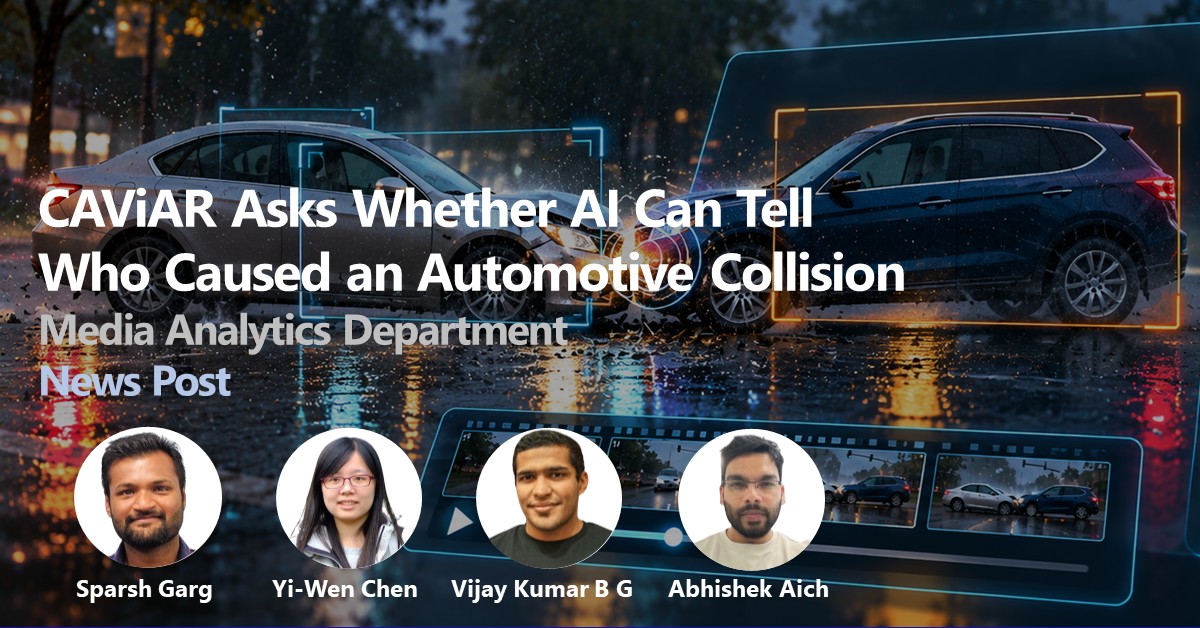
That question is central to CAViAR: A Causal Video Dataset for Fine-Grained Accident Reasoning in Real-World Scenarios, a paper from the Media Analytics department at NEC Laboratories America. The research was presented at the 6th DriveX Workshop at the European Conference on Computer Vision (ECCV 2026). CAViAR, short for Causal Accident Video and Incident Analysis Repository, is a benchmark: a standardized test set that lets researchers compare AI models on the same questions. The authors, all of NEC Laboratories America, are Sparsh Garg, Senior Associate Researcher; Yi-Wen Chen, Researcher; Vijay Kumar B. G., Principal Researcher; and Abhishek Aich, Senior Researcher.
Seeing Is Not Understanding
Modern autonomous driving systems excel at perception. They detect cars, cyclists, and pedestrians, and they predict where each will move next. They are far weaker at causal reasoning, the ability to explain why an event happened. Existing accident video collections reflect this imbalance. Accident datasets such as DoTA, DADA-2000, and MM-AU focus on detecting crashes, anticipating them, and marking when they occur in a clip. The authors compared CAViAR against 14 earlier accident datasets. None of those datasets label the at-fault road user. None label the traffic rule that was broken.
That gap matters. Vision-language models (VLMs) are increasingly asked to describe and reason about video. A VLM is an AI system that takes images and video as input and answers questions about them in natural language. If these models are going to support safety reviews and insurance claims, someone has to measure whether their explanations of fault hold up.
A Benchmark Built Around Responsibility
CAViAR contains 2,249 real dashcam videos of collisions and near misses drawn from two public sources: 1,500 clips from the Car Crash Dataset (CCD) and 749 clips from the Nexar dashcam collection. Each video carries human-written labels in three layers.
The first covers the environment: weather, lighting, and road conditions. The second covers the accident itself, including its type (rear-end, T-bone, side-by-side, or head-on) and a written account of the event sequence. The third layer, which no prior dataset provides, covers responsibility: the apparent at-fault road user, the affected road user, and the category of traffic rule that appears to have been violated. Together, these labels produce 20,108 question-and-answer pairs.
To keep rule labels consistent across countries, the team built a jurisdiction-agnostic ontology, a shared vocabulary of eleven families of visible driving behavior such as unsafe following distance, failure to yield, and improper lane changes. Think of it as a universal rulebook based on what a camera can see, not on any one state’s traffic code. Annotators flagged and excluded clips where the footage could not show who started the incident, and the authors stress that the labels describe visible evidence, not legal liability.
The test design also guards against shortcuts. Models train on CCD footage and are tested on Nexar footage, so no video, scene, or camera appears in both sets. The team evaluated three open model families, Cosmos-Reason2, Qwen3-VL, and InternVL3, each at two sizes (2 billion and 8 billion parameters). Each model ran both out of the box and after fine-tuning with low-rank adaptation (LoRA), a lightweight method that adjusts a small portion of a model’s weights. A large language model (GPT-4o) acting as a judge scored open-ended answers about fault from 0 to 5, and its scores closely tracked human ratings, with a Spearman rank correlation of 0.851.
Models See Context, Miss Fault
The results reveal what the authors call a perception-reasoning gap. Lighting is close to solved, with models identifying day or night at about 98.6% accuracy. Other perception tasks look weaker when compared against a majority-class baseline, the score a model would earn by always guessing the most common answer. Weather accuracy averaged 58.4% before fine-tuning and 62.6% after, below the 73.0% baseline. Road condition accuracy rose to 65.3% and 74.0%, compared with an 89.3% baseline.
Accident type proved harder, with accuracy of 33.1% to 35.4% against a 37.7% baseline. Models over-predicted rear-end collisions by a factor of 2.58 and recognized side-by-side crashes only about 1% of the time.
Responsibility reasoning scored lowest. The best at-fault score was 2.27 out of 5, and the best rule-violation score was 0.82 out of 5. Fine-tuning helped the smaller models considerably, raising Qwen3-VL-2B’s multiple-choice accuracy by 11.5 points. The 8-billion-parameter models saw marginal changes, including a 0.23-point drop for InternVL3-8B. A same-source test using only CCD footage produced similar scores, which indicates the gap does not stem from differences between the two video collections alone.
The most common error was not ignorance of traffic rules. Models often named a plausible rule, then attached it to the wrong vehicle or to an action that never appeared in the video.
Real-World Applications
Auto insurers and claims-processing firms that review dashcam footage at scale could use CAViAR to test whether an AI assistant’s fault assessments are reliable before relying on them to triage claims. Autonomous vehicle developers and safety validation teams could use it to check whether their driving models understand why near misses happen, not only that they happened.
Commercial fleet operators and telematics providers that coach drivers from camera footage gain a common yardstick for comparing vendors’ AI claims. Municipal transportation departments studying crash patterns at dangerous intersections could apply the same approach to their own camera networks. Because the code, annotation schema, prompts, and evaluation scripts are public on GitHub, each organization can run the tests itself.
“A model that can tell you it is raining is not the same as a model that can tell you who caused the crash. What surprised us is that the models usually know the traffic rules. Where they fail is in connecting a rule to the right vehicle at the right moment in the video, and that is the skill any safety-critical system will need,” said Sparsh Garg, Senior Associate Researcher, NEC Laboratories America.
Teaching AI to Assign Fault
AI models today often know the traffic rules. They often go wrong by matching a rule to the wrong driver. The authors want to fix that next by training models to link what they see in a video to the specific car, cyclist, or pedestrian involved. Until models can do that, the adjuster from the opening still has to decide who’s at fault herself. CAViAR gives researchers a clear way to check whether models are improving.
Reference
Visit our publication page: CAViAR: A Causal Video Dataset for Fine-Grained Accident Reasoning in Real-World Scenarios
Visit our GitHub page.
Visit our Hugging Face page.
Download the paper on arXiv.
About The Authors
Sparsh Garg is a Senior Associate Researcher in our Media Analytics Department. He received his MS in Computer Science and Engineering from Santa Clara University and his B.Tech. in Electronics and Communications Engineering from Manipal Institute of Technology. His research focuses on leveraging LLMs and VLMs to design autonomous AI agents that orchestrate and automate the full AI model lifecycle, from data processing to deployment.

Yi-Wen Chen is a Researcher in our Media Analytics Department. She received her PhD in Computer Science from the University of California, Merced, and her MS and BS from National Taiwan University. Dr. Chen’s research centers on vision-language models (VLMs), multimodal learning, and video understanding, with an emphasis on robustness, generalization, and interpretability for real-world deployments.
Vijay Kumar B. G. is a Principal Researcher in our Media Analytics Department. He received his PhD from Queen Mary University of London and his Master’s from the Indian Institute of Technology, Madras. Dr. Kumar’s research focuses on agentic LLMs, embodied AI, open-vocabulary perception, and foundational vision-language modeling, emphasizing efficiency, scalability, and reduced hallucination in AI outputs to ensure these systems are practical for deployment.
Abhishek Aich is a Senior Researcher in our Media Analytics Department. He received his B.Tech. from Biju Patnaik University of Technology, his MS from the National Institute of Technology, and his PhD in Electrical and Computer Engineering from the University of California, Riverside. Dr. Aich’s work focuses on vision-language frameworks, perception problems for autonomous driving, dynamic multi-task architectures, and generative AI.
Publication to News Series
Our Publication-to-News Series highlights the real-world impact of our latest research, translating complex innovations into practical applications. From AI and machine learning to optical networking and intelligent systems, we showcase how our work goes beyond theory to address real-world challenges. Explore how cutting-edge research at NEC Laboratories America is driving measurable outcomes across industries.
https://www.nec-labs.com/wp-content/uploads/2026/11/CAViAR-Asks-Whether-AI-Can-Tell-Who-Caused-an-Automotive-Collision.jpg
628
1200
NEC Labs America
https://www.nec-labs.com/wp-content/uploads/2025/08/NEC-Laboratories-America-Logo-Aug-2025-2.jpg
NEC Labs America2026-11-10 12:40:292026-11-10 12:44:43CAViAR Asks Whether AI Can Tell Who Caused an Automotive Collision https://www.nec-labs.com/wp-content/uploads/2026/10/Routing-Data-Through-Satellites-That-Never-Stand-Still.jpg
628
1200
NEC Labs America
https://www.nec-labs.com/wp-content/uploads/2025/08/NEC-Laboratories-America-Logo-Aug-2025-2.jpg
NEC Labs America2026-10-22 10:37:392026-11-05 15:50:50Routing Data Through Satellites That Never Stand Still
 https://www.nec-labs.com/wp-content/uploads/2026/10/Updating-What-AI-Knows-Without-Breaking-What-It-Already-Knows.jpg
628
1200
NEC Labs America
https://www.nec-labs.com/wp-content/uploads/2025/08/NEC-Laboratories-America-Logo-Aug-2025-2.jpg
NEC Labs America2026-10-20 14:37:112026-11-05 15:51:11Updating What AI Knows Without Breaking What It Already Knows
 https://www.nec-labs.com/wp-content/uploads/2026/07/Teaching-AI-to-Edit-Driving-Scenes-It-Has-Never-Seen-with-HorizonWeaver-1.jpg
628
1200
NEC Labs America
https://www.nec-labs.com/wp-content/uploads/2025/08/NEC-Laboratories-America-Logo-Aug-2025-2.jpg
NEC Labs America2026-08-11 22:04:592026-11-05 15:52:08Teaching AI to Edit Driving Scenes It Has Never Seen with HorizonWeaver
 https://www.nec-labs.com/wp-content/uploads/2026/07/Turning-Every-Telecom-Cable-into-a-City-Wide-Sensor-Network.jpg
628
1200
NEC Labs America
https://www.nec-labs.com/wp-content/uploads/2025/08/NEC-Laboratories-America-Logo-Aug-2025-2.jpg
NEC Labs America2026-07-28 09:50:322026-11-05 15:54:41Turning Every Telecom Cable into a City-Wide Sensor Network
 https://www.nec-labs.com/wp-content/uploads/2026/07/When-Video-AI-Gets-Physics-Wrong-the-Consequences-Are-Real-1.jpg
628
1200
NEC Labs America
https://www.nec-labs.com/wp-content/uploads/2025/08/NEC-Laboratories-America-Logo-Aug-2025-2.jpg
NEC Labs America2026-07-21 12:21:442026-11-05 15:55:02When Video AI Gets Physics Wrong, the Consequences Are Real
