
Meet Yue-Kai Huang: Leading Our New Optical Communications & Computing Department
Every AI model, cloud service, and video call depends on light. Data moves between data centers, across continents, and under oceans as light signals inside glass fiber thinner than a human hair.
As AI workloads grow, the networks carrying that traffic face two pressures. They must move far more data. They must also spend less energy on every bit they move.

Those pressures define the mission of the new Optical Communications and Computing department at NEC Laboratories America.
Dr. Yue-Kai Huang leads the department, which formed on September 1, 2026, when we split its Optical Networking and Sensing department into two focused research groups. The OCC department advances high-capacity optical transmission and emerging photonic computing architectures through theoretical modeling, laboratory experimentation, and real-world field trials, while the Optical Sensing & Solutions department focuses on fiber-sensing solutions.
This post introduces Dr. Huang, outlines our key research initiatives, and places that work within the trends reshaping optical networking.
From Princeton to Production Networks
Dr. Huang earned his Ph.D. in electrical and electronics engineering from Princeton University, where he focused his doctoral research on photonics and high-speed optical communication systems. He completed his M.S. in electro-optical engineering and his B.S. in electrical and electronics engineering at National Taiwan University.
At NEC Laboratories America, he has moved his research from the lab bench to commercial products. His work contributed to many of NEC’s coherent 100G to 400G products and its distributed acoustic sensing solutions. Coherent transmission encodes data in the amplitude, phase, and polarization of light, then uses a digital receiver to recover it. This approach multiplies the data each wavelength can carry. Distributed acoustic sensing (DAS) turns an ordinary fiber into a long chain of vibration sensors by analyzing light scattered back from tiny imperfections in the glass.
“Our goal is to make optical networks carry more data with less energy, then extend the same photonic tools into the computers that run AI. The team has the depth to pursue that from theory through field trials.”
– Yue-Kai Huang, Department Head, Optical Communications and Computing
His publication record covers long-distance fiber transmission, optical and radio-frequency front-end design, machine learning for network performance prediction, and optical computation with high-speed photonics. He has also co-authored field trials in which one fiber carried live 400 Gb/s traffic while sensing vibrations along its route. That line of research earned the lab a 2026 Edison Patent Award for a patent that lets a single fiber carry data and distributed sensing at the same time.
Research Priorities
From forward-looking theoretical studies to cutting-edge experiments to world- and industry-first technology field trials, we deliver globally recognized innovation in optical communications and computing that looks into the future and translates it into present reality. The OCC department is focused on three research directions.
The first direction is photonic computing for AI. The department studies photonic architectures that perform matrix multiplication, the core math operation in AI inference, with light instead of electrons. It also studies optical interconnects for chip-to-chip communication and analog optical computing to reduce accelerator power draw. Recent papers co-authored by Dr. Huang, published at ECOC and IPC, demonstrated a fiber-based computing system that uses Rayleigh backscattering, the natural scattering of light within glass, and photonic neurons to classify images and RF modulation formats. Expect this thread to grow as scrutiny of AI’s energy cost increases.
The second direction is submarine and space networks. Dr. Huang has identified space networking as an untapped opportunity for the department, as RF channels used for satellite downlinks and uplinks are currently capacity-constrained. The team has published on satellite routing for orbital networks, where a mobile orbital domain (MOD)-based hierarchical routing scheme is formulated to construct satellite backbone networks (SBNs) to reduce routing computation complexity and computation time. It has also demonstrated real-time free-space optical links for inter-satellite connectivity through mode division multiplexing. This technique sends separate data streams on distinct spatial patterns of light.
The third direction is self-managing networks. Dr. Huang’s group has published widely on machine learning models that predict signal quality across multi-span networks, along with methods that calibrate a network’s physical model from a small number of measurements. These efforts feed into network digital twins, which are software replicas of a physical network that let operators test changes before applying them. The department charter also names agentic AI-driven automation, in which AI agents plan and carry out network adjustments with limited human input. Telemetry, digital twins, and agentic control together point toward self-tuning optical networks.
Industry Trends Shaping the Agenda
The advent of AI-centric data networking combined with growing demand for globally connected, always-on networks is pushing optical communication systems toward new limits. Several market shifts make this agenda timely. AI training clusters now span thousands of accelerators. That scale pushes data center operators toward faster optical links at every distance, from rack to rack to campus to campus. Industry roadmaps have moved from 400G to 800G pluggable transceivers, with 1.6T next. Each step raises the bar for DSP, lasers, and photonic integration.
Energy is the second pressure. Electrical interconnects consume a growing share of AI system power as data rates rise. Co-packaged optics, which place optical engines directly beside the processor chip, aim to reduce that cost. Photonic computing goes a step further by moving parts of the computation itself into the optical domain.
Third, network operators must manage more traffic without matching staff growth. Automation built on telemetry, digital twins, and AI agents offers a path to run larger networks with fewer manual interventions.
Finally, global connectivity continues to reach into new environments. Cloud providers fund a growing share of new submarine cables. Low-Earth-orbit satellite constellations rely on laser links between satellites. Both environments reward the coherent transmission expertise Dr. Huang and his team have built over the years.
Building on a Strong Foundation
The new department carries forward decades of optical research at NEC Laboratories America, including the world’s first real-time 100G coherent system. Ting Wang, now Department Head Emeritus, helped build the research program both new departments inherit.
Dr. Huang leads a team including Eric C. Blow, Researcher; Andrea D’Amico, Researcher; Azita Nouri, Researcher; Ezra Ip, Senior Researcher; Philip N. Ji, Senior Researcher; and Fatih Yaman, Senior Researcher. Their combined expertise spans transmission physics, network modeling, photonic AI, and field deployment.
Follow the Optical Communications and Computing department page for new publications, conference talks, and field trial results as the team’s agenda takes shape.
Read More Blog Posts
https://www.nec-labs.com/wp-content/uploads/2026/10/Meet-Yue-Kai-Huang-Leading-Our-New-Optical-Communications-Computing-Department.jpg
628
1200
NEC Labs America
https://www.nec-labs.com/wp-content/uploads/2025/08/NEC-Laboratories-America-Logo-Aug-2025-2.jpg
NEC Labs America2026-10-13 10:45:372026-10-13 11:09:56Meet Yue-Kai Huang: Leading Our New Optical Communications & Computing Department https://www.nec-labs.com/wp-content/uploads/2026/10/Message-from-Christopher-White.jpg
628
1200
NEC Labs America
https://www.nec-labs.com/wp-content/uploads/2025/08/NEC-Laboratories-America-Logo-Aug-2025-2.jpg
NEC Labs America2026-10-05 16:55:202026-10-05 17:19:59Message from Chris White, New Head of NEC Research & Development
https://www.nec-labs.com/wp-content/uploads/2026/10/Message-from-Christopher-White.jpg
628
1200
NEC Labs America
https://www.nec-labs.com/wp-content/uploads/2025/08/NEC-Laboratories-America-Logo-Aug-2025-2.jpg
NEC Labs America2026-10-05 16:55:202026-10-05 17:19:59Message from Chris White, New Head of NEC Research & Development https://www.nec-labs.com/wp-content/uploads/2026/09/Chris-White-Promotion-SMM.jpg
628
1200
NEC Labs America
https://www.nec-labs.com/wp-content/uploads/2025/08/NEC-Laboratories-America-Logo-Aug-2025-2.jpg
NEC Labs America2026-09-23 19:54:142026-09-23 20:10:49Christopher White Appointed Corporate Senior Vice President and Global Managing Director, R&D at NEC Corporation
https://www.nec-labs.com/wp-content/uploads/2026/09/Chris-White-Promotion-SMM.jpg
628
1200
NEC Labs America
https://www.nec-labs.com/wp-content/uploads/2025/08/NEC-Laboratories-America-Logo-Aug-2025-2.jpg
NEC Labs America2026-09-23 19:54:142026-09-23 20:10:49Christopher White Appointed Corporate Senior Vice President and Global Managing Director, R&D at NEC Corporation https://www.nec-labs.com/wp-content/uploads/2026/09/NEC-Labs-America-Summer-Fun.jpg
628
1200
NEC Labs America
https://www.nec-labs.com/wp-content/uploads/2025/08/NEC-Laboratories-America-Logo-Aug-2025-2.jpg
NEC Labs America2026-09-22 16:50:282026-10-01 12:18:48Summer Fun at NEC Labs America
https://www.nec-labs.com/wp-content/uploads/2026/09/NEC-Labs-America-Summer-Fun.jpg
628
1200
NEC Labs America
https://www.nec-labs.com/wp-content/uploads/2025/08/NEC-Laboratories-America-Logo-Aug-2025-2.jpg
NEC Labs America2026-09-22 16:50:282026-10-01 12:18:48Summer Fun at NEC Labs America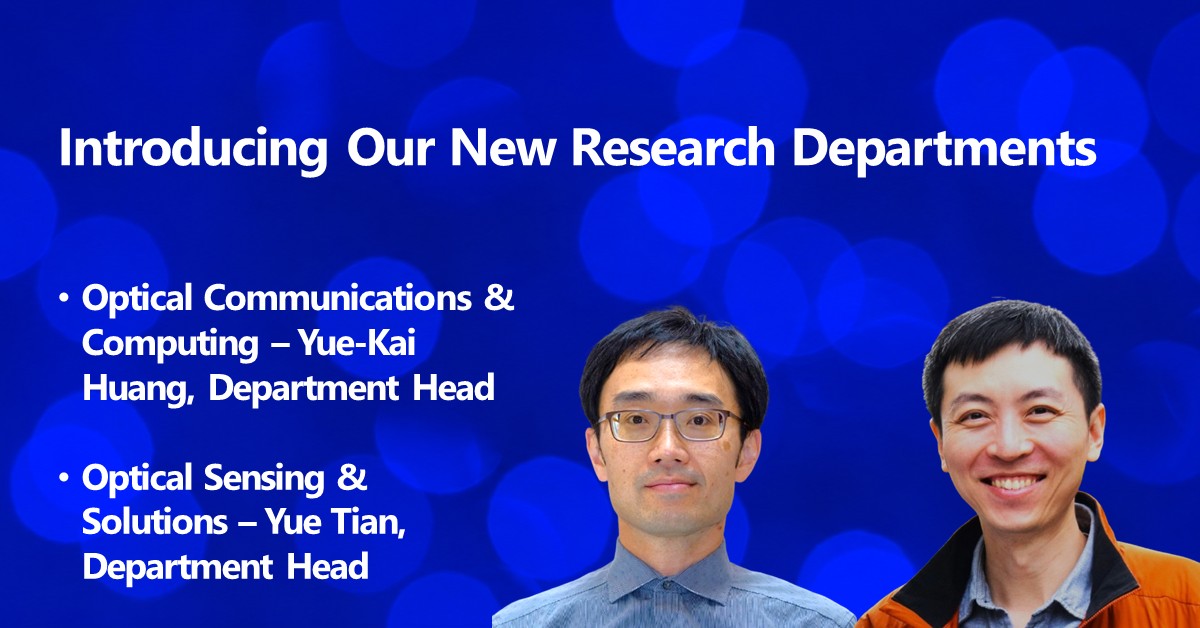 https://www.nec-labs.com/wp-content/uploads/2026/09/OCC-OSS-Blog-Post.jpg
628
1200
NEC Labs America
https://www.nec-labs.com/wp-content/uploads/2025/08/NEC-Laboratories-America-Logo-Aug-2025-2.jpg
NEC Labs America2026-09-01 07:00:042026-09-18 09:42:38NEC Laboratories America Forms Two New Departments: Optical Communications & Computing and Optical Sensing & Solutions
https://www.nec-labs.com/wp-content/uploads/2026/09/OCC-OSS-Blog-Post.jpg
628
1200
NEC Labs America
https://www.nec-labs.com/wp-content/uploads/2025/08/NEC-Laboratories-America-Logo-Aug-2025-2.jpg
NEC Labs America2026-09-01 07:00:042026-09-18 09:42:38NEC Laboratories America Forms Two New Departments: Optical Communications & Computing and Optical Sensing & Solutions https://www.nec-labs.com/wp-content/uploads/2026/08/NEC-Laboratories-America-Researchers-Win-a-2026-Edison-Patent-Award-for-Optical-Fiber-Innovation.jpg
628
1200
NEC Labs America
https://www.nec-labs.com/wp-content/uploads/2025/08/NEC-Laboratories-America-Logo-Aug-2025-2.jpg
NEC Labs America2026-08-20 09:14:182026-08-21 15:16:35NEC Laboratories America Researchers Win a 2026 Edison Patent Award for Optical Fiber Innovation
https://www.nec-labs.com/wp-content/uploads/2026/08/NEC-Laboratories-America-Researchers-Win-a-2026-Edison-Patent-Award-for-Optical-Fiber-Innovation.jpg
628
1200
NEC Labs America
https://www.nec-labs.com/wp-content/uploads/2025/08/NEC-Laboratories-America-Logo-Aug-2025-2.jpg
NEC Labs America2026-08-20 09:14:182026-08-21 15:16:35NEC Laboratories America Researchers Win a 2026 Edison Patent Award for Optical Fiber Innovation