Meet Yue Tian: Leading Optical Sensing and Solutions at NEC Laboratories America
Vast networks of telecom fiber cables already run beneath city streets, along rail lines, across power corridors, and under the sea. Nearly all of this optical fiber carries data.
Very little of it senses the world around it.
Dr. Yue Tian has spent much of his career bridging that gap.
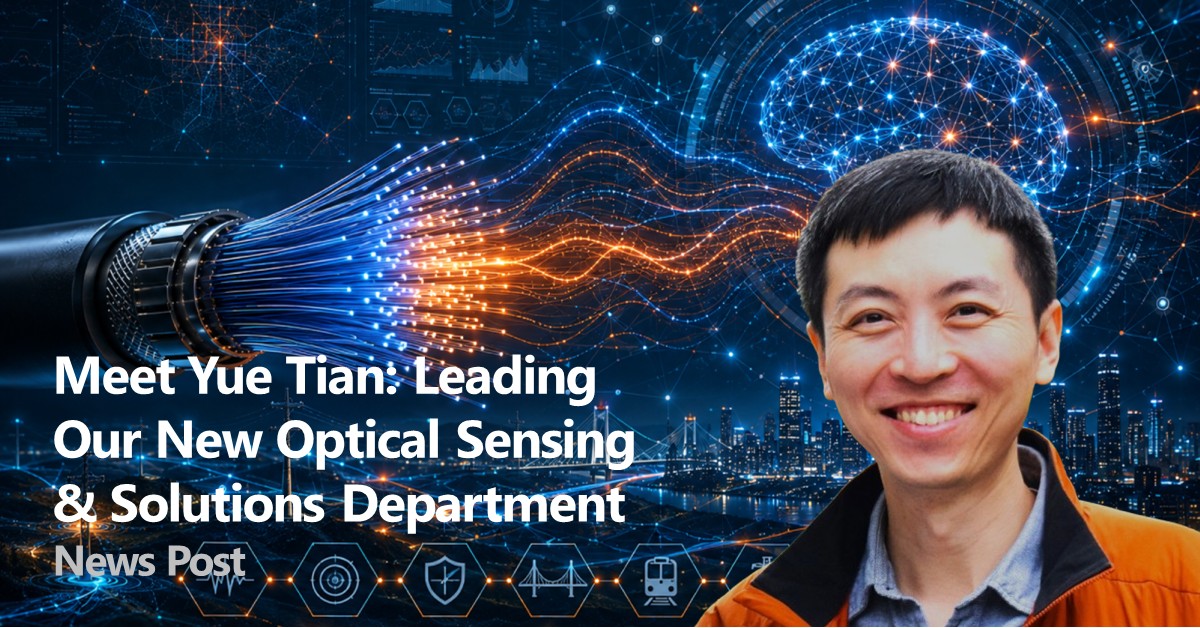
Dr. Yue Tian now leads the new Optical Sensing and Solutions department at NEC Laboratories America.
The department formed on September 1, 2026, when the lab split its Optical Networking and Sensing department into two focused research groups. From early concepts and laboratory validation to real-world field deployments on live infrastructure, the OSS department develops technologies that sense the physical world, transform observations into intelligence, and enable informed action. Building on our expertise in optics and photonics, we are expanding toward multimodal sensing, AI-powered understanding, and intelligent systems that interact with the physical world, while the Optical Communication & Computing department focuses mostly on optical transmission.
This post introduces Dr. Tian, outlines the OSS department’s research initiatives, and places that work within the trends shaping infrastructure monitoring.
A Career Built on Optical Signals and Data
Dr. Tian earned his Ph.D. in electrical engineering from Princeton University. He received his M.S. and B.S. in electrical engineering from Shanghai Jiao Tong University. His research has produced more than 50 publications, over 30 issued and pending patents, and commercialized technologies. It has also drawn support from the U.S. Department of Energy and the National Institutes of Health. His work spans distributed fiber optic sensing, optical gas sensing, fiber communications, and photonic neural networks.
Distributed fiber optic sensing (DFOS) sends pulses of light down a fiber, then analyzes the light scattered back from the glass. Changes in that returning light reveal vibration, strain, and temperature at every point along the cable. A single fiber can act as thousands of sensors spread over tens of kilometers.
Several of Dr. Tian’s projects show the range of this approach. With researchers at the American Museum of Natural History, his team used telecom fiber in Princeton, New Jersey, to monitor the 2021 emergence of Brood X cicadas over several weeks. On the communications side, he co-authored a Nature Electronics paper on a silicon photonic neural network that compensates for signal distortion in long-haul fiber links. A photonic neural network performs AI-style computation with light instead of electronic circuits.
Research Priorities
Our research spans forward-looking theoretical studies, cutting-edge experiments, artificial intelligence, and pioneering field trials. We transform existing infrastructure into dense, real-time sensing platforms that can monitor complex environments over large areas.
The new OSS department is focused on four key research areas:
- Sensing over live telecom networks at city scale. In a recent field deployment, NEC Laboratories America partnered with Verizon to turn live telecom fiber into a city-wide sensing network. The system detected vibrations along fiber routes and helped reduce cable damage incidents. Expect the team to extend this work to more routes, more event types, and tighter integration with network operations.
- Power grid and energy infrastructure. The team has used aerial telecom cables to detect blown fuses on utility poles and localize faults caused by fallen trees, designed sensor placement strategies for resilient grid monitoring, and studied subsea cable exposure caused by seabed scouring offshore wind farms. Each project treats existing fiber as a monitoring layer for critical energy assets.
- AI-powered sensing and intelligent data analytics. Fiber sensing produces enormous data streams, with useful signals often buried in noise. Dr. Tian’s group developed AI models that recognize, localize, and track target objects and events of interest, from potential cable cuts to wrong-way driving cars. The team also built AI-powered acoustic engines that can identify and understand diverse acoustic events captured by fiber sensors both on land and undersea.
- Multimodal sensing. The department charter covers infrared imaging, spectroscopy, radio-frequency spectrum sensing, and AI-enabled sensing analytics. Combining these sources with fiber data gives a more comprehensive picture of an environment than any single sensor. The team has paired fiber sensing data with computer vision models to classify traffic events at a smart intersection.
Industry Trends Shaping the Agenda
Our research follows a broad sense–understand–act vision. We develop optical and distributed fiber sensing technologies that capture physical phenomena; AI methods that interpret complex signals, combine information across sensors, diagnose events, and predict changing conditions; and intelligent solutions that translate these insights into decisions and responses. Looking ahead, we envision extending this foundation beyond optical sensing to multimodal sensing and autonomous systems, including robotics, that can perceive, reason about, and respond to the physical world.
Several trends make this agenda timely:
- Utilities face increasing pressure to detect faults early, especially where damaged lines can spark wildfires. Fiber already strung along utility poles offers a monitoring tool without new sensor hardware at every pole.
- Undersea infrastructure has also drawn new attention. Damage to submarine communications and power cables has disrupted service in several regions in recent years. Operators want to know when ships, anchors, and seabed shifts threaten a cable before it fails.
- Cities want better awareness of traffic, construction, and public safety events. Fiber sensing can cover long routes from a single interrogator unit, keeping hardware costs lower than dense camera networks.
- Telecom operators also want more value from fiber they already own. Sensing services turn passive glass into a new revenue stream and a stronger layer of network protection.
Finally, AI methods for time-series and multimodal data have matured quickly. That progress makes it practical to move from detecting a vibration to understanding its cause, then triggering the right response.
Building on a Strong Foundation
The OSS department carries forward work that Ting Wang, now Department Head Emeritus, helped build at NEC Laboratories America. That work includes early field trials showing telecom fiber could double as a sensing network for cities, power grids, and undersea infrastructure.
Dr. Tian leads a team of ten: Yuheng Chen, Yangmin Ding, Tingfeng Li, Yusuf Elbana, Shuji Murakami, Jian Fang, Junqiang Hu, Ming-Fang Huang, Yaowen Li, and Sarper Ozharar. Their expertise spans electro-optical systems, high-speed signal processing, machine learning, and field deployment.
“The fiber in the ground today can tell us far more than we have asked of it. Our job is to turn those signals into understanding, then into action that keeps infrastructure safe and reliable.” Yue Tian, Department Head, Optical Sensing and Solutions
Follow our Optical Sensing and Solutions Department Page for new publications, field deployments, and conference talks as the team’s agenda takes shape.
Read More Blog Posts
https://www.nec-labs.com/wp-content/uploads/2026/10/Meet-Yue-Tian-Leading-Our-New-Optical-Sensing-Solutions-Department.jpg
628
1200
NEC Labs America
https://www.nec-labs.com/wp-content/uploads/2025/08/NEC-Laboratories-America-Logo-Aug-2025-2.jpg
NEC Labs America2026-10-27 11:16:132026-10-27 11:20:13Meet Yue Tian: Leading Optical Sensing and Solutions at NEC Laboratories America https://www.nec-labs.com/wp-content/uploads/2026/10/Routing-Data-Through-Satellites-That-Never-Stand-Still.jpg
628
1200
NEC Labs America
https://www.nec-labs.com/wp-content/uploads/2025/08/NEC-Laboratories-America-Logo-Aug-2025-2.jpg
NEC Labs America2026-10-22 10:37:392026-10-22 13:58:13Routing Data Through Satellites That Never Stand Still
 https://www.nec-labs.com/wp-content/uploads/2026/10/Apply-for-a-2027-Summer-Internship-1.jpg
628
1200
NEC Labs America
https://www.nec-labs.com/wp-content/uploads/2025/08/NEC-Laboratories-America-Logo-Aug-2025-2.jpg
NEC Labs America2026-10-21 14:48:142026-10-21 15:25:38Apply for a Summer 2027 Internship at NEC Labs America
 https://www.nec-labs.com/wp-content/uploads/2026/10/Updating-What-AI-Knows-Without-Breaking-What-It-Already-Knows.jpg
628
1200
NEC Labs America
https://www.nec-labs.com/wp-content/uploads/2025/08/NEC-Laboratories-America-Logo-Aug-2025-2.jpg
NEC Labs America2026-10-20 14:37:112026-10-20 14:58:26Updating What AI Knows Without Breaking What It Already Knows
 https://www.nec-labs.com/wp-content/uploads/2026/10/Meet-Yue-Kai-Huang-Leading-Our-New-Optical-Communications-Computing-Department.jpg
628
1200
NEC Labs America
https://www.nec-labs.com/wp-content/uploads/2025/08/NEC-Laboratories-America-Logo-Aug-2025-2.jpg
NEC Labs America2026-10-13 10:45:372026-10-22 14:19:18Meet Yue-Kai Huang: Leading Our New Optical Communications & Computing Department
 https://www.nec-labs.com/wp-content/uploads/2026/10/Message-from-Christopher-White.jpg
628
1200
NEC Labs America
https://www.nec-labs.com/wp-content/uploads/2025/08/NEC-Laboratories-America-Logo-Aug-2025-2.jpg
NEC Labs America2026-10-05 16:55:202026-10-05 17:19:59Message from Chris White, New Head of NEC Research & Development
