Christopher White Delivers Keynote at the 2026 MIT Research and Development Conference on November 17th
Christopher White, President of NEC Laboratories America and Corporate Senior Vice President and Managing Director of Global Research & Development at NEC Corporation, will deliver a Day 1 plenary keynote, The Future of R&D: Transforming Scientific Advances into Economic and Societal Impact, at the 2026 MIT Research and Development Conference on November 17, 2026, at 3 p.m.
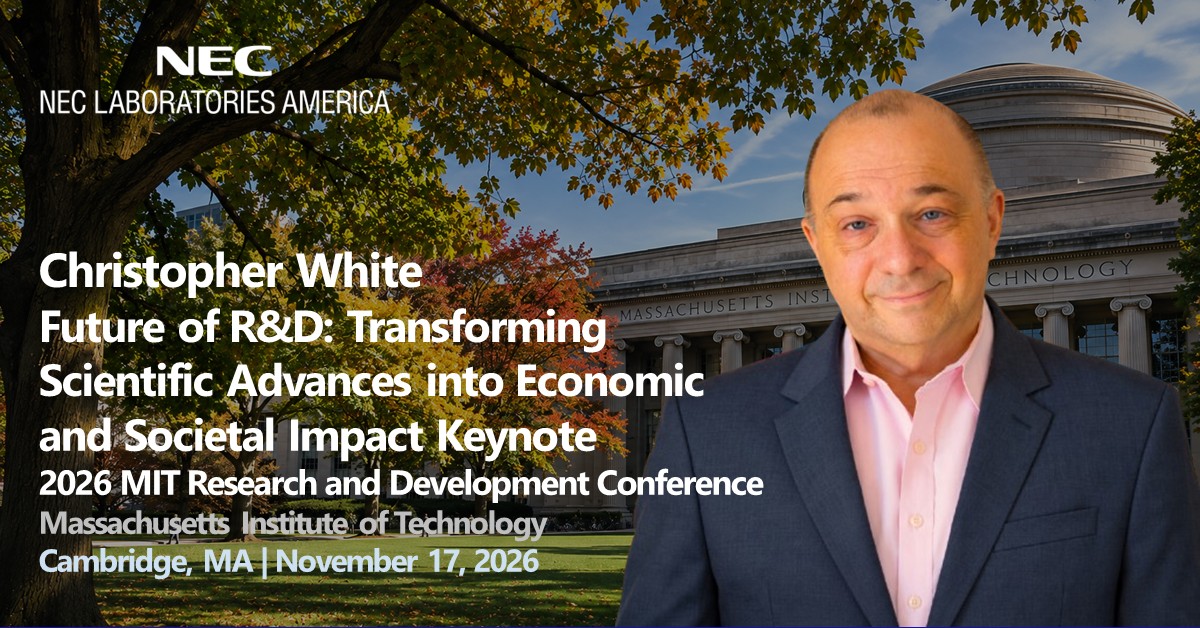
His talk will trace how innovation ecosystems have shifted from the great industrial research laboratories of the twentieth century to today’s investment-driven model, and explain why artificial intelligence may make deep industrial R&D important to corporations once again.
The Future of R&D: Transforming Scientific Advances into Economic and Societal Impact Keynote
Innovation ecosystems are not fixed. They reflect choices about where knowledge is created, how expertise develops, and how scientific advances translate into economic and societal impact.
The great industrial research laboratories of the twentieth century represented one powerful model. Institutions such as Bell Labs combined deep scientific and engineering expertise, long time horizons, experimentation, and direct connection to important industrial problems. Their value was not simply in the inventions they produced, but in the cumulative knowledge they created across disciplines and over time.
In recent decades, the innovation ecosystem has shifted toward external investment as a primary mechanism for selecting and scaling ideas. This can mobilize resources rapidly, but it can also concentrate effort around a relatively small number of prevailing ideas while making sustained investment in broad, deep industrial expertise harder to maintain.
Artificial intelligence may change this balance yet again. As hypotheses, software, designs, simulations, and experiments become increasingly inexpensive to generate, experimentation itself becomes abundant. The scarce capability shifts toward verification and intent: knowing which questions matter, which evidence to trust, and what should come next.
In this environment, industrial R&D may once again become increasingly important as a way for corporations to build and preserve the deep knowledge required to turn abundant experimentation into meaningful impact.
2026 MIT Research and Development Conference
 The 2026 MIT Research and Development Conference, Curiosity on a Mission: Accelerating from Discovery to Real-World Impact, convenes leaders from academia, industry, government, and startups to explore how breakthrough research can be translated into deployed, high-impact systems at unprecedented speed. The program spans policy, defense, construction, artificial intelligence, space systems, and emerging technologies, highlighting both the opportunities and constraints of scaling innovation in complex, real-world environments. Through keynotes, cross-sector panels, and startup showcases, the conference emphasizes the interplay between foundational science, system-level engineering, and institutional frameworks – examining how advances in computation, materials, sensing, and biology are reshaping industries from infrastructure to healthcare.
Our attendees represent a broad cross-section of 200+ organizations worldwide, approximately 30% US-based, 30% Asian, 30% European, and 10% other, typically comprising Fortune 1000 companies and multinational corporations with significant R&D focuses. This audience of 400-450 R&D executives includes our ILP member companies and the broader business community, uniquely positioned to translate cutting-edge research into real-world deployment and meaningful societal and economic impact.
About Christopher White
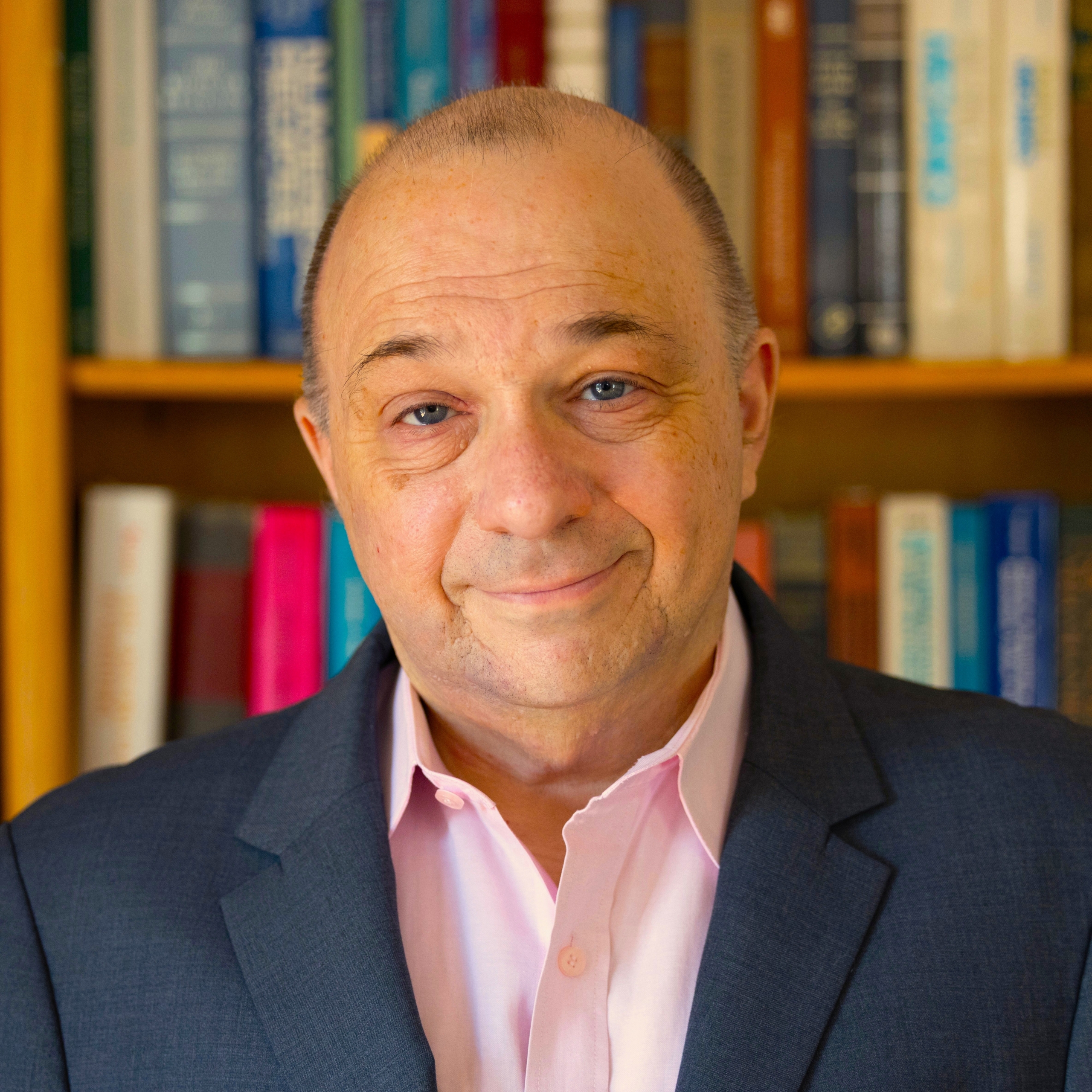 Christopher White has served as Corporate Senior Vice President and Managing Director of Research & Development at NEC Corporation since March 2026, leading NEC’s worldwide R&D strategy across its global network of laboratories in Japan, the United States, Europe, Asia Pacific, China, and Israel. He has also served as President of NEC Laboratories America, Inc. since March 2020, where he leads a team of world-class researchers focused on topics ranging from sensing and networking to machine learning-based understanding.
Chris has extensive expertise in scientific computing, hierarchical simulation techniques, quantum chemistry, optical networks, optical devices, and acoustic scattering. His research interests include developing computational models and methods for simulating and controlling interesting physical and digital systems. This has included work ranging from linear-scaling quantum chemistry simulations to the design of new optical devices, to the global control of transparent optical mesh networks, and to understanding and facilitating the propagation of ideas in organizations. In addition to managing a team of world-class researchers, his current work focuses on creating assisted-thinking tools that leverage structural similarity in data to augment human intelligence.
Prior to his role at NEC Laboratories America, Inc., he spent 22 years working at Nokia Bell Labs, where he led the Algorithms, Analytics, Augmented Intelligence and Devices (AAAID) research lab.
Chris has a Ph.D. in Theoretical Quantum Chemistry from the University of California, Berkeley, and a B.S. and M.S. in Chemistry from Carnegie Mellon University, with a concentration in Computer Science.
Read About Our Future and Past Events
 https://www.nec-labs.com/wp-content/uploads/2026/10/Haifeng-Boulder-Nov-4th-1.jpg
628
1200
NEC Labs America
https://www.nec-labs.com/wp-content/uploads/2025/08/NEC-Laboratories-America-Logo-Aug-2025-2.jpg
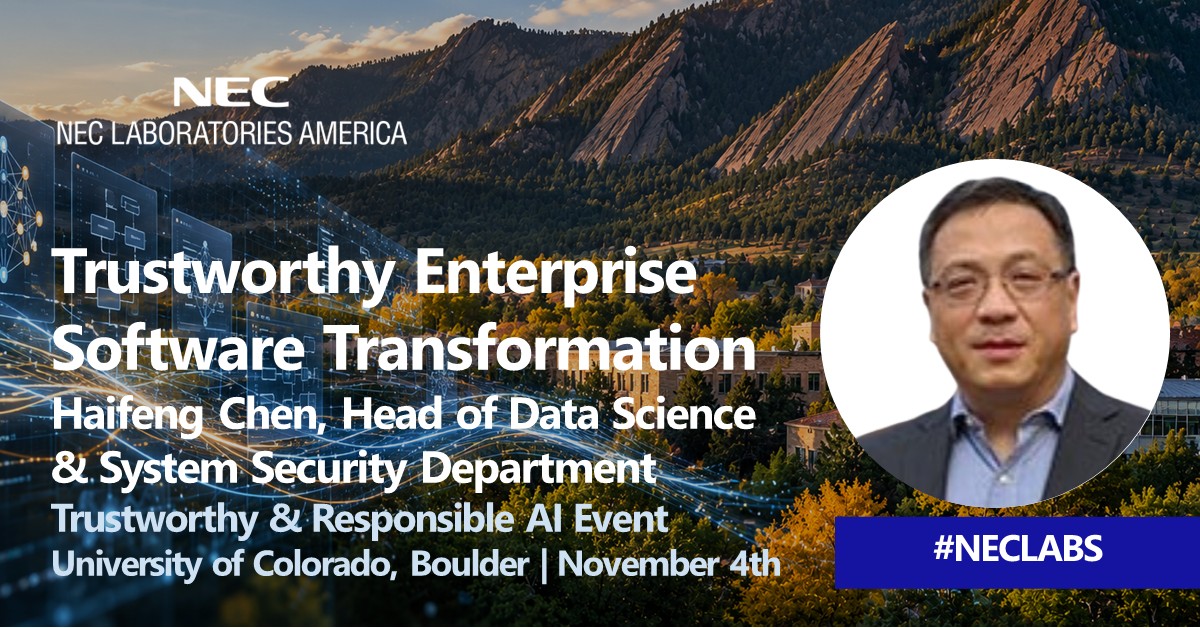
NEC Labs America2026-10-19 14:47:082026-10-20 00:29:36Haifeng Chen Speaks at the Trustworthy & Responsible AI Event at CU Boulder on November 4th
 https://www.nec-labs.com/wp-content/uploads/2026/09/ECOC-2026.jpg
628
1200
NEC Labs America
https://www.nec-labs.com/wp-content/uploads/2025/08/NEC-Laboratories-America-Logo-Aug-2025-2.jpg
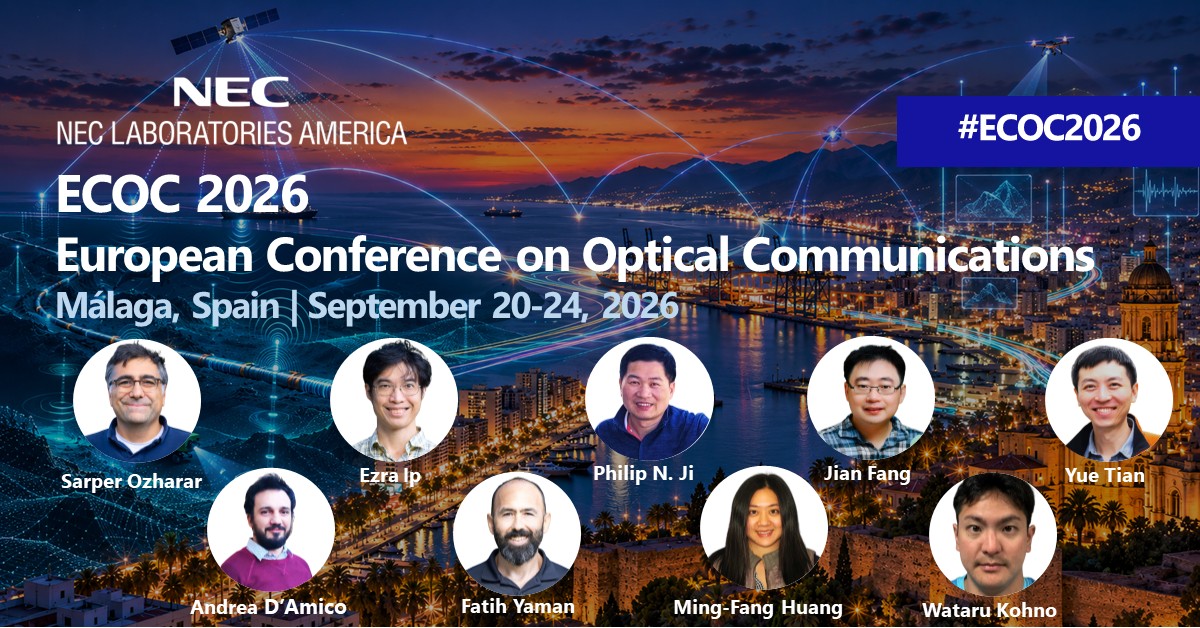
NEC Labs America2026-09-07 14:05:232026-09-07 14:51:52NEC Labs America Presents at ECOC 2026 in Málaga, Spain, September 20-24th
 https://www.nec-labs.com/wp-content/uploads/2026/08/HIPES-2026-1.jpg
628
1200
NEC Labs America
https://www.nec-labs.com/wp-content/uploads/2025/08/NEC-Laboratories-America-Logo-Aug-2025-2.jpg
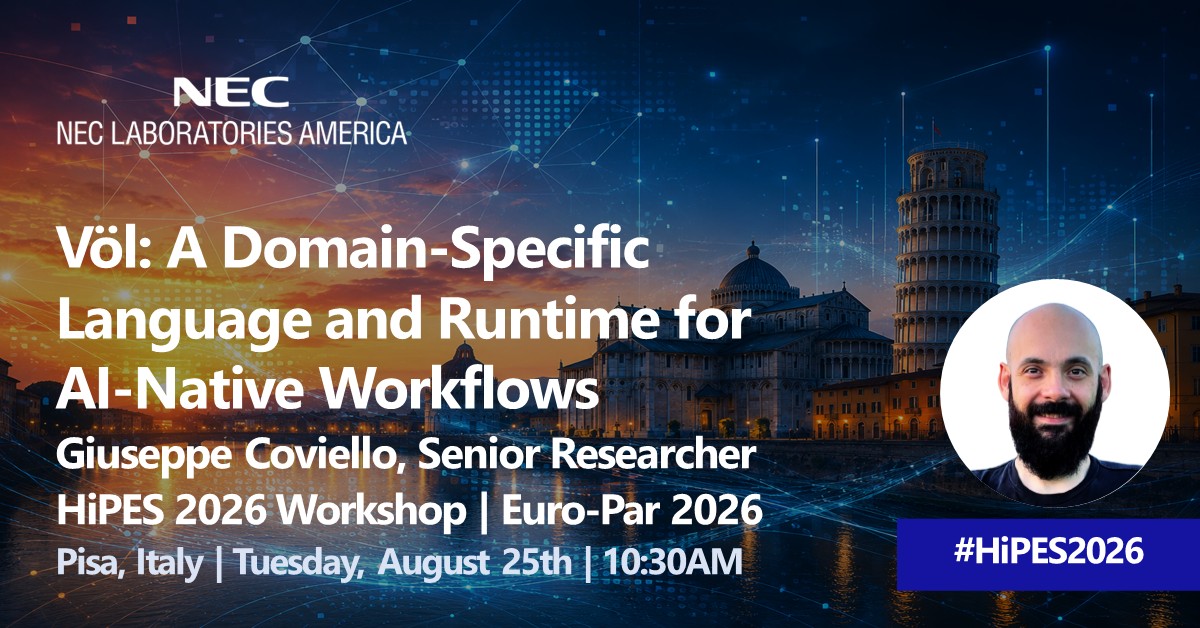
NEC Labs America2026-08-21 14:42:542026-11-06 14:40:56Giuseppe Coviello Presents at HiPES 2026 | Euro-Par in Pisa, Italy on August 25th
 https://www.nec-labs.com/wp-content/uploads/2026/06/ICML-2026-SMM.jpg
628
1200
NEC Labs America
https://www.nec-labs.com/wp-content/uploads/2025/08/NEC-Laboratories-America-Logo-Aug-2025-2.jpg
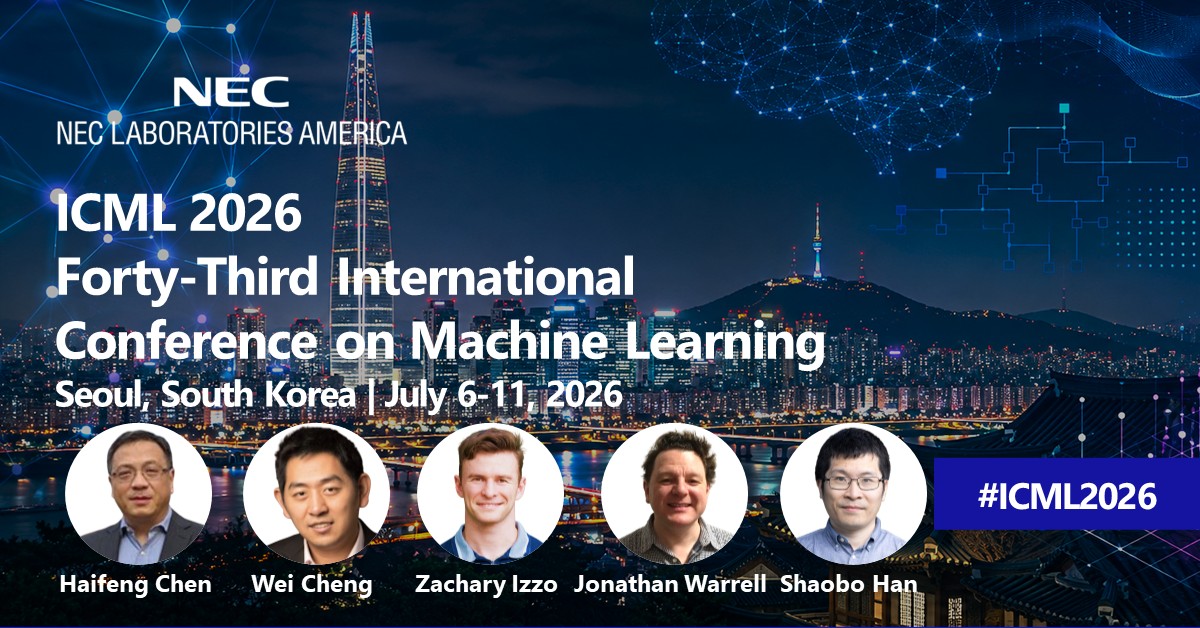
NEC Labs America2026-06-24 16:27:442026-11-06 14:41:32NEC Labs America Attends ICML 2026 Seoul, South Korea July 6-11, 2026
 https://www.nec-labs.com/wp-content/uploads/2026/06/ACL-2026.jpg
628
1200
NEC Labs America
https://www.nec-labs.com/wp-content/uploads/2025/08/NEC-Laboratories-America-Logo-Aug-2025-2.jpg
NEC Labs America2026-06-23 10:44:402026-06-26 13:45:55NEC Labs America Attends ACL 2026 San Diego July 2-7, 2026
 https://www.nec-labs.com/wp-content/uploads/2026/06/OECC-2026-1.jpg
628
1200
NEC Labs America
https://www.nec-labs.com/wp-content/uploads/2025/08/NEC-Laboratories-America-Logo-Aug-2025-2.jpg
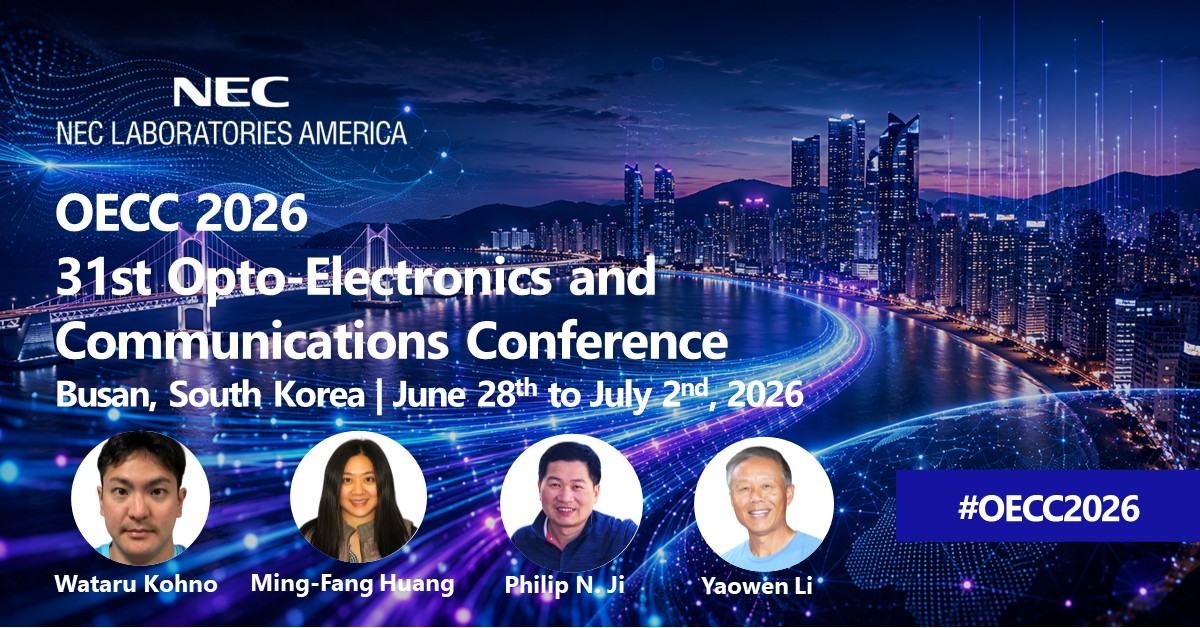
NEC Labs America2026-06-15 08:04:152026-06-22 12:55:21NEC Labs America Attends OECC June 28 – July 2, 2026
 https://www.nec-labs.com/wp-content/uploads/2026/06/CVPR-LATEST.jpg
628
1200
NEC Labs America
https://www.nec-labs.com/wp-content/uploads/2025/08/NEC-Laboratories-America-Logo-Aug-2025-2.jpg
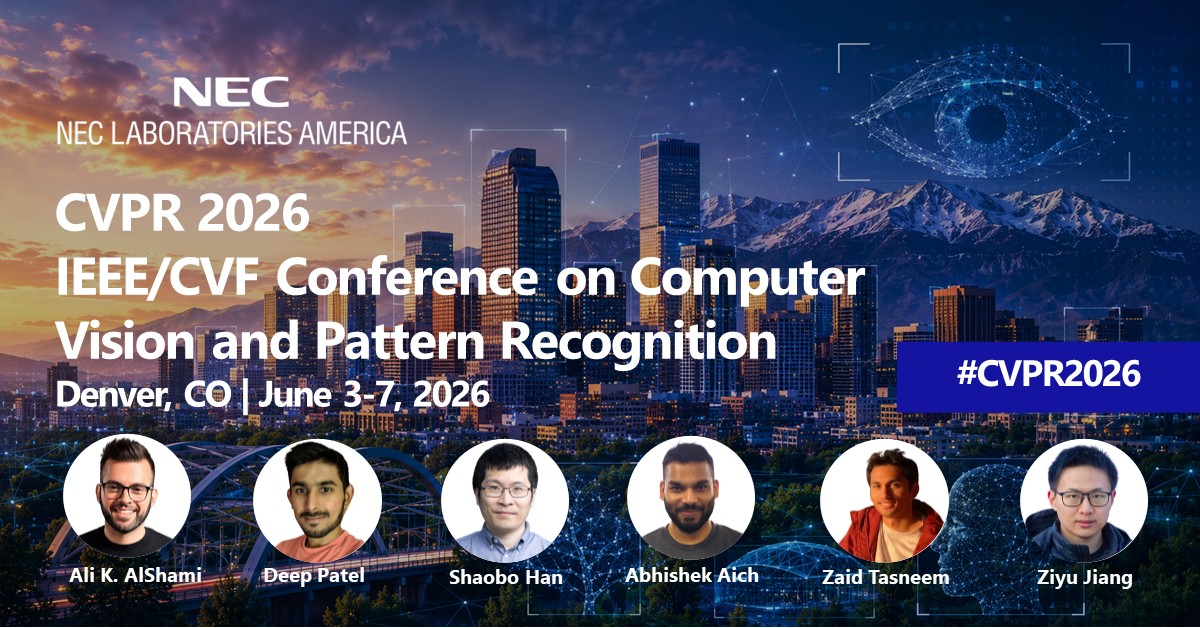
NEC Labs America2026-06-02 07:19:252026-06-26 13:11:51NEC Labs America Attends CVPR 2026 in Denver, CO June 3-7, 2026
 https://www.nec-labs.com/wp-content/uploads/2026/05/CLEO-2026.jpg
628
1200
NEC Labs America
https://www.nec-labs.com/wp-content/uploads/2025/08/NEC-Laboratories-America-Logo-Aug-2025-2.jpg
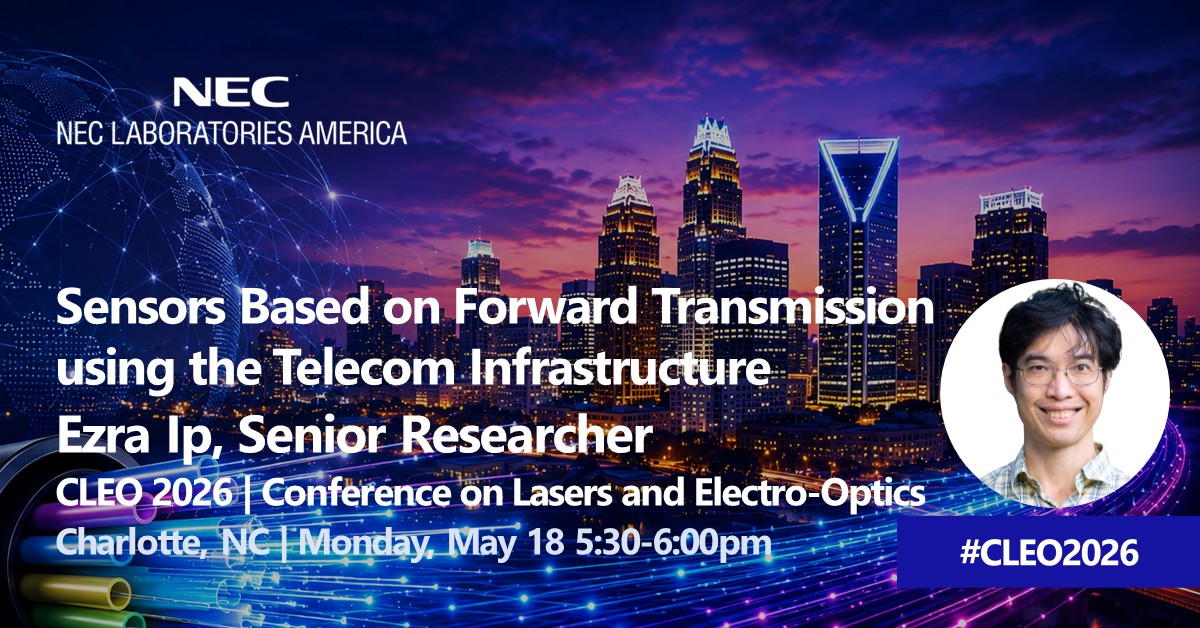
NEC Labs America2026-05-12 14:06:232026-06-02 21:42:07Ezra Ip Presents at CLEO 2026 in Charlotte, NC on May 18th
