NEC Laboratories America

Projects | Open Vocabulary Perception

PROJECTS

Open Vocabulary Perception

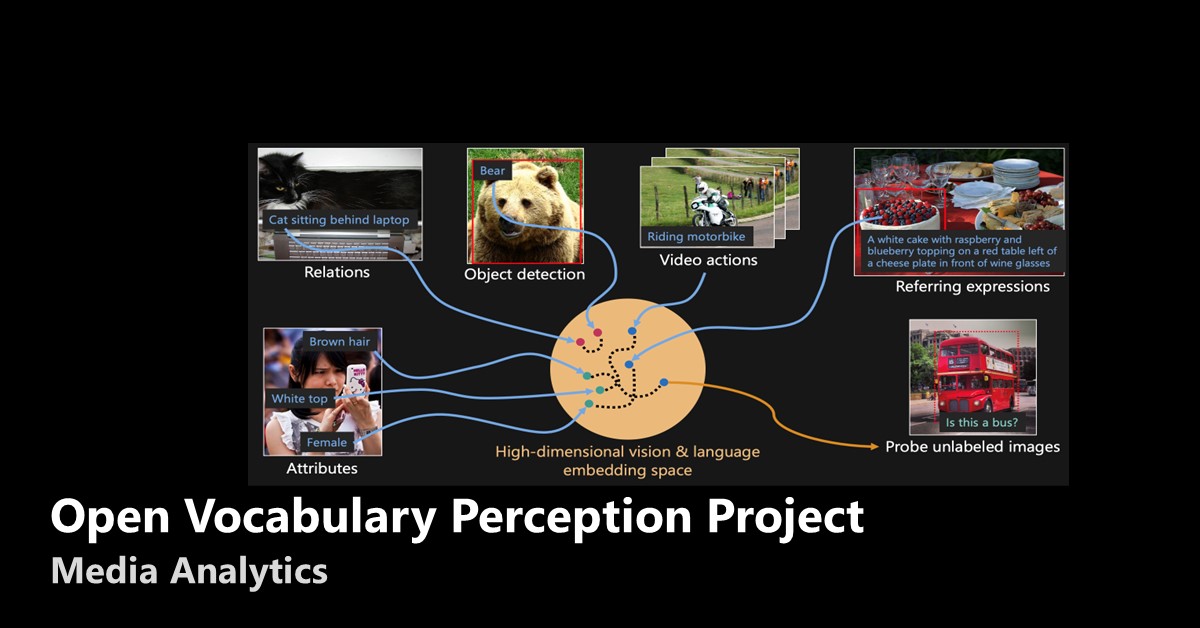
Perception methods such as object detection and image segmentation form a basic building block of most computer vision applications. We develop open vocabulary perception methods that combine the power of vision and language to provide rich descriptions of objects in scenes, including their attributes, behaviors, relations and interactions. Our open vocabulary detectors can even detect objects which have never been seen in training, by mapping visual and language concepts in a shared embedding space. Besides expanding the universality of visual perception, our industry-leading ability to produce rich descriptions allows better decision-making in downstream applications. Our perception methods rely on advances in vision transformers to achieve high accuracy, together with high speed through efficient design choices that allow multi-scale computation while limiting the cost of self-attention.

Team Member: Abhishek Aich, Vijay Kumar BG

Publication Tags: machine learning, computer vision, object detection, language based object detection, open vocabulary

Open Vocabulary Perception Project

Featured Publications

Taming Self-Training for Open-Vocabulary Object Detection

Recent studies have shown promising performance in open-vocabulary object detection (OVD) by utilizing pseudo labels (PLs) from pretrained vision and language models (VLMs). However, teacher-student self-training, a powerful and widely used paradigm to leverage PLs, is rarely explored for OVD.

Generating Enhanced Negatives for Training Language-Based Object Detectors

The recent progress in language-based open-vocabulary object detection can be largely attributed to finding better ways of leveraging large-scale data with free-form text annotations. Training such models with a discriminative objective function has proven successful, but requires good positive and negative

OmniLabel: A Challenging Benchmark for Language-Based Object Detection

Language-based object detection is a promising direction towards building a natural interface to describe objects in images that goes far beyond plain category names. While recent methods show great progress in that direction, proper evaluation is lacking. With OmniLabel, we propose a novel task definition,

Exploiting Unlabeled Data with Vision and Language Models for Object Detection

Building robust and generic object detection frameworks requires scaling to larger label spaces and bigger training datasets. However, it is prohibitively costly to acquire annotations for thousands of categories at a large scale. We propose a novel method that leverages the rich semantics available

Learning Semantic Segmentation from Multiple Datasets with Label Shifts

While it is desirable to train segmentation models on an aggregation of multiple datasets, a major challenge is that the label space of each dataset may be in conflict with one another. To tackle this challenge, we propose UniSeg, an effective and model-agnostic approach to automatically train segmentation

MM-TTA: Multi-Modal Test-Time Adaptation for 3D Semantic Segmentation

Test-time adaptation approaches have recently emerged as a practical solution for handling domain shift without access to the source domain data. In this paper, we propose and explore a new multi-modal extension of test-time adaptation for 3D semantic segmentation. We find that, directly applying existing

Domain Adaptive Semantic Segmentation using Weak Labels

We propose a novel framework for domain adaptation in semantic segmentation with image-level weak labels in the target domain. The weak labels may be obtained based on a model prediction for unsupervised domain adaptation (UDA), or from a human oracle in a new weakly-supervised domain adaptation (WDA)

Object Detection with a Unified Label Space from Multiple Datasets

Given multiple datasets with different label spaces, the goal of this work is to train a single object detector predicting over the union of all the label spaces. The practical benefits of such an object detector are obvious and significant—application-relevant categories can be picked and merged form

Memory Warps for Long-Term Online Video Representations and Anticipation

We propose a novel memory-based online video representation that is efficient, accurate and predictive. This is in contrast to prior works that often rely on computationally heavy 3D convolutions, ignore motion when aligning features over time, or operate in an off-line mode to utilize future frames.

Learning to Adapt Structured Output Space for Semantic Segmentation

Convolutional neural network-based approaches for semantic segmentation rely on supervision with pixel-level ground truth, but may not generalize well to unseen image domains. As the labeling process is tedious and labor intensive, developing algorithms that can adapt source ground truth labels to the

Learning random-walk label propagation for weakly-supervised semantic segmentation

Large-scale training for semantic segmentation is challenging due to the expense of obtaining training data for this task relative to other vision tasks. We propose a novel training approach to address this difficulty. Given cheaply-obtained sparse image labelings, we propagate the sparse labels to produce