NEC Laboratories America

Projects | AI for Space

AI for Space

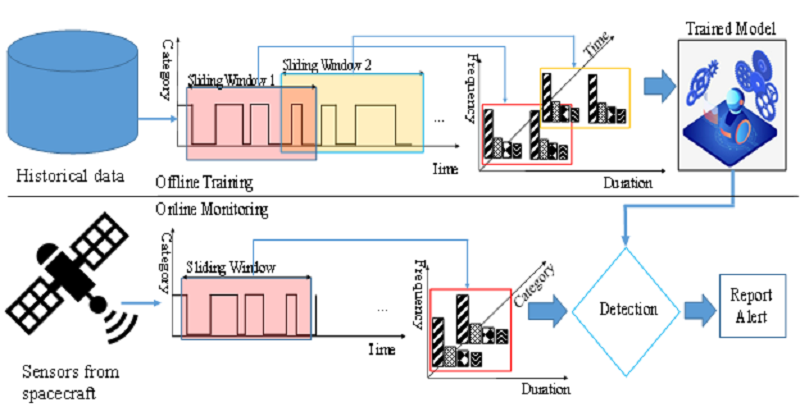
From planetary image analysis to spacecraft monitoring, AI is becoming an increasingly important tool in space exploration and development. Our AI-powered monitoring solution will perform intricate checks to ensure the spacecraft and satellites operate correctly during the production and operation phases.

The spacecraft and satellites install a large number of sensors to monitor the system and operation environment. In real applications, many sensors report categorical values rather than numerical readings. Unfortunately, most existing monitoring methods are designed only for numerical sensors and cannot be used on categorical sensors. In this project, we focus on designing and developing an efficient and effective AI-based engine to monitor numerical and categorical sensor data on spacecraft and satellites.

In addition to new engine development for spacecraft and satellites, we also focus on building AI-based solutions for other space systems and exploration tasks with our customers, including applications for drones, UAVs, autonomic driving and navigation, etc.
Read Our Related Publications

NEC Labs America Attends OECC June 28 – July 2, 2026

NEC Laboratories America is proud to participate in OECC 2026, the 31st Opto-Electronics and Communications Conference, taking place in Busan, South Korea. We look forward to connecting with the international photonics and communications community and sharing the work we’re doing to shape the next generation

NEC Labs America Attends CVPR 2026 in Denver, CO June 3-7, 2026

NEC Labs America headed to Denver for CVPR 2026, one of the most prestigious gatherings in computer vision, machine learning, and pattern recognition. The IEEE/CVF Conference on Computer Vision and Pattern Recognition brought innovators from around the world to share breakthroughs.

Making Video AI Fast Enough for the Real World

State-of-the-art video models are accurate but too slow for live deployment. This work transfers their knowledge into causal streaming models that process video frames in real time, achieving 4x lower latency with competitive accuracy across action detection and pedestrian intent tasks.

How Our AI Contributed to NASA’s Artemis Missions

NEC Laboratories America’s AI research played a role in NASA’s Artemis missions, helping analyze complex spacecraft data at scale. Our System Invariant Analysis Technology enables faster insights, improved anomaly detection, and greater confidence in mission readiness for deep space exploration.

Beyond Explainability: How We Are Redefining Interpretability in AI

AI interpretability has long been the focus, but what if it’s only part of the story? New research introduces model semantics, a framework for understanding what AI systems truly represent and how their internal structures connect to real-world phenomena.

Influential NEC Researchers in the United States Who Helped Shape Modern Computing

Many pioneers of modern artificial intelligence and machine learning spent part of their careers at NEC research labs in the United States. Researchers such as Yann LeCun, Vladimir Vapnik, Léon Bottou, Corinna Cortes, and others contributed foundational ideas in deep learning, statistical learning theory,

NeurIPS 2025 in San Diego from Nov 30th to Dec 5th, 2025

NEC Laboratories America is heading to San Diego for NeurIPS 2025, where our researchers will present cutting-edge work spanning optimization, AI systems, language modeling, and trustworthy machine learning. multi-agent coordination, scalable training, efficient inference, and techniques for detecting

Scalable Photonic Neurons for High-speed Automatic Modulation Classification

Automatic modulation classification (AMC) is becoming increasingly critical in the context of growing demands for ultra-wideband, low-latency signal intelligence in 5G/6G systems, with photonics addressing the bandwidth and real-time adaptability limitations faced by traditional radio-frequency (RF)

Graph Neural Networks, Explained: Our Role in the Future of AI

NEC Laboratories America (NECLA) is advancing the frontier of Graph Neural Networks (GNNs), a transformative AI technology that processes complex, interconnected data. Through innovations like PTDNet for robust learning, novel frameworks for explainability, StrGNN for anomaly detection in dynamic graphs,

Shaping the Future with Responsible AI, Collaboration, and Disruption

Chris White, President of NEC Laboratories America, reflects on the lab’s mission to build responsible, human-centered technology—from AI to streetscape innovation—that tackles real-world challenges. In recent keynotes and interviews, he’s emphasized the power of collaboration, the importance

NEC Labs America Attends the 39th Annual AAAI Conference on Artificial Intelligence #AAAI25

Our NEC Lab America team attended the Thirty-Ninth AAAI Conference on Artificial Intelligence (AAAI-25), in Philadelphia, Pennsylvania at the Pennsylvania Convention Center from February 25 to March 4, 2025. The purpose of the AAAI conference series was to promote research in AI and foster scientific

NEC Labs America Team Attends NeurIPS24 in Vancouver

NEC Labs America is proud to attend NeurIPS 2024 in Vancouver, Canada from December 10-15. Zachary Izzo will present Subgroup Discovery with the Cox Model, Shaobo Han will present VB-LoRA: Extreme Parameter Efficient Fine-Tuning with Vector Banks and Jonathan Warrell will present Discrete-Continuous

Introducing the Trustworthy Generative AI Project: Pioneering the Future of Compositional Generation and Reasoning

We are thrilled to announce the launch of our latest research initiative, the Trustworthy Generative AI Project. This ambitious project is set to revolutionize how we interact with multimodal content by developing cutting-edge generative models capable of compositional generation and reasoning across

The Evolution of Disciplines: From Experimental Roots to Theoretical Frameworks

Chris White discusses the evolution of scientific disciplines, which often begin with exploration driven by curiosity and experimentation. As fields grow in complexity and cost, they shift to theoretical frameworks that optimize research. This transition is crucial for sustainable progress. Currently,

Evaluating Cellularity Estimation Methods: Comparing AI Counting with Pathologists’ Visual Estimates

The development of next-generation sequencing (NGS) has enabled the discovery of cancer-specific driver gene alternations, making precision medicine possible. However, accurategenetic testing requires a sufficient amount of tumor cells in the specimen. The evaluation of tumor content ratio (TCR) from

NEC Laboratories Advances Material Design with AI-based MateriAI Platform

NEC Laboratories Europe and NEC Laboratories America have developed MateriAI, an AI-based, material design platform that accelerates the development of new, environmentally friendly materials. The prototype platform was initially designed to overcome major hurdles in the creation of new synthetic, organic

Citizen Science for the Sea with Information Technologies: An Open Platform for Gathering Marine Data and Marine Litter Detection from Leisure Boat Instruments

Data crowdsourcing is an increasingly pervasive and lifestyle-changing technology due to the flywheel effect that results from the interaction between the Internet of Things and Cloud Computing. This paper presents the Citizen Science for the Sea with Information Technologies (C4Sea-IT) framework. It

AI/Fiber-Optic Combo Poised To Improve Telecommunications

Existing underground fiber-optic telecommunications cable networks that can be accessed through street manholes are helping a team at NEC Labs America improve wireless communications systems and the Internet of Things (IoT). “Hundreds of millions of fiber-optic cables are already there for communications

A New Hope: AI Research is Conquering Today’s Computer Vision Plateau

The age of computer vision is upon us, and it’s transforming the way we live, work and interact with the world. Nearly every industry has found a use case to grow revenue, reduce cost, or create exceptional experiences using computer vision. From self-driving cars to retail automation, surgeons to

Using AI To Safely Put The First Woman On The Moon

We are helping to safely bring the first woman astronaut to the moon as part of NASA – National Aeronautics and Space Administration’s Artemis Project with our System Invariant Analysis Technology (SIAT). With Lockheed Martin Space’s T-Tauri AI platform, our SIAT analytics engine takes the data from

Our AI Research Contributing to NASA’s Artemis Space Program

By 2024, the spacecraft “Orion” developed by Lockheed Martin will bring humans to the moon in NASA’s Artemis program. The system invariant analysis technology, one of NEC’s Artificial Intelligence technologies, will perform checks to ensure that the spacecraft is tested and operating properly during

NEC Provides AI-Based Traffic Monitoring System with Fiber-Optic Sensing Technology for NEXCO CENTRAL

NEC Corporation has deployed an AI-based traffic monitoring system to Central Nippon Expressway Company Limited (NEXCO CENTRAL). The system uses fiber-optic sensing and AI technologies to visualize traffic conditions, such as the location, speed, and direction of travel, from vibrations produced by vehicle

AI-Driven Applications over Telecom Networks by Distributed Fiber Optic Sensing Technologies

By employing distributed fiber optic sensing (DFOS) technologies, field deployed fiber cables can be utilized as not only communication media for data transmissions but also sensing media for continuously monitoring of the physical phenomenon along the entire route. The fiber can be used to monitor ambient

Employing Telecom Fiber Cables as Sensing Media for Road Traffic Applications

Distributed fiber optic sensing systems (DFOS) allow deployed fiber cables to be sensing media, not only dedicated function of data transmission. The fiber cable can monitor the ambient environment over wide area for many applications. We review recent field trial results, and show how artificial intelligence

Optical Fiber Sensing Technology Visualizing the Real World via Network Infrastructures – AI technologies for traffic monitoring

Optical fibers have a sensing function that captures environmental changes around the fiber cable. According to the recent technology evolution of optical transmission and AI, the application of the fiber sensing has expanded and visualization accuracy has improved. We have proposed to monitor the traffic

Coordination of PV Smart Inverters Using Deep Reinforcement Learning for Grid Voltage Regulation

Increasing adoption of solar photovoltaic (PV) presents new challenges to modern power grid due to its variable and intermittent nature. Fluctuating outputs from PV generation can cause the grid violating voltage operation limits. PV smart inverters (SIs) provide a fast-response method to regulate voltage

Neuron-Network-based Nonlinearity Compensation Algorithm

A simplified, system-agnostic NLC algorithm based on a neuron network is proposed to pre-distort symbols at transmitter side to demonstrate ~0.6dB Q improvement after 2800km SMF transmission using 32Gbaud DP-16QAM.

Evolution from 8QAM live traffic to PCS 64-QAM with Neural-Network Based Nonlinearity Compensation on 11000 km Open Subsea Cable

We report on the evolution of the longest segment of FASTER cable at 11,017 km, with 8QAM transponders at 4b/s/Hz spectral efficiency (SE) in service. With offline testing, 6 b/s/Hz is further demonstrated using probabilistically shaped 64QAM, and a novel, low complexity nonlinearity compensation technique