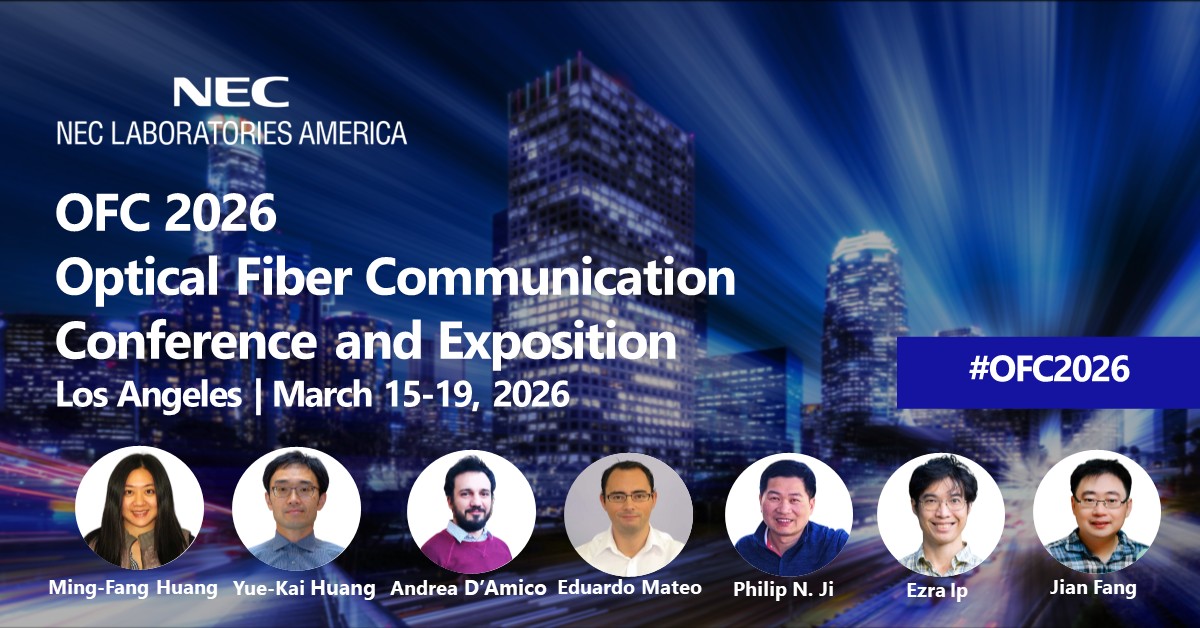
NEC Labs America Attending OFC 2026 Los Angeles, March 15-19
Our Optical Networking & Sensing (ONS) team from NEC Laboratories America will be participating in the Optical Fiber Communication Conference and Exposition (OFC) 2026, one of the world’s leading events for optical networking, communications, and photonics innovation. This year’s event will take place March 15–19, 2026, at the Los Angeles Convention Center.
OFC brings together researchers, industry leaders, and technology innovators to explore the future of high-speed optical systems and next-generation network infrastructure.
This year, our researchers are helping shape key conversations across optical sensing, multicore fiber ecosystems, fiber sensing and network visibility, and advanced optical communication system design. Through presentations, tutorials and deep-dive courses, the ONS team will share insights that bridge foundational research with real-world applications, highlighting how optical technologies continue to evolve beyond traditional telecom to support broader industry needs.
Presentations
Field Study on Phase and Polarization Dynamics of Deployed Anti-Resonant Hollow Core Fiber Cable for Vibration Sensing

- Jian Fang, NEC Laboratories America Inc., United States (Speaker)
- Session: M2J.4
- Monday, March 16th 11:30 – 11:45
- Room 515B
We report the first field study of the phase and polarization dynamics of deployed anti-resonant hollow core fiber cable in a data center interconnect for real-world vibration sensing, revealing enhanced phase sensitivity and significantly faster polarization angular rate compared with standard single mode fibers.
Authors: Jian Fang, NEC Laboratories America Inc. / Ming-Fang Huang, NEC Laboratories America Inc. / Scott Kotrla, Verizon Communications Inc / Jeffrey Mundt, Verizon Communications Inc / Ting Wang, NEC Laboratories America Inc. / Yoshiaki Aono, NEC Corporation
Learn more: https://www.ofcconference.org/schedule#/Monday/531314
Fiber Optics Sensing: Technology & Applications

- Ezra Ip, NEC Labs America, United States (Speaker)
- Session: M3J.5
- Monday, March 16th 15:00 – 16:00
- Room 515B
Authors: Ezra Ip, NEC Laboratories America Inc. / Yue-Kai Huang, NEC Laboratories America Inc. / Fatih Yaman, NEC Laboratories America Inc. / Junqiang Hu, NEC Laboratories America Inc. / Ming-Fang Huang, NEC Laboratories America Inc. / Shaobo Han, NEC Laboratories America Inc. / Jian Fang, NEC Laboratories America Inc. / Tingfeng Li, NEC Laboratories America Inc. / Sarper Ozharar, NEC Laboratories America Inc. / Yoshiaki Aono, NEC Corporation / Koji Asahi, NEC Corporation / Ting Wang, NEC Laboratories America Inc.
Learn more: https://www.ofcconference.org/schedule#/Monday/531326
Mobile Orbital Domain-Based Hierarchical Routing in Satellite Networks

- Philip N. Ji, NEC Laboratories America Inc., United States (Speaker)
- Session: Tu3F.3
- Tuesday, March 17th 17:00 – 17:15
- Room 501ABC
We propose a mobile orbital domain-based hierarchical routing scheme which addresses the challenges posed by constant satellite movement and the resulting dynamic network topology, thus significantly improving the routing scalability and efficiency in satellite networks.
Authors:Zilong Ye, NEC Laboratories America Inc / Philip Ji, NEC Laboratories America Inc / Deniz Bajin, Pomona College / Connor Wang, Pomona College / Yunxuan Wang, Pomona College / Ting Wang, NEC Laboratories America Inc
Learn more: https://www.ofcconference.org/schedule#/Tuesday/531342
Frequency-Division Multiplexed Time-Interleaved Phase-OTDR With Nested Phase References
- Ezra Ip, NEC Labs America, United States (Speaker)
- Session: W3D.2
- Wednesday, March 18th 14:30 – 14:45
- Room 408B
We propose a method to compensate for the phase offset between samples from different tributaries in a time-interleaved phase OTDR using nested phase-reference channels. We demonstrate our method for a four-span bidirectional link with high-loss loopback.
Authors:Ezra Ip, NEC Laboratories America Inc. / Yue-Kai Huang, NEC Laboratories America Inc. / Fatih Yaman, NEC Laboratories America Inc. / Junqiang Hu, NEC Laboratories America Inc. / Ting Wang, NEC Laboratories America Inc.
Learn more: https://www.ofcconference.org/schedule#/Wednesday/531385
Tutorials & Classes
Optical Sensing as a Service on Transceiver and Fiber Systems: Catering to More than just Telecom Industry


- Ming-Fang Huang, NEC Laboratories America Inc., United States (Organizer)
- Yue-Kai Huang, NEC Laboratories America Inc., United States (Speaker)
- Thursday, March 19th 14:00 – 16:00
- Room 502A
Joint optical sensing and communication technologies have received extensive attention due to fiber utilization maximization and cost-effectiveness enhancement. However, several challenges remain in realizing Optical Sensing as a Service (OSaaS), including the translation of technologies into practical applications, the need for standardization, and the alignment of interests between operators and vendors.
OSaaS facilitates the intelligent operation of optical networks, thereby improving network resilience and availability. The standardization organizations are also actively promoting fiber-optic systems with sensor capabilities, such as SMART CABLE. In addition, the emerging DSP-based sensing eliminates the range limitation of backscattering-based technologies. This technology provides opportunities for device vendors to develop innovative products and expand market reach. Beyond telecommunication applications, OSaaS can expedite intensive acquisition of sensor data and foster innovation of new applications in diverse fields, such as environmental and civil infrastructure monitoring. This effectively revitalizes existing optical fiber assets by creating a revenue stream.
Therefore, this panel aims to show the OSaaS prospects of a) transformations from technologies into applications or products, b) deployments and verifications, and c) standardization activities.
The key questions to address in this panel are:
- What are the key application areas that suit a particular sensing technique?
- Can hybridization of sensing technologies help address blind spots or trade-offs?
- What are the challenges, opportunities and valuable use cases of deploying OSaaS?
- How to coordinate sensing paradigms with AI-assisted operations (e.g., digital twins, LLM, autonomous driving networks, etc.), incl. data interpretations and system requirements?
- What role will standards and interoperability play in adoption and deployment?
- Who will primarily invest in OSaaS, and what will the landscape look like in 5-10 years?
Is the Ecosystem Ready for Multicore Fibers?


- Andrea D’Amico, NEC Laboratories America Inc., United States (Organizer)
- Eduardo Mateo, NEC, Japan (Speaker)
- Wednesday, March 18th 16:30 – 18:30
- Room 502A
The exponential rise in global data traffic from cloud computing, IoT, AI, and 5G is straining single‑core optical fiber networks to their physical and economic limits. Multicore fiber (MCF) technology offers a viable path to boost capacity, efficiency, and scalability in the telecom ecosystem. Worldwide field trials have demonstrated MCF’s capabilities, supported by advances in fan‑in/fan‑out devices for backward compatibility, multicore transceivers, connectors, and amplifiers. These developments make MCF attractive for data centers and backbone networks, yet challenges persist. The lack of unified global standards hampers design interoperability and infrastructure integration, while technical hurdles in splicing and fan‑in/fan‑out devices complicate single‑core interconnection. High costs for new components and transitioning from legacy systems further slow adoption. Overcoming these barriers will require coordinated industry action to refine manufacturing, ensure interoperability, and strengthen the business case. This panel convenes experts from industry, academia, and standards bodies to evaluate MCF readiness and chart deployment pathways.
The key questions to address in this panel are:
- Which applications (submarine cables, data centers, metro/backbone) are most ready for MCF adoption?
- How mature are the manufacturing processes for MCFs and related components, and what are the bottlenecks?
- What are the challenges in retrofitting or co-deploying legacy fibers and MCFs?
- What is the business case for MCF versus simply increasing the number of single-core fibers?
- How will MCF adoption reshape the competitive landscape for network operators and vendors?
- What is the current state of global standardization efforts across the product spectrum: fibers, connectors, amplifiers, and measurement equipment?
- How can public-private partnerships, research consortia, and policymakers support the transition?
- What are the next milestones for ecosystem readiness?
- What are the latest results from commercial pilots and large-scale trials/testbeds?
Learn more: https://www.ofcconference.org/program/special-events/panel-is-the-ecosystem-ready-for-multicore-fibers/
Toward Holistic Network and Environment Visibility: Are Fiber Sensing and Tomography Ready to Deliver in Real Networks?
- Ming-Fang Huang, NEC Laboratories America Inc., United States (Organizer)
- Philip N. Ji, NEC Laboratories America Inc., United States (Speaker)
- Sunday, March 15th 13:00 – 15:30
- Room 408A
As the demand for resilient, intelligent, and perceptual optical infrastructure continues to grow, fiber sensing and in-service network tomography are emerging as a promising path toward achieving comprehensive visibility—not only of the fiber network itself, but also of the physical environments it traverses. Fiber sensing technologies have demonstrated the ability to detect seismic activity, temperature variations, and acoustic signals over long distances, enabling possibilities for dual-purpose infrastructure that supports both high-speed data transmission and real-time environmental monitoring. At the same time, coherent-DSP-based link tomography is redefining how we observe and manage in-service fiber networks, offering new means for monitoring distributed link parameters, diagnosing performance of networks, detecting localized impairments—all without deploying intrusive hardware.
While both fiber sensing and link tomography have demonstrated impressive capabilities in field trials and demos, the question remains: are they ready to meet the demands of real, heterogeneous, and large-scale networks? This workshop will explore the technical maturity, practical feasibility, and deployment potential of fiber sensing and tomography technologies and assess whether these advanced monitoring techniques are academic curiosities or true game-changers in the way we use optical networks.
The key questions to address in this workshop are:
- What are the current limitations and readiness levels of fiber sensing and tomography technologies for real-world deployment?
- Can fiber sensing and tomography provide actionable insights and use cases for network operators?
- In what ways does tomography complement or overlap with traditional monitoring systems such as OTDR or optical channel monitor (OCM)?
- How are early signs of standardization, commercialization, or network integration beginning to emerge?
400, 800Gb/s and Beyond Optical Communications Systems: Design and Design Trade-offs (Course)
- Ezra Ip, NEC Labs America, United States (Instructor)
- Sunday, March 15th 08:30 – 12:30
- Short Course Level: Advanced Beginner
Short Course Description
The increasing demand for data and video-intensive content and the adoption of cloud services are driving the need for ever-increasing capacity in service providers’ backbone and metro networks, while also creating the need for high-speed interconnect of hyper-scale data centers. To meet the growing demand for bandwidth, communication and content service providers are deploying 100Gb/s and 200Gb/s throughout their networks today and are increasingly planning to deploy even higher speeds, such as 400Gb/s and beyond, on shorter, high-capacity links. We are also seeing a trend toward flex-rate systems where transmission speeds and capacity can be optimized for a given fiber distance.
The first part of this course provides an overview of the drivers and applications of 400Gb/s and beyond optical systems in data center and service provider networks. It describes the requirements and expectations network operators will have on cost, power consumption, footprint, reliability, optical performance, and interoperability. We present practical design issues of 400Gb/s systems in long-haul, metro and data center networks, and we critically review the availability and performance of the key building blocks. In particular, we discuss the technologies needed to implement different modulation formats, and the corresponding trade-off between complexity/cost of different implementations and the achievable fiber transmission distance. We also look at future bit rates and technologies beyond 400Gb/s, including super-channel, flex-rate, and highly parallel short reach systems.
Short Course Benefits
This course should enable you to:
- Identify key requirements and drivers for 400Gb/s applications
- Understand key building blocks of coherent systems
- Understand digital signal processing algorithms in coherent systems
- Discuss non-coherent alternative solutions in short-reach systems
- Describe the availability and performance of 400Gb/s.
- Discuss 400Gb/s transmission limitations
- Understand 400Gb/s data center networks
- Summarize 400Gb/s standards activities
- Describe drivers and technologies for systems beyond 400Gb/s
Short Course Audience
The course is intended for engineers and technical managers who want an up-to-date overview of 400Gb/s and beyond optical communications systems, including technologies, applications in different networks, and design trade-offs. The course requires some understanding of basic optical transmission systems.
Learn more: https://www.ofcconference.org/program/short-courses/sc203/