
NEC Laboratories America: Celebrating 23 Years of Research Innovation!
The NEC Laboratories America story begins with the NEC Research Institute (NECI), which was founded in 1988 to conduct long-term basic research in computing and communications.
On November 1, 2002, NECI merged with NEC C&C Research Laboratories to form NEC Laboratories America.
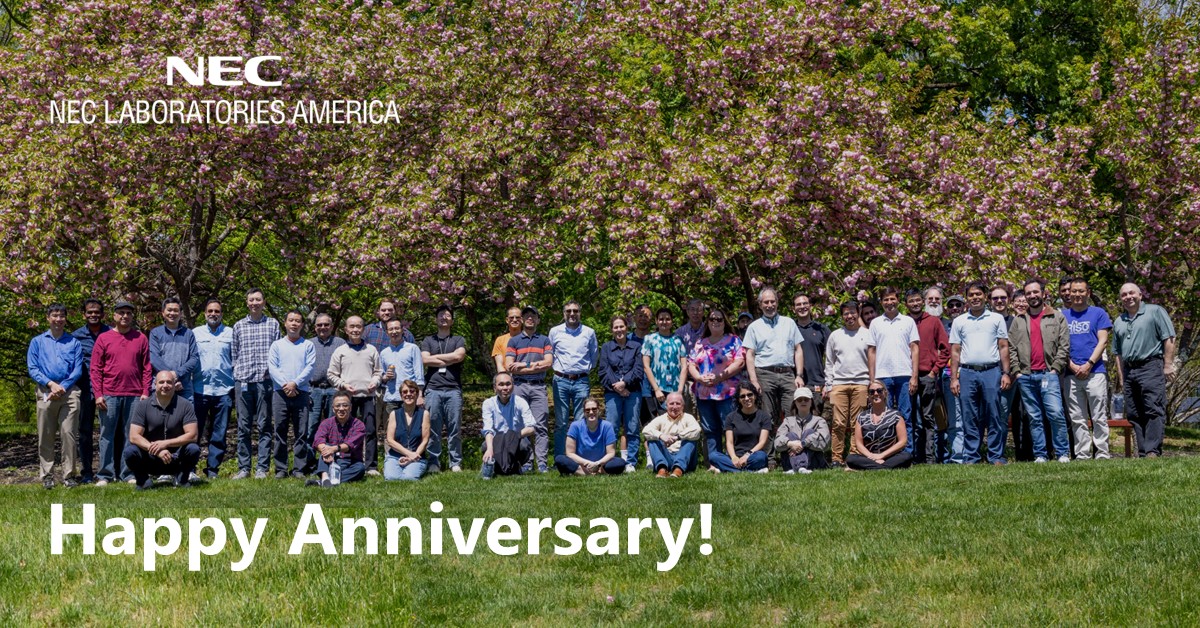
Today, as we mark our 23rd anniversary, we celebrate a journey of bold ideas, disruptive innovation, world-class breakthroughs, and enduring impact across artificial intelligence, optics, networking, sensing, and system architecture.
Over the past two decades, we have grown into the U.S.-based center for NEC’s global research network, combining deep research with real-world, deployable solutions.
Leadership Spotlight
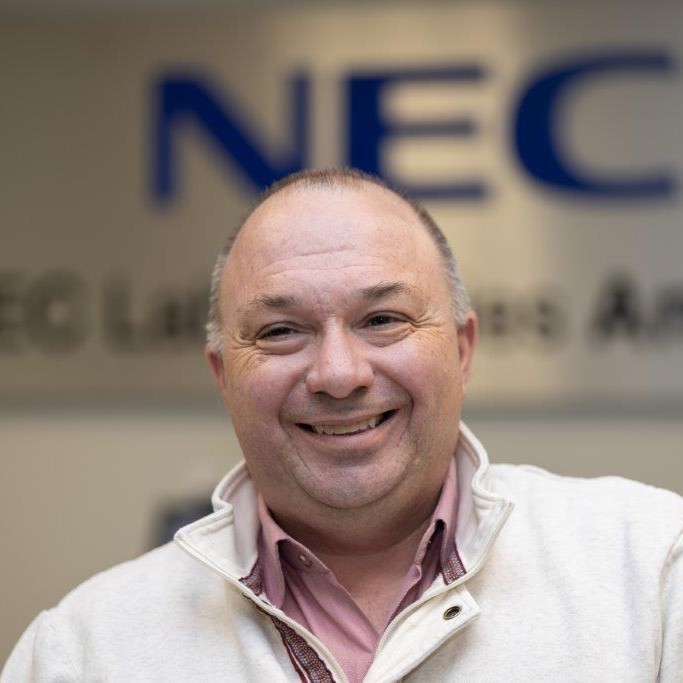 At the heart of our mission is our president, Dr. Christopher White, who continues to guide the organization toward impactful, market-driven innovation. His vision emphasizes bridging the gap between exploratory research and commercial transformation, ensuring that NECLA’s discoveries lead to real-world benefits.
“At NEC Laboratories America, our mission is to generate significant new knowledge and create innovative solutions that remove critical barriers and open new markets.”
— Christopher White, President, NEC Laboratories America
Innovation & Research Breakthroughs
Our success is built on the brilliance and creativity of our researchers. Our research achievements stem from our five core research departments: Data Science & System Security, Integrated Systems, Machine Learning, Media Analytics, and Optical Networking & Sensing. Our teams are exploring:
- Trusted large-language and multimodal AI systems
- Advanced optical networking and distributed sensing for smart infrastructure
- New architectures for secure, data-driven computing
Our researchers consistently advanced the frontiers of science while translating them into practical technologies and services. Some of our most significant milestones include:
- Optical Communications: Record-breaking fiber-optic bandwidth, including 101 Tbit/s transmission through a single-core fiber in 2011 and a 1.05 Pbit/s transmission over multi-core fiber in 2013.
- Machine Learning: Early contributions to deep-learning frameworks that helped pave the way for the PyTorch ecosystem.
- Intellectual Property: Hundreds of patents across AI, networking, and sensing—recent filings include self-supervised multimodal learning and multimodal semantic analysis for image retrieval.
Our organization has been home to influential scientists, including Turing Award laureates Leslie Valiant and Robert Tarjan, as well as many alumni who now hold leading positions in academia and industry. Our culture of inquiry, collaboration, and applied impact continues to attract exceptional minds from around the world.
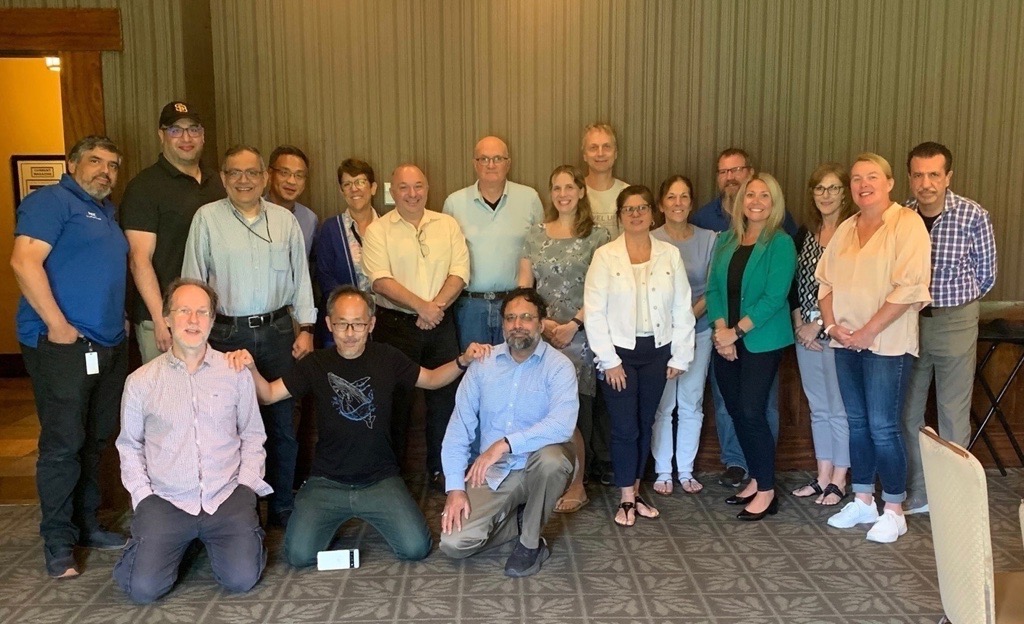 Our Research Mission
- Bridging Basic Research and Real-World Impact: Every project aligns scientific discovery with societal and industrial needs.
- Global Leadership in Intellectual Property: NEC and NEC Laboratories America collectively rank among the world’s top patent holders in biometrics, AI, and communications.
- Collaboration Across Sectors: NEC Laboratories America partners with universities, startups, and industry to accelerate the transition from idea to implementation.
Looking Forward
On this anniversary, we salute the scientists, engineers, interns, partners, and alumni whose work defines NEC Laboratories America. Their research continues to build the foundations for the technologies that power our connected world—from AI and 5G to intelligent sensing and cybersecurity. We are poised to lead the next generation of technological evolution.
Visit our Areas of Research

NEC Laboratories America drives innovation through five core research departments—Data Science & System Security, Integrated Systems, Machine Learning, Media Analytics, and Optical Networking & Sensing—each working at the intersection of advanced theory and real-world application. From developing trusted AI and multimodal systems to designing next-generation optical networks and intelligent sensing technologies, NECLA researchers are pushing the boundaries of what’s possible in computing and communications. Their work powers breakthroughs in cybersecurity, distributed systems, and 5G connectivity, while also laying the foundations for future technologies. Through close collaboration with NEC’s global research network and leading universities, NECLA transforms bold ideas into impactful solutions that connect and improve the world.
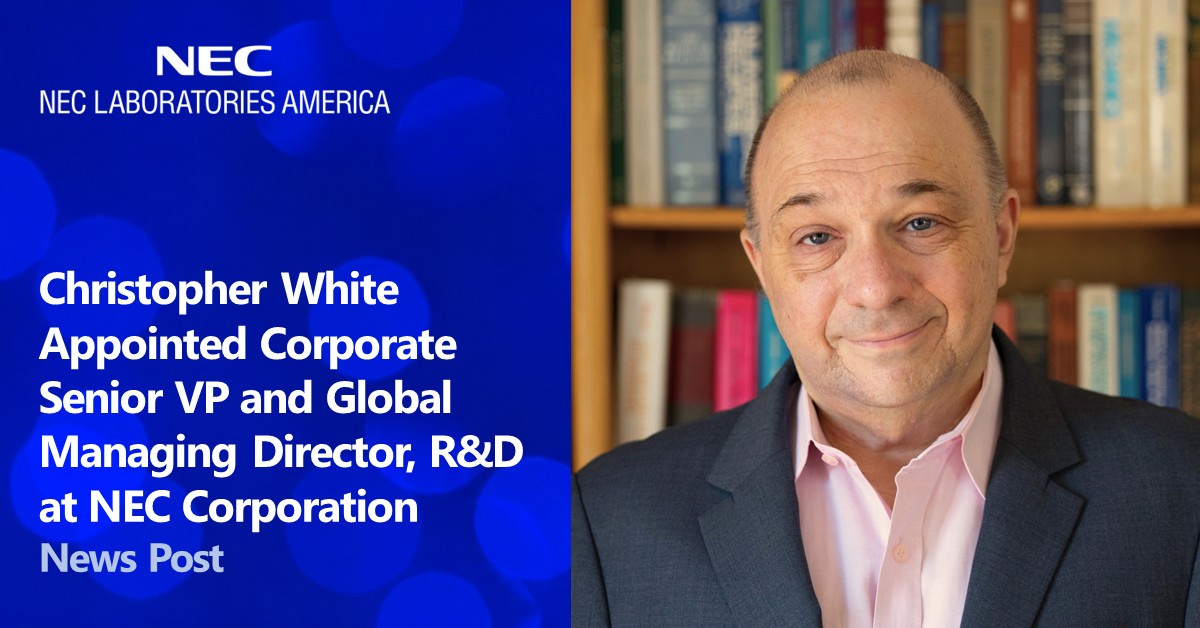 https://www.nec-labs.com/wp-content/uploads/2026/09/Chris-White-Promotion-SMM.jpg
628
1200
NEC Labs America
https://www.nec-labs.com/wp-content/uploads/2025/08/NEC-Laboratories-America-Logo-Aug-2025-2.jpg
NEC Labs America2026-09-23 19:54:142026-09-23 20:10:49Christopher White Appointed Corporate Senior Vice President and Global Managing Director, R&D at NEC Corporation
https://www.nec-labs.com/wp-content/uploads/2026/09/Chris-White-Promotion-SMM.jpg
628
1200
NEC Labs America
https://www.nec-labs.com/wp-content/uploads/2025/08/NEC-Laboratories-America-Logo-Aug-2025-2.jpg
NEC Labs America2026-09-23 19:54:142026-09-23 20:10:49Christopher White Appointed Corporate Senior Vice President and Global Managing Director, R&D at NEC Corporation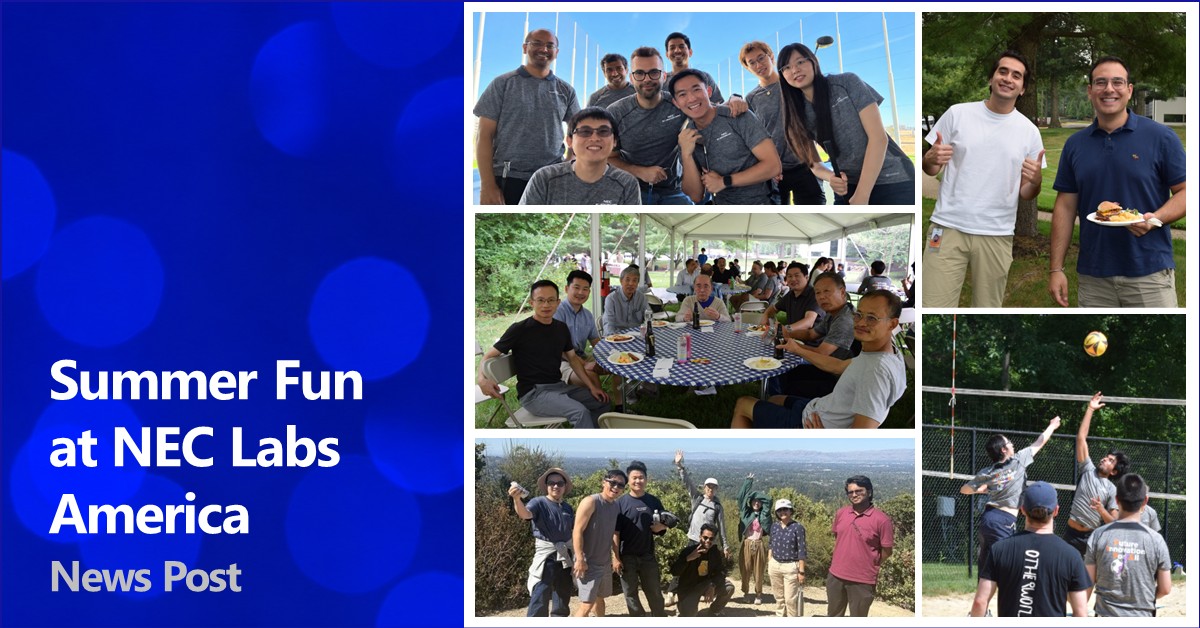 https://www.nec-labs.com/wp-content/uploads/2026/09/NEC-Labs-America-Summer-Fun.jpg
628
1200
NEC Labs America
https://www.nec-labs.com/wp-content/uploads/2025/08/NEC-Laboratories-America-Logo-Aug-2025-2.jpg
NEC Labs America2026-09-22 16:50:282026-09-23 20:00:31Summer Fun at NEC Labs America
https://www.nec-labs.com/wp-content/uploads/2026/09/NEC-Labs-America-Summer-Fun.jpg
628
1200
NEC Labs America
https://www.nec-labs.com/wp-content/uploads/2025/08/NEC-Laboratories-America-Logo-Aug-2025-2.jpg
NEC Labs America2026-09-22 16:50:282026-09-23 20:00:31Summer Fun at NEC Labs America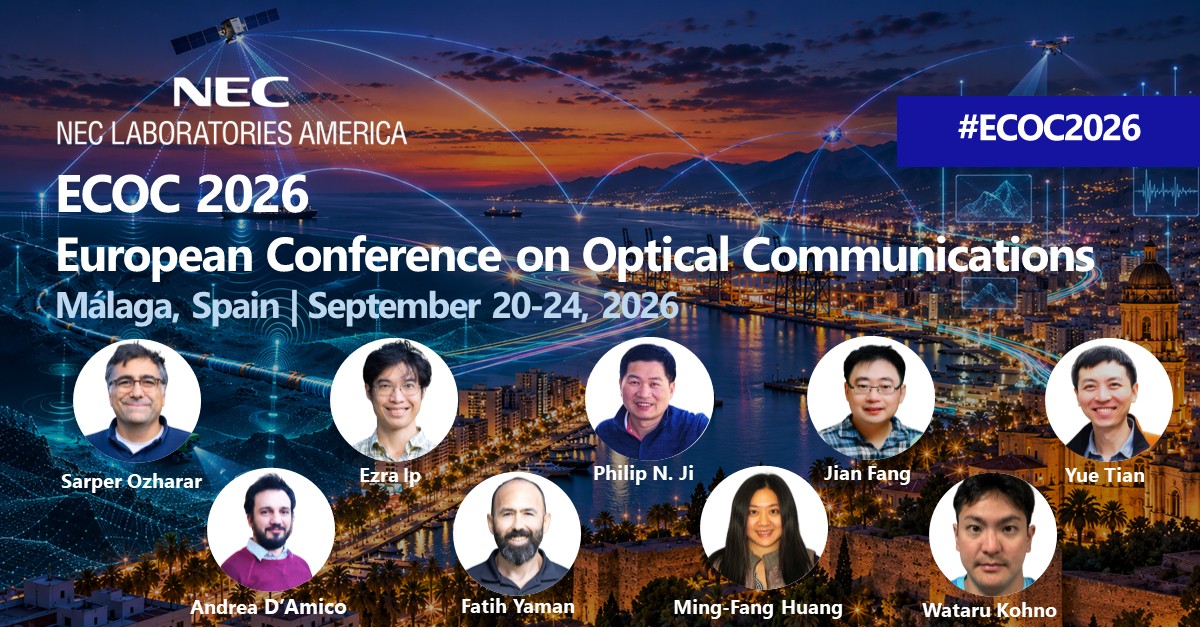 https://www.nec-labs.com/wp-content/uploads/2026/09/ECOC-2026.jpg
628
1200
NEC Labs America
https://www.nec-labs.com/wp-content/uploads/2025/08/NEC-Laboratories-America-Logo-Aug-2025-2.jpg
NEC Labs America2026-09-07 14:05:232026-09-07 14:51:52NEC Labs America Presents at ECOC 2026 in Málaga, Spain, September 20-24th
https://www.nec-labs.com/wp-content/uploads/2026/09/ECOC-2026.jpg
628
1200
NEC Labs America
https://www.nec-labs.com/wp-content/uploads/2025/08/NEC-Laboratories-America-Logo-Aug-2025-2.jpg
NEC Labs America2026-09-07 14:05:232026-09-07 14:51:52NEC Labs America Presents at ECOC 2026 in Málaga, Spain, September 20-24th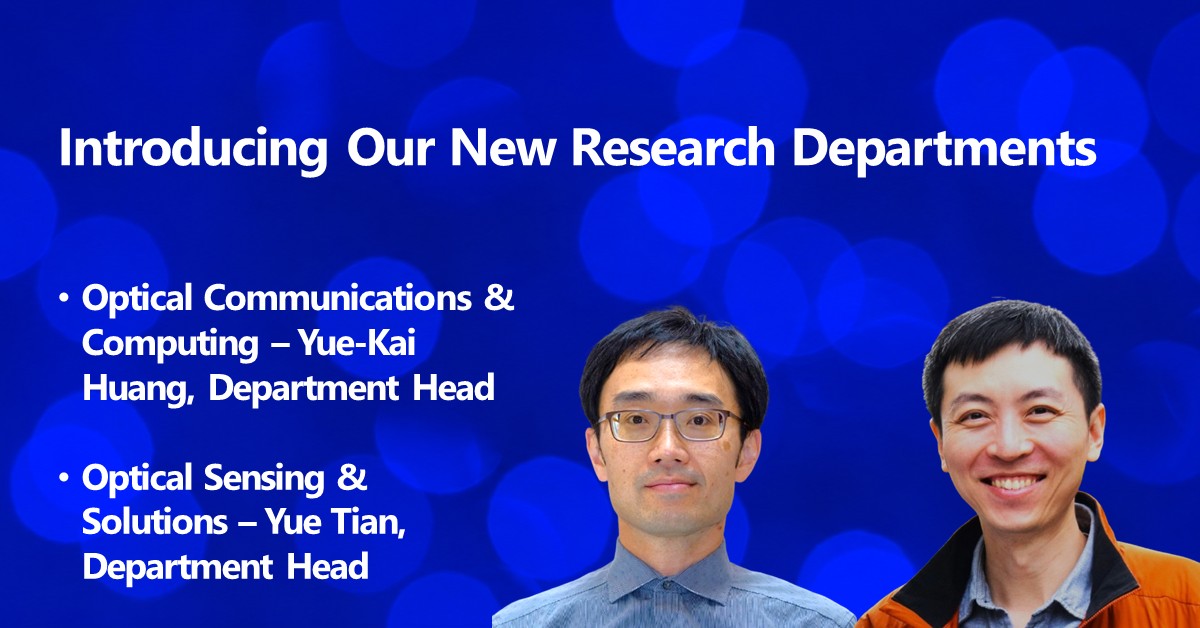 https://www.nec-labs.com/wp-content/uploads/2026/09/OCC-OSS-Blog-Post.jpg
628
1200
NEC Labs America
https://www.nec-labs.com/wp-content/uploads/2025/08/NEC-Laboratories-America-Logo-Aug-2025-2.jpg
NEC Labs America2026-09-01 07:00:042026-09-18 09:42:38NEC Laboratories America Forms Two New Departments: Optical Communications & Computing and Optical Sensing & Solutions
https://www.nec-labs.com/wp-content/uploads/2026/09/OCC-OSS-Blog-Post.jpg
628
1200
NEC Labs America
https://www.nec-labs.com/wp-content/uploads/2025/08/NEC-Laboratories-America-Logo-Aug-2025-2.jpg
NEC Labs America2026-09-01 07:00:042026-09-18 09:42:38NEC Laboratories America Forms Two New Departments: Optical Communications & Computing and Optical Sensing & Solutions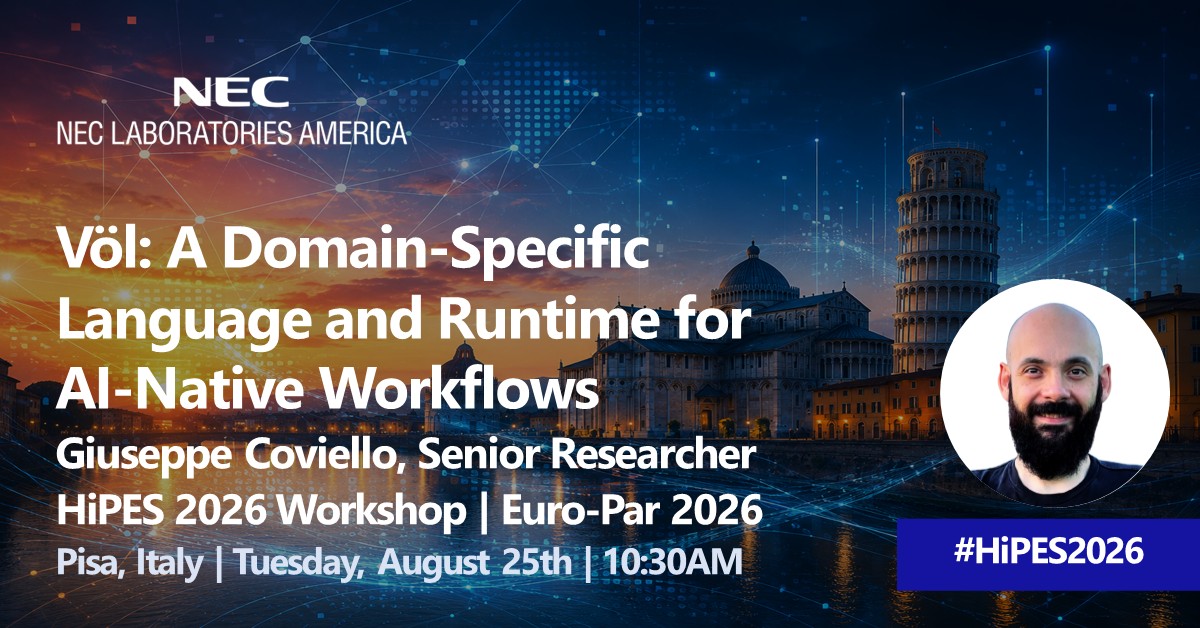 https://www.nec-labs.com/wp-content/uploads/2026/08/HIPES-2026-1.jpg
628
1200
NEC Labs America
https://www.nec-labs.com/wp-content/uploads/2025/08/NEC-Laboratories-America-Logo-Aug-2025-2.jpg
NEC Labs America2026-08-21 14:42:542026-08-21 19:32:50Giuseppe Coviello Presents at HiPES 2026 | Euro-Par in Pisa, Italy on August 25th
https://www.nec-labs.com/wp-content/uploads/2026/08/HIPES-2026-1.jpg
628
1200
NEC Labs America
https://www.nec-labs.com/wp-content/uploads/2025/08/NEC-Laboratories-America-Logo-Aug-2025-2.jpg
NEC Labs America2026-08-21 14:42:542026-08-21 19:32:50Giuseppe Coviello Presents at HiPES 2026 | Euro-Par in Pisa, Italy on August 25th https://www.nec-labs.com/wp-content/uploads/2026/08/NEC-Laboratories-America-Researchers-Win-a-2026-Edison-Patent-Award-for-Optical-Fiber-Innovation.jpg
628
1200
NEC Labs America
https://www.nec-labs.com/wp-content/uploads/2025/08/NEC-Laboratories-America-Logo-Aug-2025-2.jpg
NEC Labs America2026-08-20 09:14:182026-08-21 15:16:35NEC Laboratories America Researchers Win a 2026 Edison Patent Award for Optical Fiber Innovation
https://www.nec-labs.com/wp-content/uploads/2026/08/NEC-Laboratories-America-Researchers-Win-a-2026-Edison-Patent-Award-for-Optical-Fiber-Innovation.jpg
628
1200
NEC Labs America
https://www.nec-labs.com/wp-content/uploads/2025/08/NEC-Laboratories-America-Logo-Aug-2025-2.jpg
NEC Labs America2026-08-20 09:14:182026-08-21 15:16:35NEC Laboratories America Researchers Win a 2026 Edison Patent Award for Optical Fiber Innovation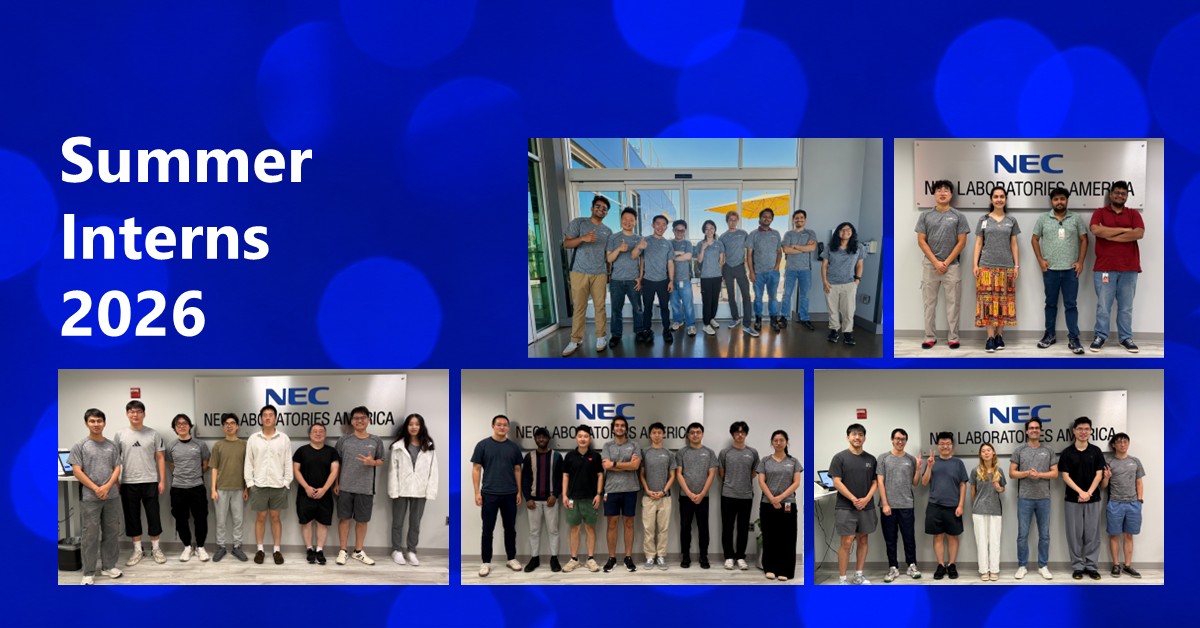 https://www.nec-labs.com/wp-content/uploads/2026/08/Summer-Interns-2026-1.jpg
628
1200
NEC Labs America
https://www.nec-labs.com/wp-content/uploads/2025/08/NEC-Laboratories-America-Logo-Aug-2025-2.jpg
NEC Labs America2026-08-18 12:59:042026-08-18 13:39:18Summer Interns 2026
https://www.nec-labs.com/wp-content/uploads/2026/08/Summer-Interns-2026-1.jpg
628
1200
NEC Labs America
https://www.nec-labs.com/wp-content/uploads/2025/08/NEC-Laboratories-America-Logo-Aug-2025-2.jpg
NEC Labs America2026-08-18 12:59:042026-08-18 13:39:18Summer Interns 2026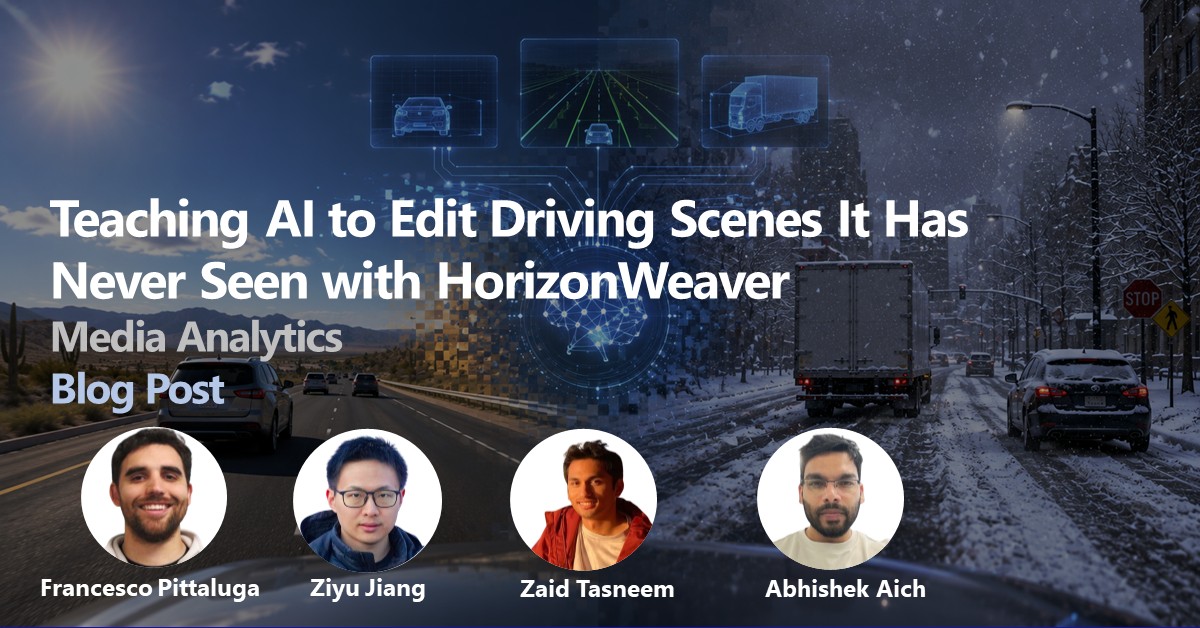 https://www.nec-labs.com/wp-content/uploads/2026/07/Teaching-AI-to-Edit-Driving-Scenes-It-Has-Never-Seen-with-HorizonWeaver-1.jpg
628
1200
NEC Labs America
https://www.nec-labs.com/wp-content/uploads/2025/08/NEC-Laboratories-America-Logo-Aug-2025-2.jpg
NEC Labs America2026-08-11 22:04:592026-08-11 22:05:56Teaching AI to Edit Driving Scenes It Has Never Seen with HorizonWeaver
https://www.nec-labs.com/wp-content/uploads/2026/07/Teaching-AI-to-Edit-Driving-Scenes-It-Has-Never-Seen-with-HorizonWeaver-1.jpg
628
1200
NEC Labs America
https://www.nec-labs.com/wp-content/uploads/2025/08/NEC-Laboratories-America-Logo-Aug-2025-2.jpg
NEC Labs America2026-08-11 22:04:592026-08-11 22:05:56Teaching AI to Edit Driving Scenes It Has Never Seen with HorizonWeaver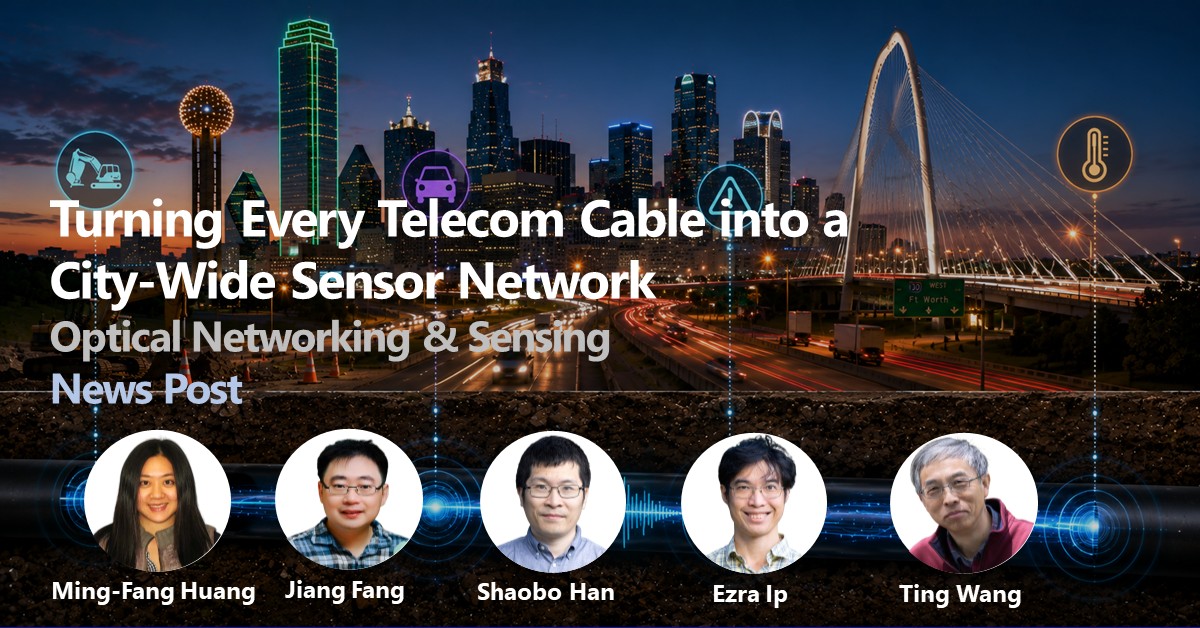 https://www.nec-labs.com/wp-content/uploads/2026/07/Turning-Every-Telecom-Cable-into-a-City-Wide-Sensor-Network.jpg
628
1200
NEC Labs America
https://www.nec-labs.com/wp-content/uploads/2025/08/NEC-Laboratories-America-Logo-Aug-2025-2.jpg
NEC Labs America2026-07-28 09:50:322026-07-28 12:55:09Turning Every Telecom Cable into a City-Wide Sensor Network
https://www.nec-labs.com/wp-content/uploads/2026/07/Turning-Every-Telecom-Cable-into-a-City-Wide-Sensor-Network.jpg
628
1200
NEC Labs America
https://www.nec-labs.com/wp-content/uploads/2025/08/NEC-Laboratories-America-Logo-Aug-2025-2.jpg
NEC Labs America2026-07-28 09:50:322026-07-28 12:55:09Turning Every Telecom Cable into a City-Wide Sensor Network