
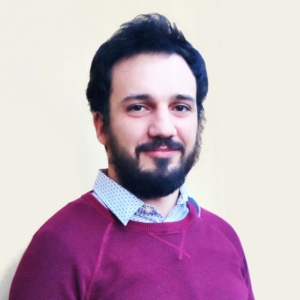
Andrea D’Amico Andrea D’Amico is a Researcher in the Optical Networking and Sensing Department at NEC Laboratories America. He holds a Ph.D. in Telecommunications Engineering from Politecnico di Torino, where his research focused on quality of transmission estimation, nonlinear fiber modeling, and the application of machine learning to open optical networks. He also earned a Master’s degree in Theoretical Physics and a Bachelor’s degree in Physics from the Università di Pisa.

At NEC, Andrea conducts advanced research for the integration of physical-layer modeling and system-level intelligence to support the evolution of large-scale optical networks. His work focuses on abstracting complex signal behaviors into models that inform automation, optimization, and control across diverse deployment scenarios. By aligning physical accuracy with network adaptability, he contributes to the development of flexible and high-capacity infrastructures capable of meeting the demands of next-generation connectivity.

Posts

NEC Labs America Attended OFC 2025 in San Francisco

The NEC Labs America Optical Networking and Sensing team is attending the 2025 Optical Fiber Communications Conference and Exhibition (OFC), the premier global event for optical networking and communications. Bringing together over 13,500 attendees from 83+ countries, more than 670 exhibitors, and hundreds of sessions featuring industry leaders, OFC 2025 serves as the central hub for innovation and collaboration in the field. At this year’s conference, NEC Labs America will showcase its cutting-edge research and advancements through multiple presentations, demonstrations, and workshops.

400-Gb/s mode division multiplexing-based bidirectional free space optical communication in real-time with commercial transponders

In this work, for the first time, we experimentally demonstrate mode division multiplexing-based bidirectional free space optical communication in real-time using commercial transponders. As proof of concept, via bidirectional pairs of Hermite-Gaussian modes (HG00, HG10, and HG01), using a Telecom Infra Project Phoenix compliant commercial 400G transponder, 400-Gb/s data signals (56-Gbaud, DP-16QAM) are bidirectionally transmitted error free, i.e., with less than 1e-2 pre-FEC BERs, over approximately 1-m of free space

Field Verification of Fault Localization with Integrated Physical-Parameter-Aware Methodology

We report the first field verification of fault localization in an optical line system (OLS) by integrating digital longitudinal monitoring and OLS calibration, highlighting changes in physical metrics and parameters. Use cases shown are degradation of a fiber span loss and optical amplifier noise figure.

Enhancing Optical Multiplex Section QoT Estimation Using Scalable Gray-box DNN

In Optical Multiplex Section (OMS) control and optimization framework, end-to-end (Global) and span-by-span (Local) DNN gray-box strategies are compared in terms of scalability and accuracy of the output signal and noise power predictions. Experimental measurements are carried out in OMSs with increasing number of spans.

Characterization and Modeling of the Noise Figure Ripple in a Dual-Stage EDFA

The noise figure ripple of a dual-stage EDFA is studied starting from experimental measurements under full spectral load conditions and defining device characteristics. Asemi-analytical model is then proposed showing 0.1 dB standard deviation on the error distribution in all cases of operation.

Extension of the Local-Optimization Global-Optimization (LOGO) Launch Power Strategy to Multi-Band Optical Networks

We propose extending the LOGO strategy for launch power settings to multi-band scenarios, maintaining low complexity while addressing key inter-band nonlinear effects and accurate amplifier models. This methodology simplifies multi-band optical multiplex section control, providing an immediate, descriptive estimation of optimized launch power.

Measuring the Transceivers Back-to-Back BER-OSNR Characteristic Using Only a Variable Optical Attenuator

We propose a transceiver back-to-back BER-OSNR characterization method that requires only a single VOA; it leverages the receiver SNR degradation caused by received power attenuation. Experiments using commercial transceivers show that the measurement error is less than 0.2 dB in the Q-factor.

Machine Learning Model for EDFA Predicting SHB Effects

Experiments show that machine learning model of an EDFA is capable of modelling spectral hole burning effects accurately. As a result, it significantly outperforms black-box models that neglect inhomogeneous effects. Model achieves a record average RMSE of 0.0165 dB between the model predictions and measurements.

First Field Demonstration of Hollow-Core Fibre Supporting Distributed Acoustic Sensing and DWDM Transmission

We demonstrate a method for measuring the backscatter coefficient of hollow-core fibre (HCF), and show the feasibility of distributed acoustic sensing (DAS) with simultaneous 9.6-Tb/s DWDM transmission over a 1.6-km field-deployed HCF cable.

NEC Labs America Team Attends the 2024 European Conference on Optical Communication (ECOC) in Frankfurt, Germany

Our optical networking & sending team has arrived in Frankfurt for the 2024 European Conference on Optical Communication (ECOC)  and is excited to present many papers and tutorials this week. Please follow this page and on our social media channels for updates.