NEC Labs America’s (NECLA) President Christopher White is attending Stanford University’s SystemX Alliance 2022 Fall Conference this week, where he is meeting with Ph.D. students, industry-leading researchers and business leaders presenting on a wide range of research topics. The annual conference will highlight exciting research in the areas of advanced materials, data analytics, energy and power management, 3D nanoprinting, and photonic and quantum computing, to name but a few!
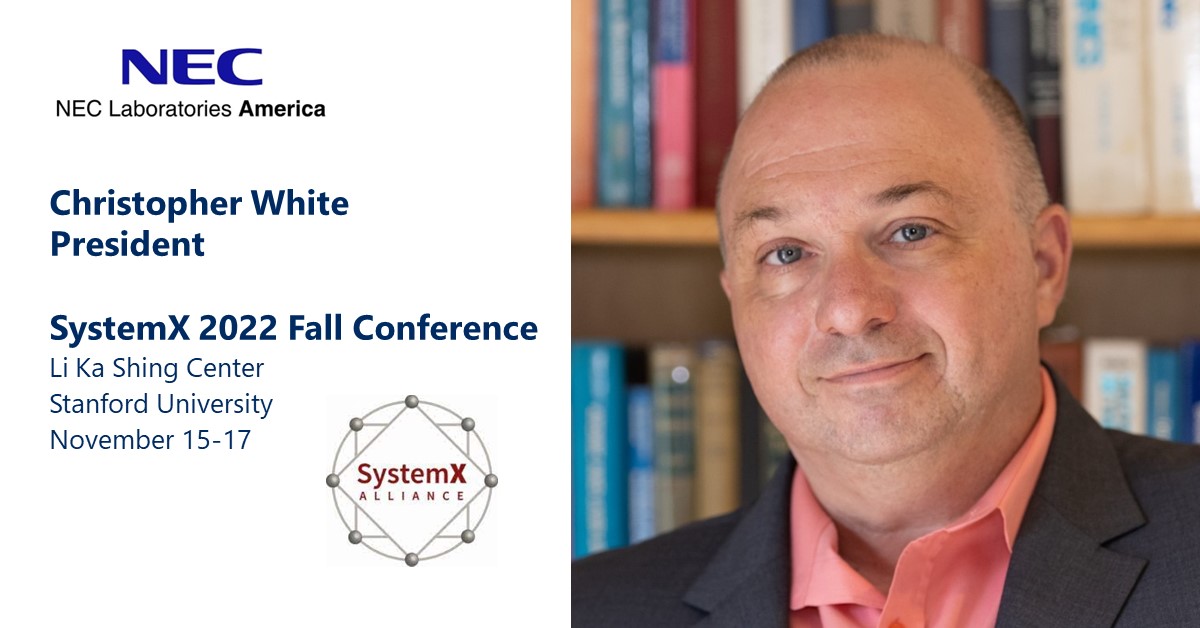
As a member of the alliance, NECLA works with students and professors to advance key research and the development of real-world solutions such as carbon-efficient Machine Learning software and hardware platforms (Green AI). The SystemX Alliance’s many areas of research are highly complementary to NECLA’s own research in Data Science & System Security, Integrated Systems, Machine Learning, Media Analytics, and Optical Networking and Sensing.
“We’re excited to work with talented Stanford Ph.D. students and their professors on important research that will help society, communities, and citizens,” stated Christopher White, President, of NECLA. “This valuable collaboration is poised to generate significant insights and advances on tackling challenges of the ever-increasing complexity and energy demands of modern AI systems, which limits their benefits to organizations with access to powerful hardware and data infrastructure.”
NECLA is also the professional home of Stanford graduate, Wang-Pin Hsiung, Associate Researcher, Integrated Systems Group.
Wang-Pin Hsiung joined NECLA shortly after graduating with an M.S. in Computer Science and a concentration in Databases and Systems. In his work at the lab’s Integrated Systems group, he focuses on database research, 5G, Internet of Things (IoT), edge computing and cloud computing technologies. His group’s research delves into high-performance intelligent distributed systems, applications and services on complex and large-scale communication networks. They also develop next generation wireless technologies for sensing the world, localizing critical assets, and improving the capacity, coverage and scalability of communication networks like 5G. Among his accomplishments are multiple patent filings with his NECLA colleagues related to advances in managing communications in distributed computing systems, edge-cloud optimization of 5G applications, and free flow fever screening, an important public health innovation spurred by the COVID pandemic.
According to Wang-Pin, “I really enjoy working at NEC Labs America because it offers me the opportunity to collaborate with and learn from many people with different research and business expertise. I have the freedom to work on a variety of challenging projects. The research is always new and exciting.”
To learn more about NECLA’s challenging research opportunities, please visit us at our Careers page.
Read About Our Future and Past Events
 https://www.nec-labs.com/wp-content/uploads/2026/06/CVPR-LATEST.jpg
628
1200
NEC Labs America
https://www.nec-labs.com/wp-content/uploads/2025/08/NEC-Laboratories-America-Logo-Aug-2025-2.jpg
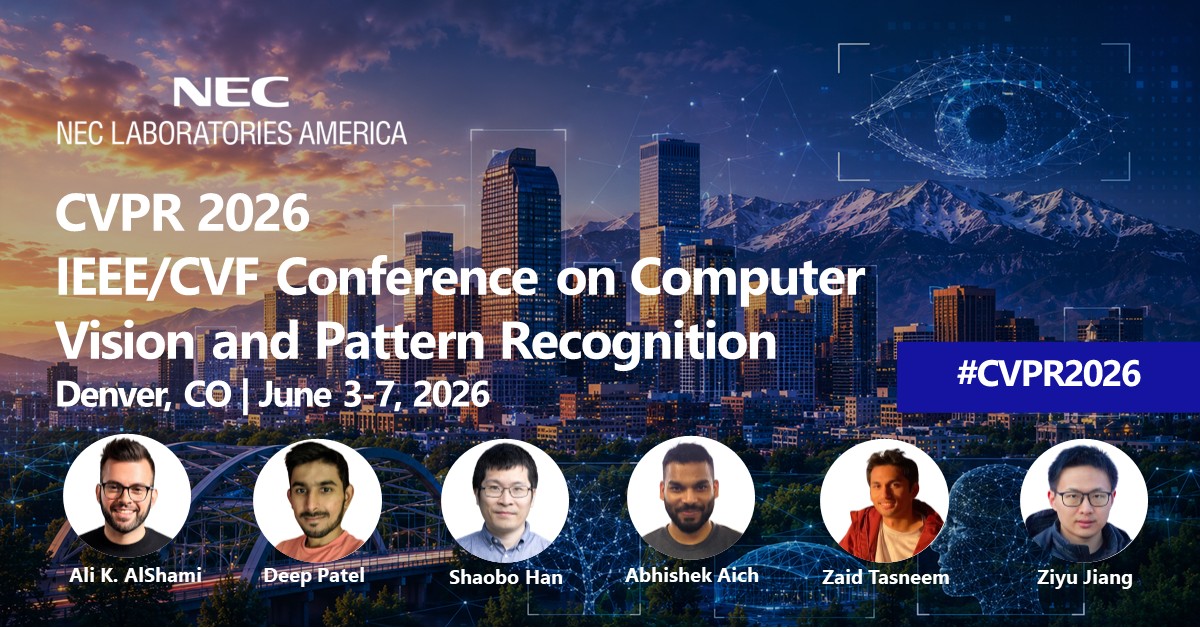
NEC Labs America2026-06-02 07:19:252026-06-26 13:11:51NEC Labs America Attends CVPR 2026 in Denver, CO June 3-7, 2026
https://www.nec-labs.com/wp-content/uploads/2026/06/CVPR-LATEST.jpg
628
1200
NEC Labs America
https://www.nec-labs.com/wp-content/uploads/2025/08/NEC-Laboratories-America-Logo-Aug-2025-2.jpg
NEC Labs America2026-06-02 07:19:252026-06-26 13:11:51NEC Labs America Attends CVPR 2026 in Denver, CO June 3-7, 2026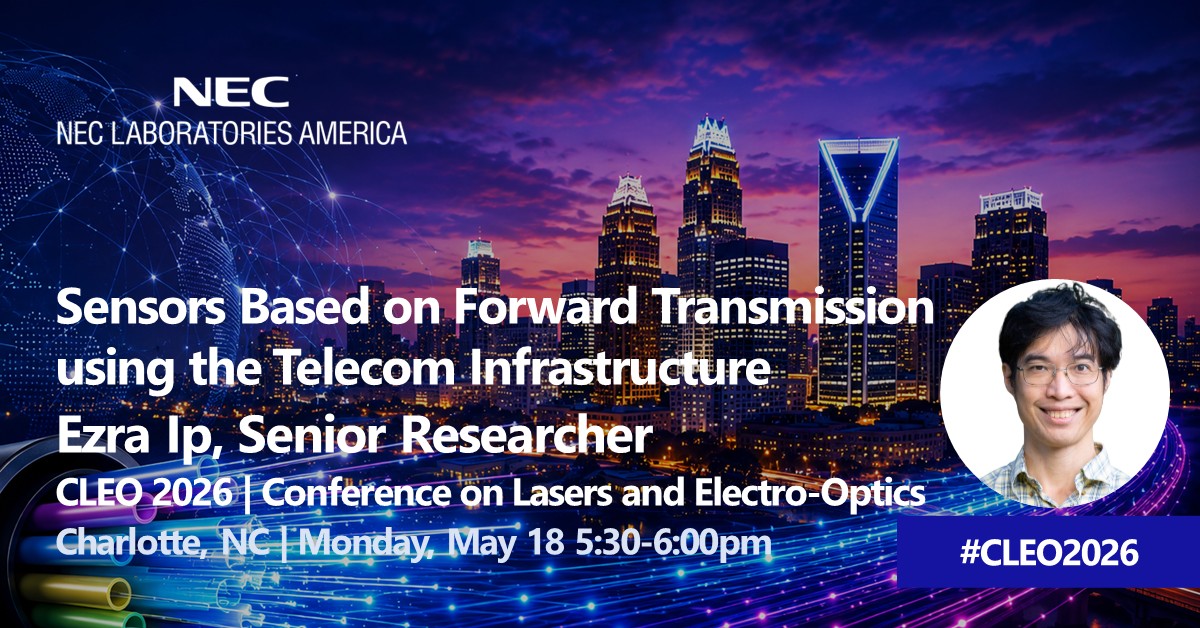 https://www.nec-labs.com/wp-content/uploads/2026/05/CLEO-2026.jpg
628
1200
NEC Labs America
https://www.nec-labs.com/wp-content/uploads/2025/08/NEC-Laboratories-America-Logo-Aug-2025-2.jpg
NEC Labs America2026-05-12 14:06:232026-06-02 21:42:07Ezra Ip Presents at CLEO 2026 in Charlotte, NC on May 18th
https://www.nec-labs.com/wp-content/uploads/2026/05/CLEO-2026.jpg
628
1200
NEC Labs America
https://www.nec-labs.com/wp-content/uploads/2025/08/NEC-Laboratories-America-Logo-Aug-2025-2.jpg
NEC Labs America2026-05-12 14:06:232026-06-02 21:42:07Ezra Ip Presents at CLEO 2026 in Charlotte, NC on May 18th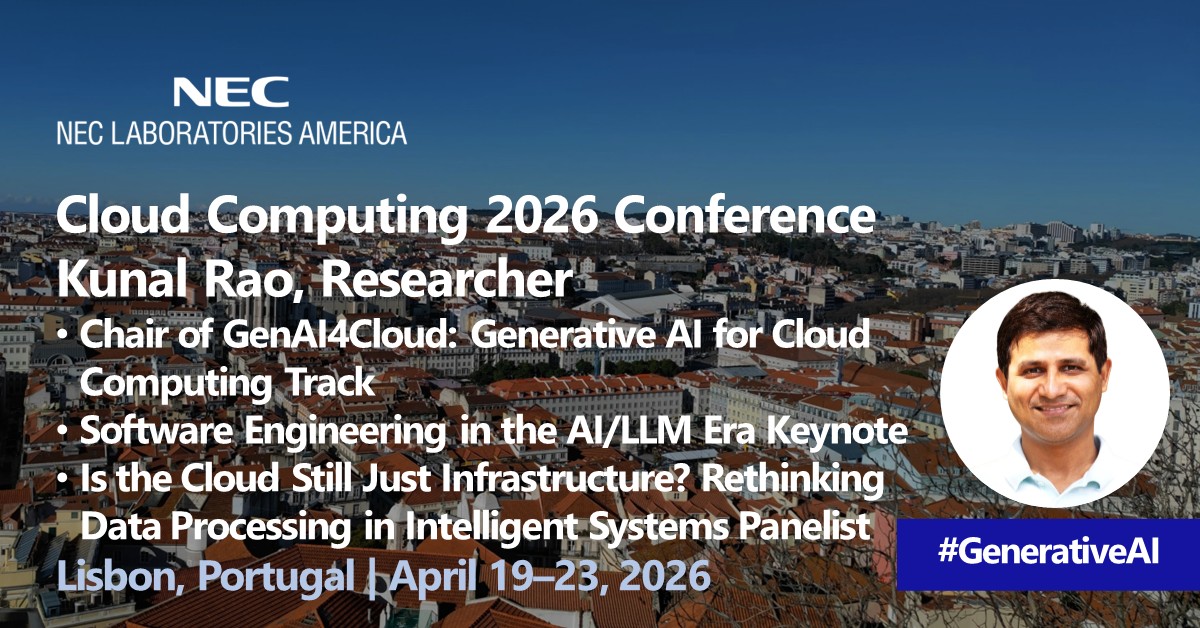 https://www.nec-labs.com/wp-content/uploads/2026/04/Kunal-April-1.jpg
628
1200
NEC Labs America
https://www.nec-labs.com/wp-content/uploads/2025/08/NEC-Laboratories-America-Logo-Aug-2025-2.jpg
NEC Labs America2026-04-20 14:45:452026-06-26 13:13:07Future of Cloud Computing with GenAI: Kunal Rao at Cloud Computing 2026
https://www.nec-labs.com/wp-content/uploads/2026/04/Kunal-April-1.jpg
628
1200
NEC Labs America
https://www.nec-labs.com/wp-content/uploads/2025/08/NEC-Laboratories-America-Logo-Aug-2025-2.jpg
NEC Labs America2026-04-20 14:45:452026-06-26 13:13:07Future of Cloud Computing with GenAI: Kunal Rao at Cloud Computing 2026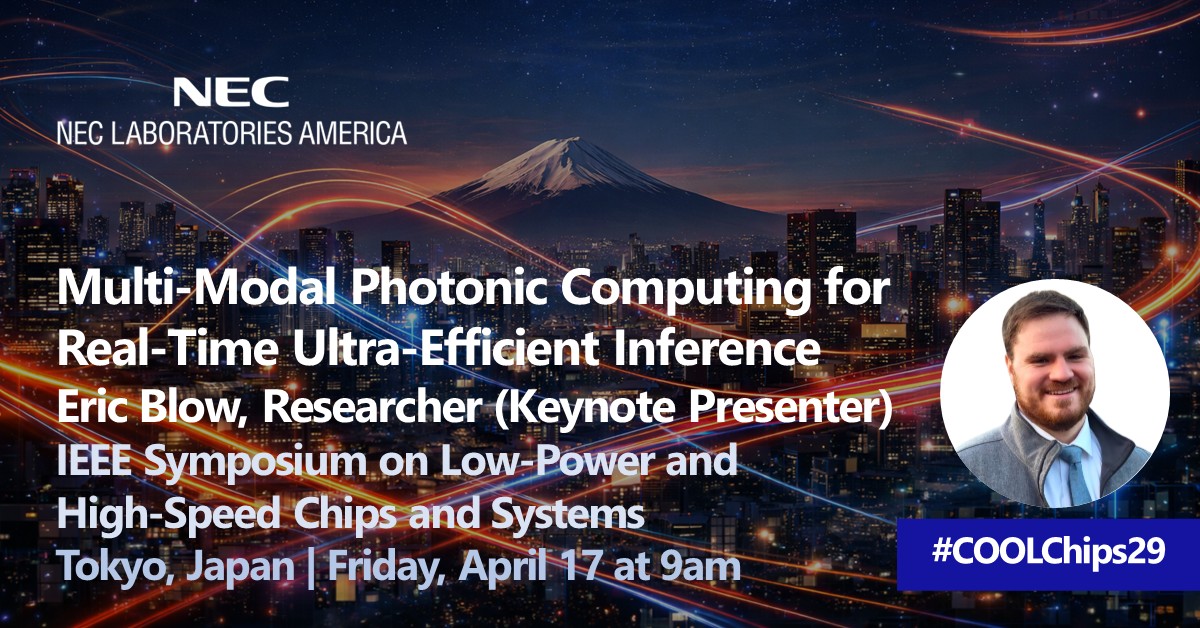 https://www.nec-labs.com/wp-content/uploads/2026/04/Eric-Cool-Chips-2026.jpg
628
1200
NEC Labs America
https://www.nec-labs.com/wp-content/uploads/2025/08/NEC-Laboratories-America-Logo-Aug-2025-2.jpg
NEC Labs America2026-04-15 19:00:202026-06-26 13:14:06Eric C. Blow to Deliver Photonic AI Keynote at COOL Chips 29 in Tokyo on April 17th
https://www.nec-labs.com/wp-content/uploads/2026/04/Eric-Cool-Chips-2026.jpg
628
1200
NEC Labs America
https://www.nec-labs.com/wp-content/uploads/2025/08/NEC-Laboratories-America-Logo-Aug-2025-2.jpg
NEC Labs America2026-04-15 19:00:202026-06-26 13:14:06Eric C. Blow to Deliver Photonic AI Keynote at COOL Chips 29 in Tokyo on April 17th