Future of Cloud Computing with GenAI: Kunal Rao at Cloud Computing 2026
As generative AI continues to reshape the technology landscape, its impact on cloud computing is becoming increasingly profound. At the upcoming Cloud Computing 2026 Conference in Lisbon, Portugal (April 19–23, 2026), NEC Laboratories America’s Kunal Rao will play a leading role in exploring this transformation, both as a track chair, keynote speaker and panelist.
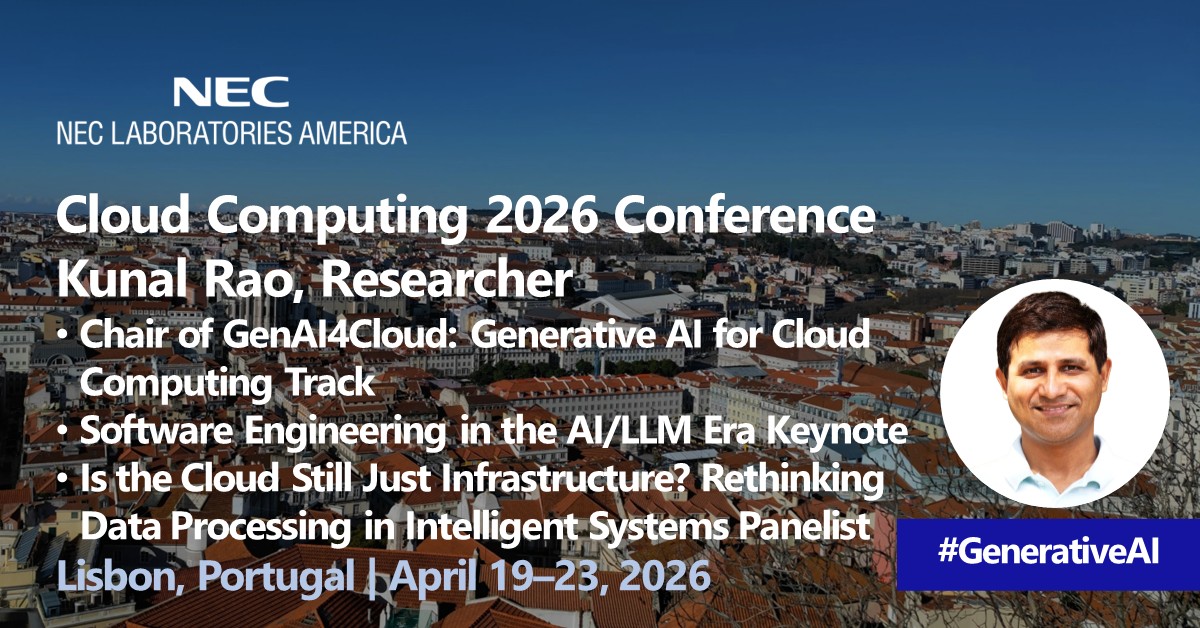
On April 21 from 1800-1930, Kunal will be a panelist for the “Is the Cloud Still Just Infrastructure? Rethinking Data Processing in Intelligent Systems” panel. The participants will discuss that the cloud is no longer just passive infrastructure; it is becoming an active, intelligent layer that participates in data processing, decision-making, and system optimization. As AI-driven workloads grow, cloud environments are evolving into dynamic platforms that integrate computation, data, and intelligence to support real-time, adaptive applications. Moderator: Prof. Dr. Christoph Neumann, Ostbayerische Technische Hochschule Amberg-Weiden, Germany. Panelists: Wolfgang Forstmeier, Siemens AG, Germany; Dr. Raju Shrestha, Oslo Metropolitan University (OsloMet), Norway; Kunal Rao, NEC Laboratories America, Inc., USA; Jorge Carola, Siemens SA, Portugal.
On April 22, Kunal will chair the special track “GenAI4Cloud: Generative AI for Cloud Computing,” a forum dedicated to advancing research and innovation at the intersection of generative AI and cloud platforms. This track brings together researchers and practitioners to examine how large language models, AI agents, and generative systems are fundamentally redefining cloud infrastructure design, management, and optimization. From AI agents operating as first-class entities within cloud environments to LLM-driven orchestration and autonomous system management, the traditional cloud stack is rapidly evolving. The GenAI4Cloud track highlights emerging architectures, intelligent runtimes, and infrastructure designed specifically for generative AI workloads deployed across cloud and edge environments. These developments point toward a future where cloud systems are not only scalable and distributed, but also adaptive, self-optimizing, and deeply integrated with AI.
On April 22 at 900am, Kunal will further expand on these ideas as a keynote speaker with his talk, “Software Engineering in the AI/LLM Era.” His keynote will address how software development practices are changing in response to AI-native systems, including new paradigms for building, testing, and maintaining applications powered by large language models. As AI becomes embedded across the software lifecycle, developers and organizations must rethink traditional engineering approaches to fully leverage its capabilities. Together, these contributions reflect NEC Laboratories America’s commitment to advancing foundational technologies that bridge AI and real-world systems. By shaping conversations around generative AI and cloud computing, Kunal’s work highlights the critical role of research in defining the next generation of intelligent infrastructure.
👉 Learn more about the GenAI4Cloud track: https://www.iaria.org/conferences2026/filesCLOUDCOMPUTING26/GenAI4Cloud.pdf
👉 View the conference program: https://www.iaria.org/conferences2026/ProgramCLOUDCOMPUTING26.html
Read About Our Future and Past Events
 https://www.nec-labs.com/wp-content/uploads/2026/03/Yangmin-Harvard-March-18-1.jpg
628
1200
NEC Labs America
https://www.nec-labs.com/wp-content/uploads/2025/08/NEC-Laboratories-America-Logo-Aug-2025-2.jpg
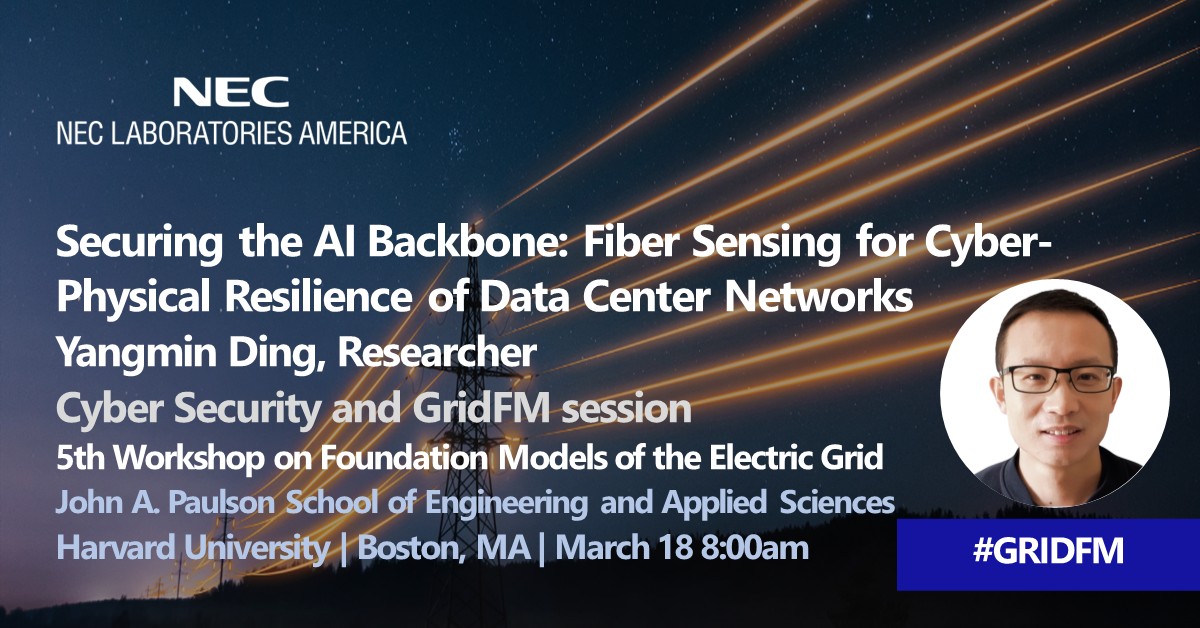
NEC Labs America2026-03-13 11:23:552026-05-27 16:02:10Yangmin Ding Presents at the 5th Workshop on Foundation Models of the Electric Grid on March 18th
https://www.nec-labs.com/wp-content/uploads/2026/03/Yangmin-Harvard-March-18-1.jpg
628
1200
NEC Labs America
https://www.nec-labs.com/wp-content/uploads/2025/08/NEC-Laboratories-America-Logo-Aug-2025-2.jpg
NEC Labs America2026-03-13 11:23:552026-05-27 16:02:10Yangmin Ding Presents at the 5th Workshop on Foundation Models of the Electric Grid on March 18th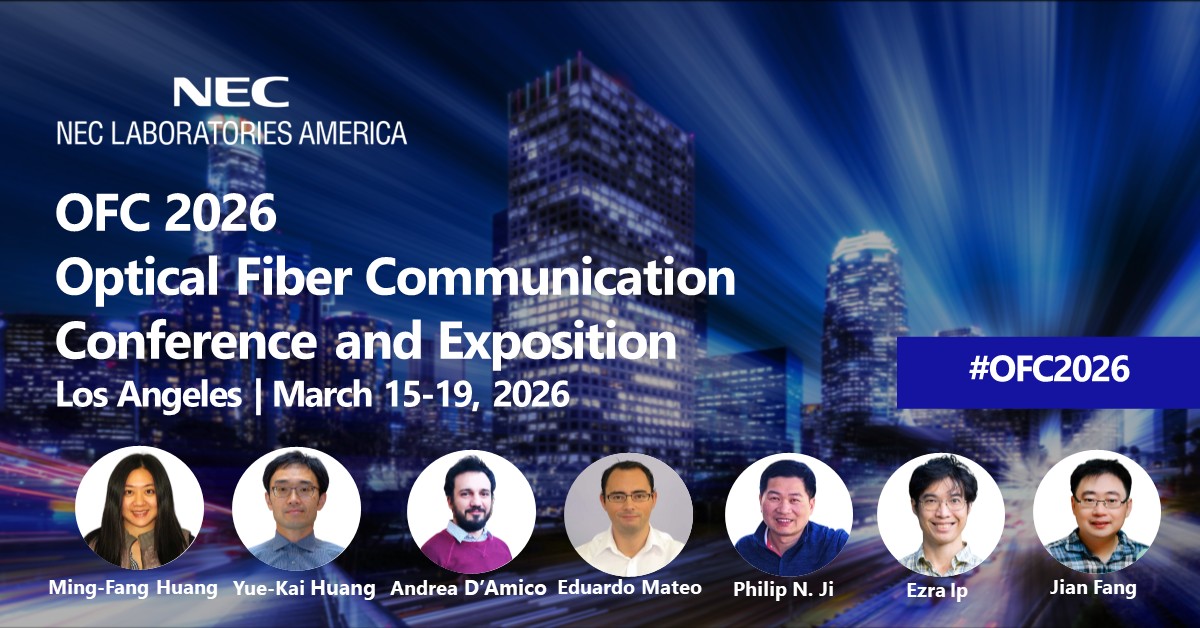 https://www.nec-labs.com/wp-content/uploads/2026/02/OFC-2026-1.jpg
628
1200
NEC Labs America
https://www.nec-labs.com/wp-content/uploads/2025/08/NEC-Laboratories-America-Logo-Aug-2025-2.jpg
NEC Labs America2026-02-24 21:46:282026-05-27 16:03:07NEC Labs America Attending OFC 2026 Los Angeles, March 15-19
https://www.nec-labs.com/wp-content/uploads/2026/02/OFC-2026-1.jpg
628
1200
NEC Labs America
https://www.nec-labs.com/wp-content/uploads/2025/08/NEC-Laboratories-America-Logo-Aug-2025-2.jpg
NEC Labs America2026-02-24 21:46:282026-05-27 16:03:07NEC Labs America Attending OFC 2026 Los Angeles, March 15-19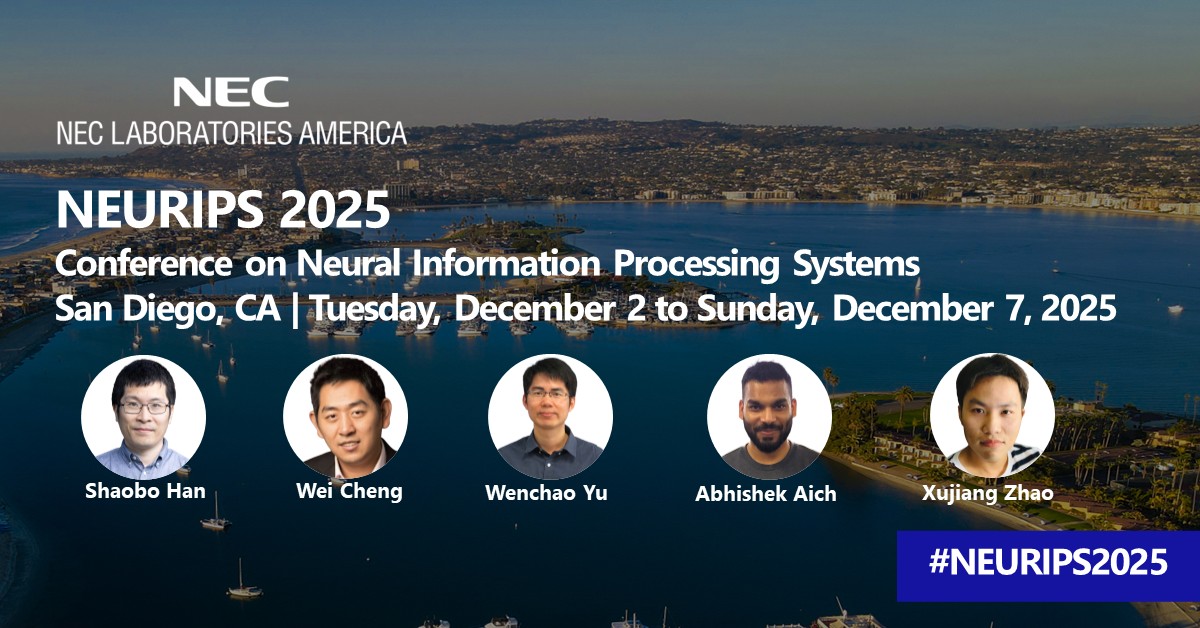 https://www.nec-labs.com/wp-content/uploads/2025/11/NEURIPS-2025-2.jpg
628
1200
NEC Labs America
https://www.nec-labs.com/wp-content/uploads/2025/08/NEC-Laboratories-America-Logo-Aug-2025-2.jpg
NEC Labs America2025-11-19 17:44:032026-06-27 09:34:31NeurIPS 2025 in San Diego from Nov 30th to Dec 5th, 2025
https://www.nec-labs.com/wp-content/uploads/2025/11/NEURIPS-2025-2.jpg
628
1200
NEC Labs America
https://www.nec-labs.com/wp-content/uploads/2025/08/NEC-Laboratories-America-Logo-Aug-2025-2.jpg
NEC Labs America2025-11-19 17:44:032026-06-27 09:34:31NeurIPS 2025 in San Diego from Nov 30th to Dec 5th, 2025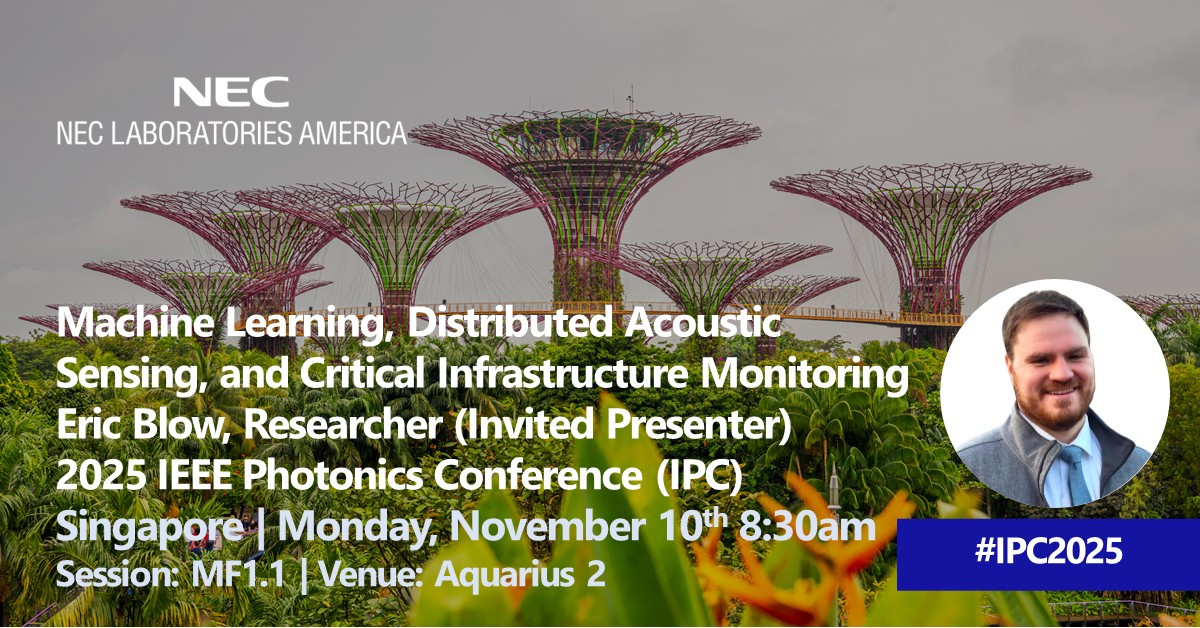 https://www.nec-labs.com/wp-content/uploads/2025/11/Eric-Blow-IPC2025-Monday.jpg
628
1200
NEC Labs America
https://www.nec-labs.com/wp-content/uploads/2025/08/NEC-Laboratories-America-Logo-Aug-2025-2.jpg
NEC Labs America2025-11-06 08:55:412026-06-26 13:16:33Eric Blow Presents at the IEEE Photonics Conference Singapore on November 10th & 13th
https://www.nec-labs.com/wp-content/uploads/2025/11/Eric-Blow-IPC2025-Monday.jpg
628
1200
NEC Labs America
https://www.nec-labs.com/wp-content/uploads/2025/08/NEC-Laboratories-America-Logo-Aug-2025-2.jpg
NEC Labs America2025-11-06 08:55:412026-06-26 13:16:33Eric Blow Presents at the IEEE Photonics Conference Singapore on November 10th & 13th