Yangmin Ding Presents at the 5th Workshop on Foundation Models of the Electric Grid on March 18th
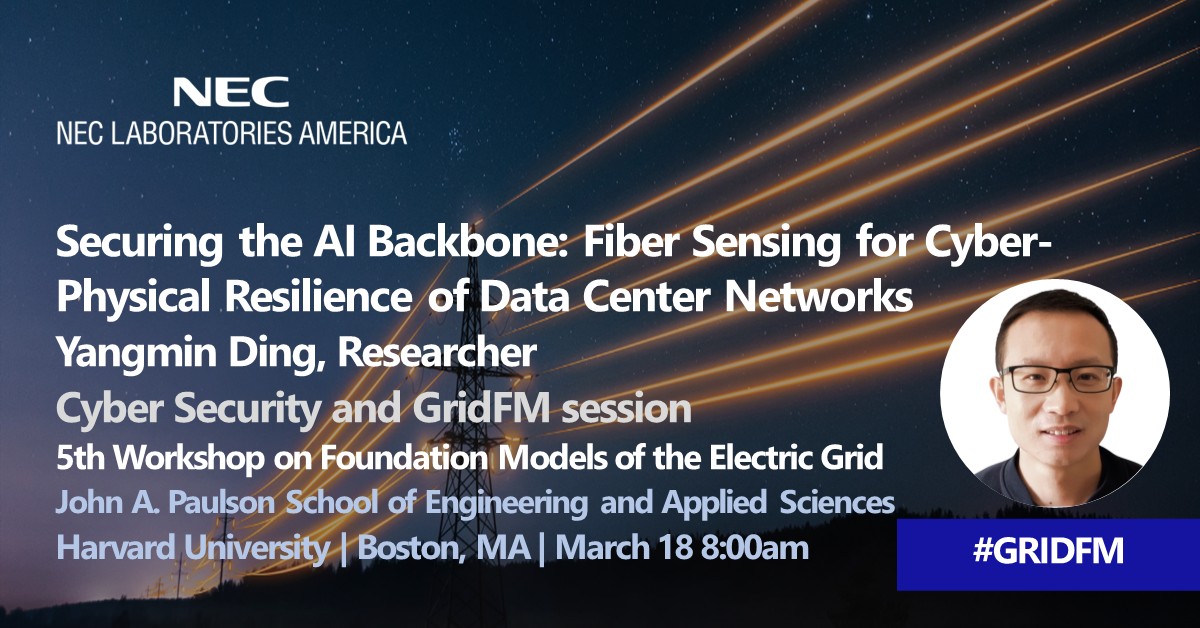
Yangmin Ding, Researcher in the Optical Networking and Sensing Department, will present, Securing the AI Backbone: Fiber Sensing for Cyber-Physical Resilience of Data Center Networks.
📅 5th Workshop on Foundation Models of the Electric Grid, hosted by GridFM
📍 John A. Paulson School of Engineering and Applied Sciences at Harvard University, Boston, MA
🕗 March 18, 8:00 AM
Learn more: https://gridfm.org/harvard/
Securing the AI Backbone: Fiber Sensing for Cyber-Physical Resilience of Data Center Networks
Yangmin will demonstrate how Distributed Fiber Optic Sensing (DFOS) transforms existing communication cables into a proactive cyber-physical security layer. By repurposing fibers into real-time sensors, we achieve meter-scale detection of physical anomalies with high accuracy in field deployments. Ultimately, this physical-layer protection provides the foundational resilience required for trustworthy foundation models.
5th Workshop on Foundation Models of the Electric Grid
The explosive growth of foundation models relies on increasingly dense fiber-optic networks within AI data centers. Yet this critical physical backbone remains vulnerable to tampering, sabotage, and environmental damage, creating risks that traditional software cybersecurity cannot detect. This event will present new research and perspectives on how foundation models and advanced AI can support the operation, security, and resilience of the electric grid while addressing emerging cyber-physical risks.
GridFM
GridFM is a research initiative and workshop series focused on exploring how foundation models and artificial intelligence can be applied to improve the reliability, security, and operation of modern electric power grids.Foundation models (FMs), pre-trained on large datasets and readily adaptable to a broad set of applications, are revolutionizing the field of artificial intelligence (AI). Powerful FMs for language and weather have recently emerged, proving that such models can be developed for complex systems. The GridFM project pioneers the concept of FMs for the electric power grid to be trained on grid data – as opposed to text data – with the overarching goal to develop the underlying technology to cope with the increasing complexity and uncertainties of a faster-growing grid (e.g., due to hyperscalar data centers, crypto mining etc.).
A key benefit is the generalizability of FMs that enables stakeholders to readily fine-tune the model for specific needs and their own proprietary data in a scalable and economical way. These capabilities make the FM approach ideal for unifying data, technology, and industry expertise toward a common goal. Because of that, the GridFM project is supported by a fast-growing community of volunteers from industry, academia, and government from more than 100 organizations with over 250 members. To enable an open collaboration, the GridFM community is partnering with Linux Foundation for Energy, which is providing the tools and resources to developing non-differentiating code that can enable all GridFM stakeholders to develop and implement GridFM to transform their business and the power sector at large.
The GridFM community has three subgroups on technology, collaboration and governance. The entire community meets every 4th Wednesday of the month at 11 am ET. In addition, the GridFM community meets twice a year for a technical deep dive/workshop.
Read About Our Future and Past Events
 https://www.nec-labs.com/wp-content/uploads/2026/06/ACL-2026.jpg
628
1200
NEC Labs America
https://www.nec-labs.com/wp-content/uploads/2025/08/NEC-Laboratories-America-Logo-Aug-2025-2.jpg
NEC Labs America2026-06-23 10:44:402026-06-26 13:45:55NEC Labs America Attends ACL 2026 San Diego July 2-7, 2026
https://www.nec-labs.com/wp-content/uploads/2026/06/ACL-2026.jpg
628
1200
NEC Labs America
https://www.nec-labs.com/wp-content/uploads/2025/08/NEC-Laboratories-America-Logo-Aug-2025-2.jpg
NEC Labs America2026-06-23 10:44:402026-06-26 13:45:55NEC Labs America Attends ACL 2026 San Diego July 2-7, 2026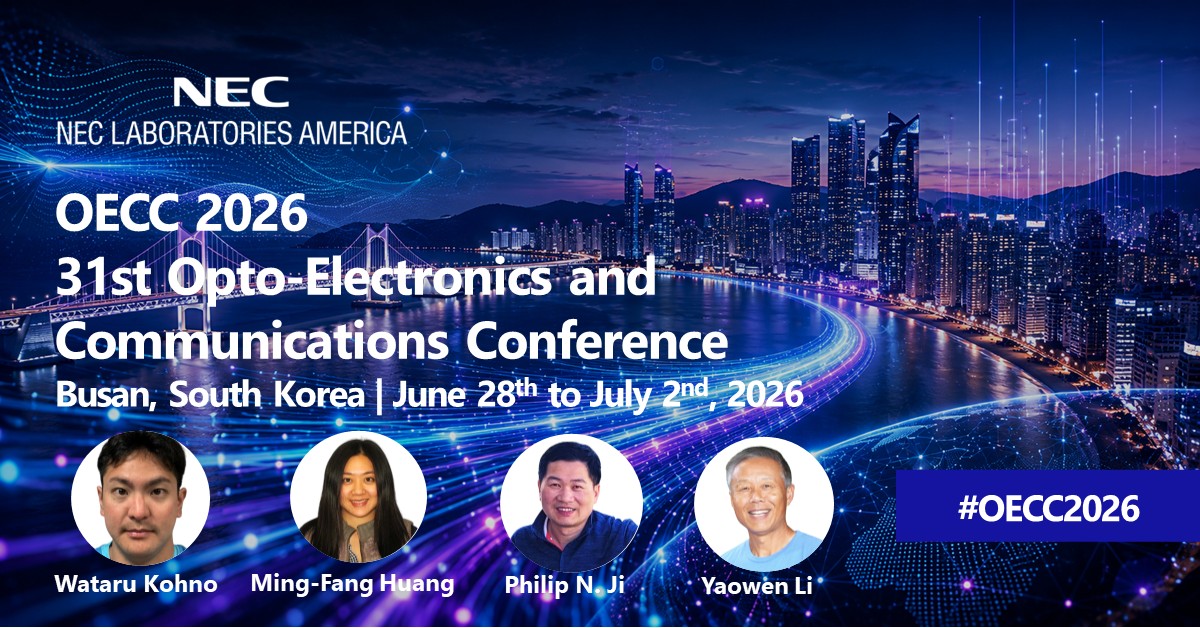 https://www.nec-labs.com/wp-content/uploads/2026/06/OECC-2026-1.jpg
628
1200
NEC Labs America
https://www.nec-labs.com/wp-content/uploads/2025/08/NEC-Laboratories-America-Logo-Aug-2025-2.jpg
NEC Labs America2026-06-15 08:04:152026-06-22 12:55:21NEC Labs America Attends OECC June 28 – July 2, 2026
https://www.nec-labs.com/wp-content/uploads/2026/06/OECC-2026-1.jpg
628
1200
NEC Labs America
https://www.nec-labs.com/wp-content/uploads/2025/08/NEC-Laboratories-America-Logo-Aug-2025-2.jpg
NEC Labs America2026-06-15 08:04:152026-06-22 12:55:21NEC Labs America Attends OECC June 28 – July 2, 2026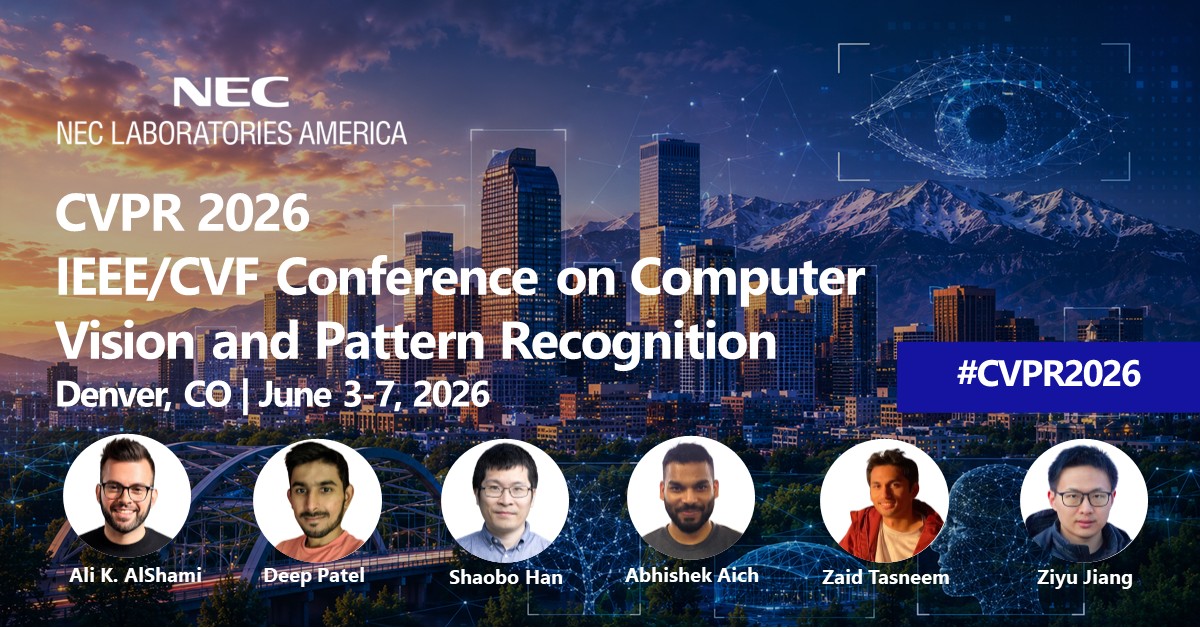 https://www.nec-labs.com/wp-content/uploads/2026/06/CVPR-LATEST.jpg
628
1200
NEC Labs America
https://www.nec-labs.com/wp-content/uploads/2025/08/NEC-Laboratories-America-Logo-Aug-2025-2.jpg
NEC Labs America2026-06-02 07:19:252026-06-26 13:11:51NEC Labs America Attends CVPR 2026 in Denver, CO June 3-7, 2026
https://www.nec-labs.com/wp-content/uploads/2026/06/CVPR-LATEST.jpg
628
1200
NEC Labs America
https://www.nec-labs.com/wp-content/uploads/2025/08/NEC-Laboratories-America-Logo-Aug-2025-2.jpg
NEC Labs America2026-06-02 07:19:252026-06-26 13:11:51NEC Labs America Attends CVPR 2026 in Denver, CO June 3-7, 2026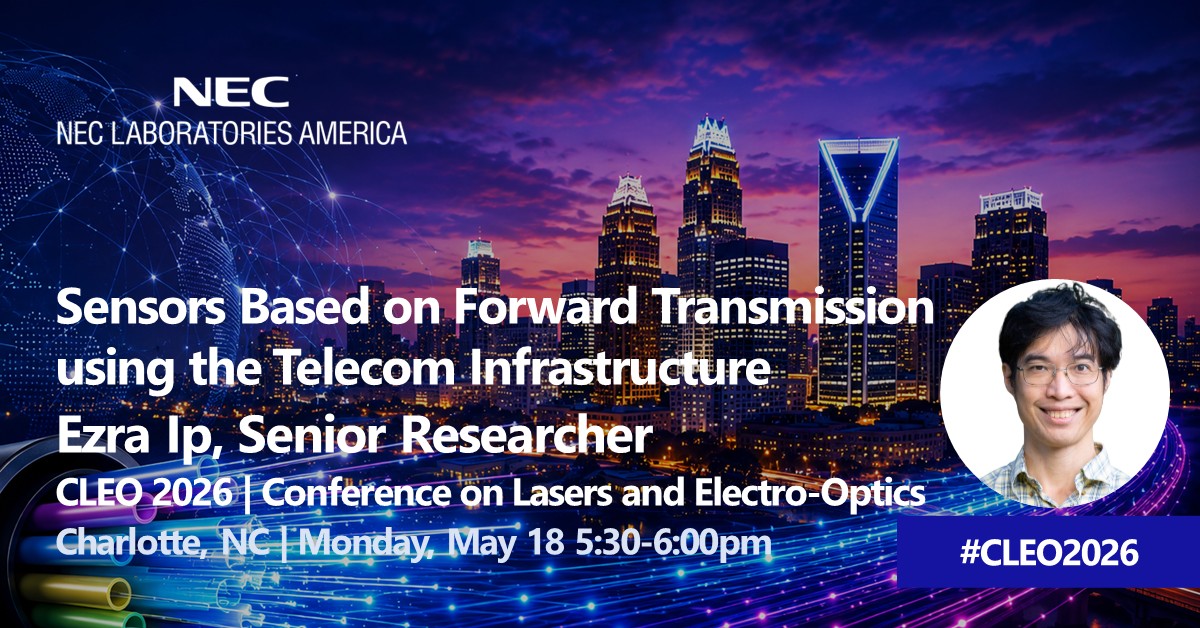 https://www.nec-labs.com/wp-content/uploads/2026/05/CLEO-2026.jpg
628
1200
NEC Labs America
https://www.nec-labs.com/wp-content/uploads/2025/08/NEC-Laboratories-America-Logo-Aug-2025-2.jpg
NEC Labs America2026-05-12 14:06:232026-06-02 21:42:07Ezra Ip Presents at CLEO 2026 in Charlotte, NC on May 18th
https://www.nec-labs.com/wp-content/uploads/2026/05/CLEO-2026.jpg
628
1200
NEC Labs America
https://www.nec-labs.com/wp-content/uploads/2025/08/NEC-Laboratories-America-Logo-Aug-2025-2.jpg
NEC Labs America2026-05-12 14:06:232026-06-02 21:42:07Ezra Ip Presents at CLEO 2026 in Charlotte, NC on May 18th