
Unearthing Nature’s Orchestra – How Fiber Optic Cables Can Hear Cicada Secrets
Introduction
In the ever-evolving landscape of science and technology, unexpected discoveries often lead to groundbreaking innovations. Recently, our researchers uncovered a remarkable application for fiber optic cables—monitoring the vibrant activities of cicadas and other insects. We will delve into how these unassuming cables, originally designed for high-speed internet transmission, became unexpected allies in the world of entomology.
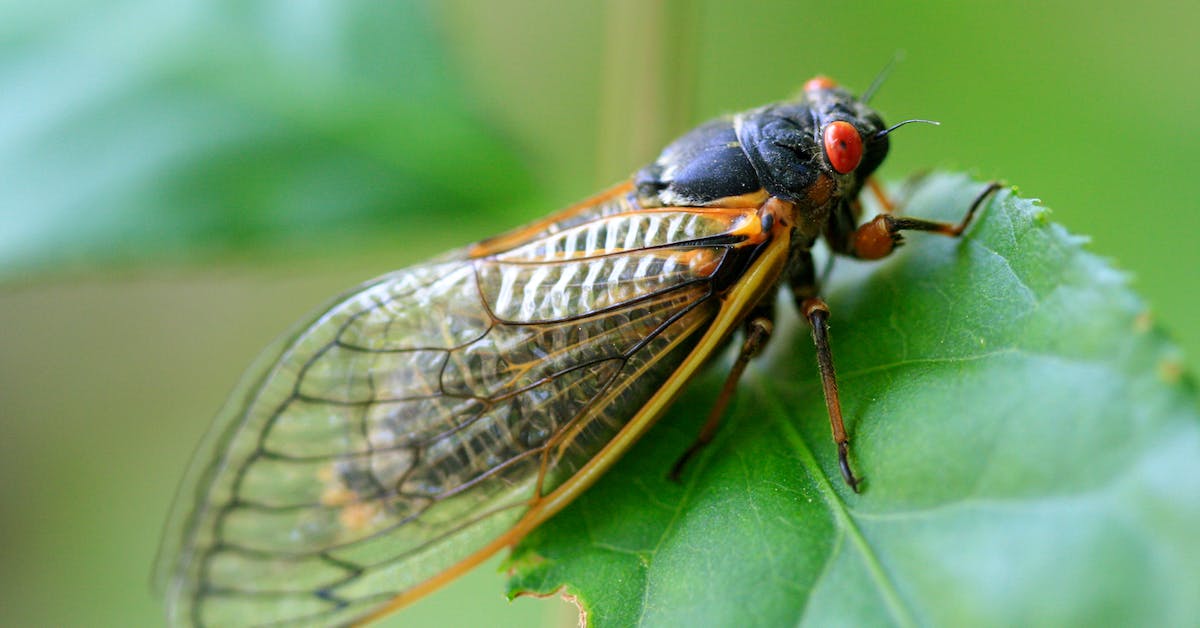
For years, our Optical Networking and Sensing team had been working tirelessly on developing technology that could leverage existing fiber optic cables to monitor acoustic signals. This groundbreaking technology, Distributed Acoustic Sensing (DAS), boasts various monitoring applications, including vehicle traffic, oil and gas pipelines, infrastructure, security, and environmental monitoring. The magic of DAS lies in its ability to turn fiber optic cables into sensitive acoustic sensors. It accomplishes this by sending a laser pulse down a fiber cable and analyzing the reflected light to identify acoustic disturbances and vibrations. The technology’s sensitivity is astonishing — it can detect seismic activities, the loud sounds of passing ambulances, and, intriguingly, the chorus of cicadas.
The Puzzling Cicada Signal: A Serendipitous Discovery
In the spring of 2021, our researcher, Sarper Ozharar, was poring over DAS data at the fiber optics test bed in Princeton, New Jersey, when something unusual caught his attention. He noticed a peculiar signal in the data—an unmistakable frequency buzzing that seemed to permeate the recordings. It was an unexpected encounter that would lead to an unlikely collaboration between our optical scientists and an entomologist.
Further investigation revealed that the DAS-equipped fiber optic cables had an uncanny ability to detect the distinctive sounds of cicadas. This revelation prompted our team to collaborate with Dr. Jessica Ware, an entomologist at the American Museum of Natural History. She confirmed that the cables could capture the volume and patterns of cicada sounds, shedding new light on the behavior of these elusive insects.
Learn more about the resulting paper, Long-Term Monitoring And Analysis Of Brood X Cicada Activity By Distributed Fiber Optic Sensing Technology, by Sarper Ozharar, Jessica L. Ware, Yue Tian and Yangmin Ding below.
Unraveling Cicada Mysteries: Temperature, Population Size, and More
The potential of this technology became increasingly evident as it allowed for meticulous tracking of cicada populations. Cicadas, known for their lengthy periods of underground dwelling (13 or 17 years), emerge to mate spectacularly. DAS-equipped fiber optic cables can record the entire journey, from the emergence to the peak of their chorus and eventually their decline. What is more, it unveiled a direct correlation between temperature fluctuations and the modulation of cicada calls. This newfound knowledge provides entomologists valuable insights into cicada behavior and population dynamics.
Read below for coverage in Wired, Popular Science, American Museum of Natural History and other leading science publications.
The Versatility of Fiber Optic Cables: A Multifunctional Sensor
When affixed to utility poles, these fiber optic cables are multifunctional sensors capable of detecting temperature changes, vibrations, and the loud sounds of cicadas. The concept of distributed fiber optic sensing takes center stage, where disturbances within the cable generate backscattered light. This light is then meticulously analyzed to pinpoint the exact location and intensity of the disturbance. A single 31-mile-long cable equipped with a sensor can detect disturbances with precision as fine as 3 feet.
Conclusion
In conclusion, fiber optic cables, initially designed for high-speed internet transmission, have emerged as invaluable entomology tools. Their capacity to chronicle insect populations’ emergence, abundance, and behavior opens new horizons in our quest to understand these remarkable creatures. As DAS technology continues to evolve, we anticipate even more ingenious applications like this one, promising to unveil the hidden intricacies of the natural world and rewrite the rules of insect monitoring. The Brood X cicadas won’t return until 2038, but we will be ready and listening.
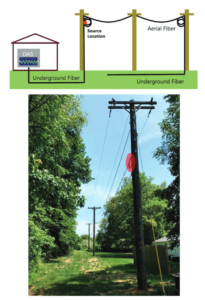
The schematics and a picture of the testbed, the red circle shows the chosen monitoring location in the diagram and the picture
Authors
Sarper Ozharar

Jessica L. Ware



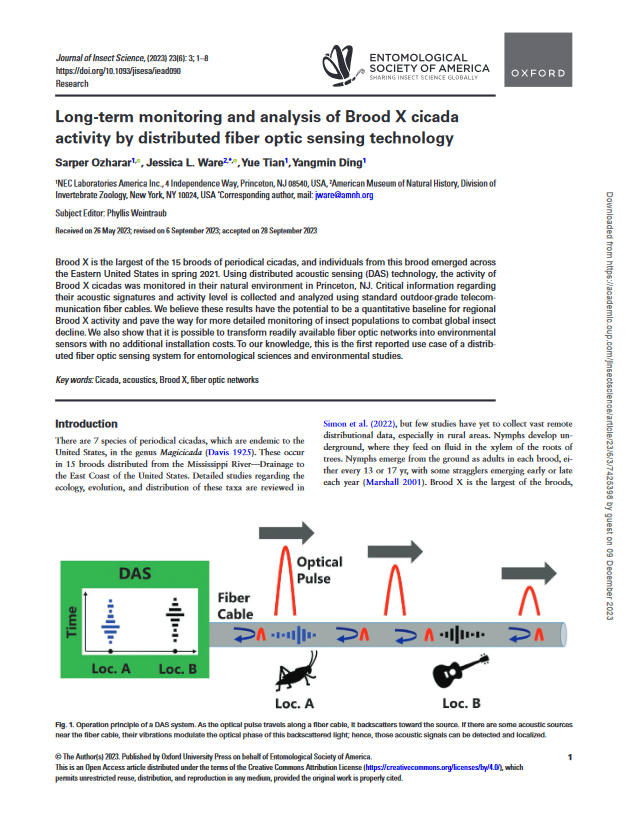
Long-Term Monitoring And Analysis Of Brood X Cicada Activity By Distributed Fiber Optic Sensing Technology Paper
Sarper Ozharar1, Jessica L. Ware 2,* Yue Tian 1, Yangmin Ding 1
1NEC Laboratories America Inc., 4 Independence Way, Princeton, NJ 08540, USA,
2American Museum of Natural History, Division of Invertebrate Zoology, New York, NY 10024, USA *Corresponding author, mail: jware@amnh.org
Journal of Insect Science, Volume 23, Issue 6, November 2023, 3,
https://doi.org/10.1093/jisesa/iead090
https://academic.oup.com/jinsectscience/article/23/6/3/7425398
Published: 30 November 2023
Abstract
Brood X is the largest of the 15 broods of periodical cicadas, and individuals from this brood emerged across the Eastern United States in spring 2021. Using distributed acoustic sensing (DAS) technology, the activity of Brood X cicadas was monitored in their natural environment in Princeton, NJ. Critical information regarding their acoustic signatures and activity level is collected and analyzed using standard outdoor-grade telecommunication fiber cables. We believe these results have the potential to be a quantitative baseline for regional Brood X activity and pave the way for more detailed monitoring of insect populations to combat global insect decline. We also show that it is possible to transform readily available fiber optic networks into environmental sensors with no additional installation costs. To our knowledge, this is the first reported use case of a distributed fiber optic sensing system for entomological sciences and environmental studies.
Media Mentions








Read Our News Posts
 https://www.nec-labs.com/wp-content/uploads/2026/03/Womens-Day-Blog-Post.jpg
628
1200
NEC Labs America
https://www.nec-labs.com/wp-content/uploads/2025/08/NEC-Laboratories-America-Logo-Aug-2025-2.jpg
NEC Labs America2026-03-05 12:36:572026-06-22 21:23:13Celebrating the Women of NEC Laboratories America
https://www.nec-labs.com/wp-content/uploads/2026/03/Womens-Day-Blog-Post.jpg
628
1200
NEC Labs America
https://www.nec-labs.com/wp-content/uploads/2025/08/NEC-Laboratories-America-Logo-Aug-2025-2.jpg
NEC Labs America2026-03-05 12:36:572026-06-22 21:23:13Celebrating the Women of NEC Laboratories America https://www.nec-labs.com/wp-content/uploads/2026/02/Honoring-Black-Innovators-Who-Shaped-Technology.jpg
628
1200
NEC Labs America
https://www.nec-labs.com/wp-content/uploads/2025/08/NEC-Laboratories-America-Logo-Aug-2025-2.jpg
NEC Labs America2026-02-24 08:11:592026-06-23 22:06:56Honoring Black Innovators Who Shaped Technology
https://www.nec-labs.com/wp-content/uploads/2026/02/Honoring-Black-Innovators-Who-Shaped-Technology.jpg
628
1200
NEC Labs America
https://www.nec-labs.com/wp-content/uploads/2025/08/NEC-Laboratories-America-Logo-Aug-2025-2.jpg
NEC Labs America2026-02-24 08:11:592026-06-23 22:06:56Honoring Black Innovators Who Shaped Technology https://www.nec-labs.com/wp-content/uploads/2025/12/2025-Year-in-Review-Blog-Post.jpg
628
1200
NEC Labs America
https://www.nec-labs.com/wp-content/uploads/2025/08/NEC-Laboratories-America-Logo-Aug-2025-2.jpg
NEC Labs America2025-12-18 10:22:482026-06-24 19:23:38NEC Laboratories America 2025: A Year of Disruptive Innovation
https://www.nec-labs.com/wp-content/uploads/2025/12/2025-Year-in-Review-Blog-Post.jpg
628
1200
NEC Labs America
https://www.nec-labs.com/wp-content/uploads/2025/08/NEC-Laboratories-America-Logo-Aug-2025-2.jpg
NEC Labs America2025-12-18 10:22:482026-06-24 19:23:38NEC Laboratories America 2025: A Year of Disruptive Innovation https://www.nec-labs.com/wp-content/uploads/2025/11/Apply-for-Summer-2026-Internship-No-Logo.jpg
628
1200
NEC Labs America
https://www.nec-labs.com/wp-content/uploads/2025/08/NEC-Laboratories-America-Logo-Aug-2025-2.jpg
NEC Labs America2025-11-24 09:43:142026-06-24 19:28:29Apply for a Summer 2026 Internship
https://www.nec-labs.com/wp-content/uploads/2025/11/Apply-for-Summer-2026-Internship-No-Logo.jpg
628
1200
NEC Labs America
https://www.nec-labs.com/wp-content/uploads/2025/08/NEC-Laboratories-America-Logo-Aug-2025-2.jpg
NEC Labs America2025-11-24 09:43:142026-06-24 19:28:29Apply for a Summer 2026 Internship https://www.nec-labs.com/wp-content/uploads/2025/11/Anniversary.jpg
628
1200
NEC Labs America
https://www.nec-labs.com/wp-content/uploads/2025/08/NEC-Laboratories-America-Logo-Aug-2025-2.jpg
NEC Labs America2025-11-01 10:58:072026-06-24 19:29:54NEC Laboratories America: Celebrating 23 Years of Research Innovation!
https://www.nec-labs.com/wp-content/uploads/2025/11/Anniversary.jpg
628
1200
NEC Labs America
https://www.nec-labs.com/wp-content/uploads/2025/08/NEC-Laboratories-America-Logo-Aug-2025-2.jpg
NEC Labs America2025-11-01 10:58:072026-06-24 19:29:54NEC Laboratories America: Celebrating 23 Years of Research Innovation! https://www.nec-labs.com/wp-content/uploads/2025/08/Kayaking-2025.jpg
628
1200
NEC Labs America
https://www.nec-labs.com/wp-content/uploads/2025/08/NEC-Laboratories-America-Logo-Aug-2025-2.jpg
NEC Labs America2025-08-22 13:06:572026-06-24 19:32:41Summer Highlights at NEC Labs America: Teamwork, Innovation, and Fun
https://www.nec-labs.com/wp-content/uploads/2025/08/Kayaking-2025.jpg
628
1200
NEC Labs America
https://www.nec-labs.com/wp-content/uploads/2025/08/NEC-Laboratories-America-Logo-Aug-2025-2.jpg
NEC Labs America2025-08-22 13:06:572026-06-24 19:32:41Summer Highlights at NEC Labs America: Teamwork, Innovation, and Fun