Teaching AI to Edit Driving Scenes It Has Never Seen with HorizonWeaver
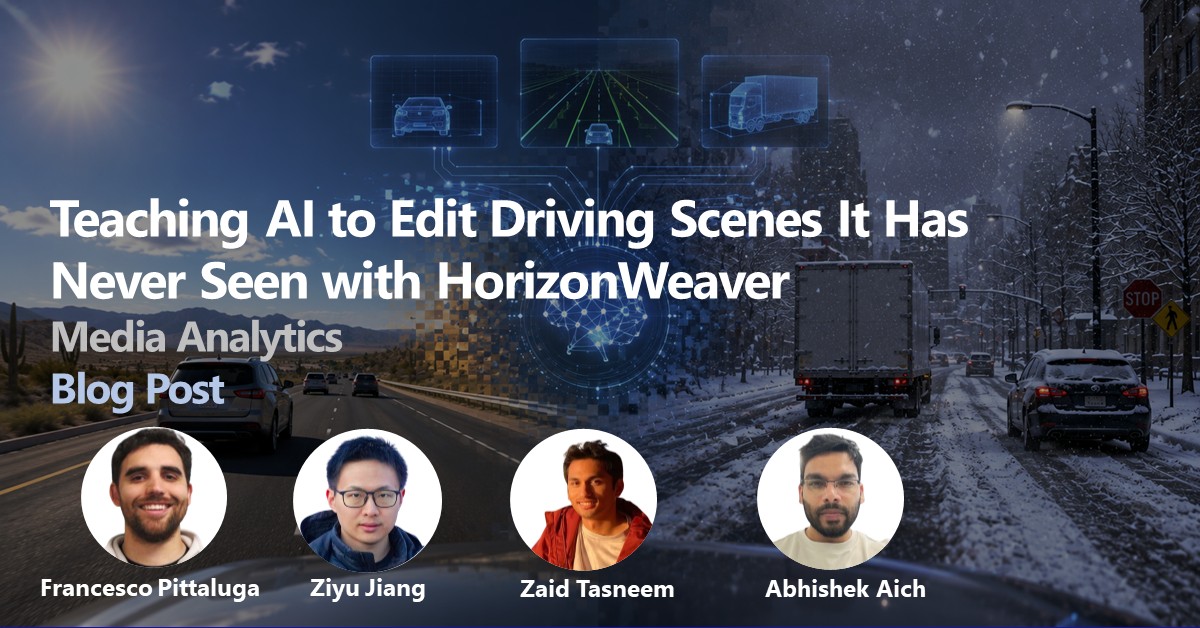
A safety engineer at an autonomous vehicle company pulls up a folder of test footage recorded last spring on a sunny highway outside Phoenix. Regulators want proof that the vehicle’s software can also handle a delivery truck stopped in the middle of a snow-covered street in Minneapolis. Still, no such footage exists yet, and waiting for that exact moment to happen on public roads is neither safe nor practical.
Introduction
This is the problem that NEC Laboratories America’s Media Analytics Department set out to solve with HorizonWeaver: Generalizable Multi-Level Semantic Editing for Driving Scenes, a paper developed in collaboration with Simon Fraser University. The authors are Mauricio Soroco and Wuyang Chen of Simon Fraser University, along with Francesco Pittaluga, Zaid Tasneem, Abhishek Aich, Bingbing Zhuang, Manmohan Chandraker, and Ziyu Jiang of NEC Laboratories America.
Image Editors Built for The Wrong World
Most image editing tools that follow written instructions were built and trained on photos of everyday objects or artwork, things like a single chair in a room or a landscape painting. Ask one of these tools to change the weather on a city street while keeping every lane marking, traffic sign, and parked car exactly where it belongs, and the results tend to fall apart.
The paper points to three reasons why.
- First, driving scenes are crowded with dozens of interacting objects. Hence, an editor must make small, precise changes to individual vehicles or pedestrians while also handling changes to the whole scene, such as switching from day to night, without one kind of edit disturbing the other.
- Second, an editor needs to preserve everything the instruction did not ask it to touch, since safety depends on details like lane geometry and traffic signs staying intact, while still following complex instructions with several conditions at once.
- Third, the handful of driving datasets available today were mostly recorded in a small number of cities and weather patterns, so editors trained on them struggle the moment they see a new environment.
On a benchmark built specifically to test scenes the model had never encountered, existing editors such as Qwen-Image, UltraEdit, BAGEL, and OmniGen2 all showed measurably higher error rates than the approach the team introduces in this paper.
Masks That Speak Instructions
HorizonWeaver addresses these three problems with contributions to the data, the model, and the training process. On the data side, the team built a paired dataset of 255,000 images across 13 categories of driving scene edits, such as adding a pedestrian or changing the weather, drawn from three real-world driving datasets called Boreas, nuScenes, and Argoverse2. Rather than editing a single image and hoping the result looks realistic, the team paired real photographs taken from nearly the same camera position on different days, so the model can learn what changes between a clear afternoon and a snowy one.
On the model side, the paper introduces LangMasks, a way of attaching short text instructions directly to specific pixel regions in an image, like circling a car in a photo and writing a note next to it that says replace this with a white van. This lets the model make several precise, localized edits inside a single busy scene without confusing one instruction for another.
On the training side, the researchers designed a pair of loss functions, mathematical penalties used to guide how a model learns, that reward the model for keeping untouched parts of the scene consistent while still following the instructions closely for the parts it is asked to change.
Numbers That Hold Up
On a set of scenes drawn from nuPlan, a dataset the model never saw during training, HorizonWeaver reduced pixel-level error, measured as L1 distance, by 45.5 percent compared with the strongest competing method, while improving CLIP similarity by 12.1 percent and DINO similarity by 24.1 percent, two measures of how closely an edited image matches its intended content and style.
In a study where 26 people reviewed 409 edited images side by side with four leading alternatives, including Qwen-Image, UltraEdit, BAGEL, and OmniGen2, HorizonWeaver’s edits were chosen as the best match to the instructions 61.1 percent of the time, compared with 14.7 percent for the next best method.
The team also tested whether the added scene variety helps downstream driving software. After training a bird’s-eye view map segmentation model, which identifies road features like crosswalks and lane dividers from overhead-style imagery, on real images augmented with HorizonWeaver-edited scenes, the mean accuracy of that model rose from 0.1859 to 0.2477, an improvement of 33 percent.
That Minneapolis delivery truck the safety engineer needed but never filmed is exactly the kind of scene HorizonWeaver is built to generate: a real Phoenix highway edited into a snow-covered street, with the truck, lane markings, and traffic signs all staying where they belong.
Where This Fits Today
Autonomous vehicle developers and automotive suppliers can use this kind of scene editing to stress test perception and planning software against weather, lighting, and traffic conditions that are too rare or too dangerous to capture on public roads. Simulation and digital twin companies can go further, using the same techniques to multiply a limited set of recorded drives into a much larger library of test scenarios, cutting down on how much new footage needs to be filmed in the first place. Government transportation safety agencies and academic researchers, meanwhile, have less use for the editing tool itself and more for what it produces: the dataset and evaluation benchmarks give them a shared, repeatable way to compare how different perception systems handle unfamiliar environments.
Driving scenes are some of the hardest environments to edit convincingly because a single mistake, like erasing a stop sign or misplacing a lane, is not just a visual flaw; it is a safety issue, said Francesco Pittaluga, Senior Researcher at NEC Laboratories America. We built HorizonWeaver so that the model understands the difference between the objects that safely can change and the ones that never should.
The authors note that HorizonWeaver still relies on instructions generated by large language models and filtering performed by vision language models, both of which can introduce occasional errors or unrealistic edits. They point to human-in-the-loop verification as a direction for future work, alongside continued efforts to broaden the range of driving environments and edit types the model can handle.
About The Authors
Abhishek Aich is a Senior Researcher in our Media Analytics Department. He received a B.Tech. at Biju Patnaik University of Technology, an M.S. at National Institute of Technology and a Ph.D. in Electrical and Computer Engineering at the University of California, Riverside. Dr. Aich’s work focuses on vision-language frameworks, perception problems for autonomous driving, dynamic multi-task architectures and generative AI.
Francesco Pittaluga is a Senior Researcher in our Media Analytics Department. He received his BS in Electrical Engineering and Computer Science from Tufts University and his PhD in Electrical Engineering from the University of Florida. Dr. Pittaluga’s research focuses on applying computer vision to autonomous systems, with an emphasis on privacy-aware representation learning and imaging under adverse conditions.
Manmohan Chandraker is the Department Head of the Media Analytics Department at NEC Laboratories America. He received his PhD in Computer Science from the University of California, San Diego. He was a postdoctoral scholar at the University of California, Berkeley. His team solves fundamental challenges in computer vision, with a focus on understanding and interaction in 3D scenes, foundational vision-language models, robust learning across domains and responsible AI.
Zaid Tasneem is a Researcher in our Media Analytics Department. He has a PhD from Rice University, an MS from the University of Florida, and a B.Tech. from the Indian Institute of Technology, Kanpur. His research focuses on developing agentic simulation frameworks and generative modeling techniques for autonomous driving, contributing to next-generation media intelligence and autonomy platforms.
Ziyu Jiang is a Senior Researcher in our Media Analytics Department. He earned his Ph.D. in Computer Science from Texas A&M University. Dr. Jiang’s work spans two core areas: autonomous driving, where he focuses on building a simulator (a digital twin of the real world) to train and validate autonomous driving algorithms, and robotics, where he is developing an agentic system that enables advanced robot deployment and self-evolution.
Publication to News Series
Our Publication-to-News Series highlights the real-world impact of our latest research, translating complex innovations into practical applications. From AI and machine learning to optical networking and intelligent systems, we showcase how our work goes beyond theory to address real-world challenges. Explore how cutting-edge research at NEC Laboratories America is driving measurable outcomes across industries.
https://www.nec-labs.com/wp-content/uploads/2026/07/Teaching-AI-to-Edit-Driving-Scenes-It-Has-Never-Seen-with-HorizonWeaver-1.jpg
628
1200
NEC Labs America
https://www.nec-labs.com/wp-content/uploads/2025/08/NEC-Laboratories-America-Logo-Aug-2025-2.jpg
NEC Labs America2026-08-11 22:04:592026-08-11 22:05:56Teaching AI to Edit Driving Scenes It Has Never Seen with HorizonWeaver https://www.nec-labs.com/wp-content/uploads/2026/07/Turning-Every-Telecom-Cable-into-a-City-Wide-Sensor-Network.jpg
628
1200
NEC Labs America
https://www.nec-labs.com/wp-content/uploads/2025/08/NEC-Laboratories-America-Logo-Aug-2025-2.jpg
NEC Labs America2026-07-28 09:50:322026-07-28 12:55:09Turning Every Telecom Cable into a City-Wide Sensor Network
https://www.nec-labs.com/wp-content/uploads/2026/07/Turning-Every-Telecom-Cable-into-a-City-Wide-Sensor-Network.jpg
628
1200
NEC Labs America
https://www.nec-labs.com/wp-content/uploads/2025/08/NEC-Laboratories-America-Logo-Aug-2025-2.jpg
NEC Labs America2026-07-28 09:50:322026-07-28 12:55:09Turning Every Telecom Cable into a City-Wide Sensor Network https://www.nec-labs.com/wp-content/uploads/2026/07/When-Video-AI-Gets-Physics-Wrong-the-Consequences-Are-Real-1.jpg
628
1200
NEC Labs America
https://www.nec-labs.com/wp-content/uploads/2025/08/NEC-Laboratories-America-Logo-Aug-2025-2.jpg
NEC Labs America2026-07-21 12:21:442026-07-27 23:37:32When Video AI Gets Physics Wrong, the Consequences Are Real
https://www.nec-labs.com/wp-content/uploads/2026/07/When-Video-AI-Gets-Physics-Wrong-the-Consequences-Are-Real-1.jpg
628
1200
NEC Labs America
https://www.nec-labs.com/wp-content/uploads/2025/08/NEC-Laboratories-America-Logo-Aug-2025-2.jpg
NEC Labs America2026-07-21 12:21:442026-07-27 23:37:32When Video AI Gets Physics Wrong, the Consequences Are Real https://www.nec-labs.com/wp-content/uploads/2026/07/Mix-CLAP-Teaching-Audio-AI-to-Work-in-the-Noisy-Real-World.jpg
628
1200
NEC Labs America
https://www.nec-labs.com/wp-content/uploads/2025/08/NEC-Laboratories-America-Logo-Aug-2025-2.jpg
NEC Labs America2026-07-08 13:18:522026-07-24 22:17:19Mix-CLAP: Teaching Audio AI to Work in the Noisy Real World
https://www.nec-labs.com/wp-content/uploads/2026/07/Mix-CLAP-Teaching-Audio-AI-to-Work-in-the-Noisy-Real-World.jpg
628
1200
NEC Labs America
https://www.nec-labs.com/wp-content/uploads/2025/08/NEC-Laboratories-America-Logo-Aug-2025-2.jpg
NEC Labs America2026-07-08 13:18:522026-07-24 22:17:19Mix-CLAP: Teaching Audio AI to Work in the Noisy Real World