
Graph Neural Networks, Explained: Our Role in the Future of AI
Introduction
Graph Neural Networks (GNNs) have revolutionized the field of machine learning by enabling the processing of data structured as graphs. Unlike traditional neural networks that operate on grid-like data, GNNs are adept at capturing the complex relationships and interdependencies inherent in graph structures.
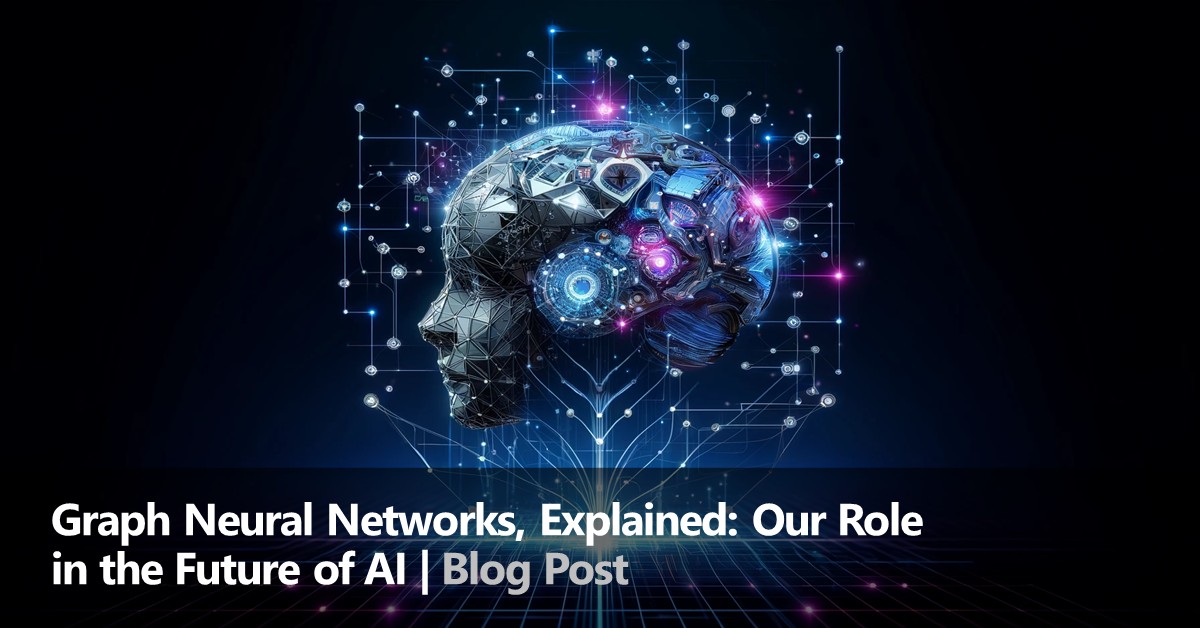
This capability makes them invaluable across various domains, including social network analysis, bioinformatics, and recommendation systems.
Understanding Graph Neural Networks
At their core, GNNs function by propagating information along the edges of a graph, allowing nodes to aggregate features from their neighbors. This message-passing mechanism enables GNNs to learn representations encapsulating local neighborhood structures and global graph properties. Typically, this involves multiple layers where each layer aggregates information from a node’s immediate neighbors, progressively expanding the receptive field and capturing higher-order dependencies.
Graph Neural Networks (GNNs) are a type of neural network architecture designed for learning patterns and making predictions on graph-structured data. In contrast to traditional neural networks that operate on grid-structured data like images or sequences, GNNs are well-suited for data represented as graphs, where entities (nodes) are connected by relationships (edges).
The Significance of GNNs
GNNs are essential because they can model complex systems where entities are interconnected. Traditional machine learning models often struggle with such data due to their inability to naturally handle non-Euclidean structures. GNNs, however, excel in these scenarios by leveraging the graph topology to inform the learning process. This makes them particularly effective for node classification, link prediction, and graph classification.
NEC Laboratories America’s Contributions to GNN Research
NEC Laboratories America (NECLA) has been advancing GNN methodologies, addressing challenges related to robustness, explainability, and application to dynamic graphs. Our research has led to significant innovations that enhance the performance and applicability of GNNs.
Enhancing Robustness in GNNs
One critical challenge in deploying GNNs is their sensitivity to noisy or adversarial inputs. Our researchers have developed methods to improve GNNs’ resilience against such perturbations. For instance, in the study “Learning to Drop: Robust Graph Neural Network via Topological Denoising,” the authors introduce a parameterized topological denoising network (PTDNet).
PTDNet enhances GNN robustness by learning to identify and drop task-irrelevant edges, thereby mitigating the impact of noise in the graph structure. The approach employs nuclear norm regularization to enforce a low-rank constraint on the sparsified graph, promoting better generalization. This method has demonstrated significant performance improvements, especially in noisy datasets.

Wei Cheng, a senior researcher at NECLA, emphasizes the importance of this work: “By focusing on the most relevant connections within a graph, we’ve been able to significantly enhance the robustness of GNNs against noisy data, which is a common challenge in real-world applications.”
Advancing Explainability of GNNs
Understanding their decision-making processes becomes paramount as GNNs are increasingly applied in sensitive domains. NECLA has contributed to this aspect by proposing robust fidelity measures for evaluating the explainability of GNNs. In the paper “Towards Robust Fidelity for Evaluating Explainability of Graph Neural Networks,” the authors introduce an information-theoretic framework to assess explanation functions. They highlight limitations in existing fidelity metrics and propose alternatives resilient to distribution shifts, ensuring more reliable evaluations of GNN explanations. This work provides a foundation for developing GNN models that are accurate and interpretable.

Haifeng Chen, the Department Head of Data Science & System Security at NECLA, notes: “Our goal is to make GNNs not just powerful, but also transparent and trustworthy, especially when they’re used in critical decision-making processes.”
Anomaly Detection in Dynamic Graphs
Dynamic graphs, where the structure evolves, present unique challenges for anomaly detection. NECLA’s research in this area has led to the development of Structural Temporal Graph Neural Networks (StrGNN). Detailed in the publication “Structural Temporal Graph Neural Networks for Anomaly Detection in Dynamic Graphs“
StrGNN is designed to detect anomalous edges by capturing structural and temporal information. The model extracts h-hop enclosing subgraphs centered on target edges and utilizes graph convolution operations alongside gated recurrent units to process temporal features. Deployed in real enterprise security systems, StrGNN has proven effective in identifying advanced threats and optimizing incident response.
Zhengzhang Chen, a senior researcher in the project, explains: “By integrating structural and temporal data, StrGNN can effectively pinpoint anomalies in dynamic systems, which is crucial for proactive threat detection.”
Calibration of GNNs with Out-of-Distribution Nodes
Ensuring that GNNs maintain reliable performance when encountering out-of-distribution (OOD) nodes is crucial for their deployment in real-world scenarios. NECLA addressed this issue in the study “Calibrate Graph Neural Networks under Out-of-Distribution Nodes via Deep Q-learning.” The researchers propose a Graph Edge Re-weighting via Deep Q-learning (GERDQ) framework that adjusts edge weights to mitigate the adverse effects of OOD nodes. By formulating the edge re-weighting process as a Markov Decision Process and employing deep Q-learning, the framework enhances the calibration of GNNs, leading to improved reliability in diverse applications.
Applications and Future Directions
The advancements in GNN research at NECLA have broad implications across various fields. In bioinformatics, for example, GNNs have been utilized to model protein interactions, aiding in understanding complex biological processes.
Read Our News Posts
 https://www.nec-labs.com/wp-content/uploads/2024/03/NEC-Laboratories-Advances-Material-Design-with-AI-based-MateriAI-Platform-.jpg
628
1200
NEC Labs America
https://www.nec-labs.com/wp-content/uploads/2025/08/NEC-Laboratories-America-Logo-Aug-2025-2.jpg
NEC Labs America2024-03-14 10:33:082026-06-26 10:58:38NEC Laboratories Advances Material Design with AI-based MateriAI Platform
https://www.nec-labs.com/wp-content/uploads/2024/03/NEC-Laboratories-Advances-Material-Design-with-AI-based-MateriAI-Platform-.jpg
628
1200
NEC Labs America
https://www.nec-labs.com/wp-content/uploads/2025/08/NEC-Laboratories-America-Logo-Aug-2025-2.jpg
NEC Labs America2024-03-14 10:33:082026-06-26 10:58:38NEC Laboratories Advances Material Design with AI-based MateriAI Platform https://www.nec-labs.com/wp-content/uploads/2024/01/Summer-Intern-2024.jpg
628
1200
NEC Labs America
https://www.nec-labs.com/wp-content/uploads/2025/08/NEC-Laboratories-America-Logo-Aug-2025-2.jpg
NEC Labs America2024-01-08 19:22:402026-06-26 10:59:27Apply for a Summer 2024 Internship
https://www.nec-labs.com/wp-content/uploads/2024/01/Summer-Intern-2024.jpg
628
1200
NEC Labs America
https://www.nec-labs.com/wp-content/uploads/2025/08/NEC-Laboratories-America-Logo-Aug-2025-2.jpg
NEC Labs America2024-01-08 19:22:402026-06-26 10:59:27Apply for a Summer 2024 Internship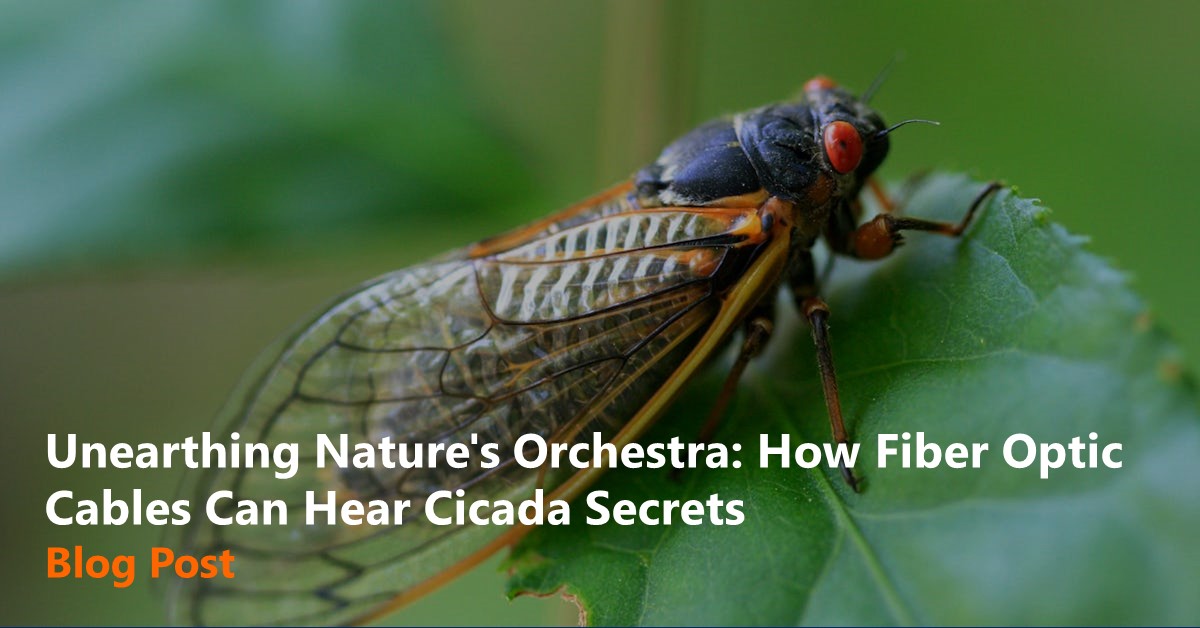 https://www.nec-labs.com/wp-content/uploads/2023/06/Unearthing-Natures-Orchestra-How-Fiber-Optic-Cables-Can-Hear-Cicada-Secrets.jpg
628
1200
NEC Labs America
https://www.nec-labs.com/wp-content/uploads/2025/08/NEC-Laboratories-America-Logo-Aug-2025-2.jpg
NEC Labs America2023-12-11 09:00:532026-06-26 11:00:23Unearthing Nature’s Orchestra – How Fiber Optic Cables Can Hear Cicada Secrets
https://www.nec-labs.com/wp-content/uploads/2023/06/Unearthing-Natures-Orchestra-How-Fiber-Optic-Cables-Can-Hear-Cicada-Secrets.jpg
628
1200
NEC Labs America
https://www.nec-labs.com/wp-content/uploads/2025/08/NEC-Laboratories-America-Logo-Aug-2025-2.jpg
NEC Labs America2023-12-11 09:00:532026-06-26 11:00:23Unearthing Nature’s Orchestra – How Fiber Optic Cables Can Hear Cicada Secrets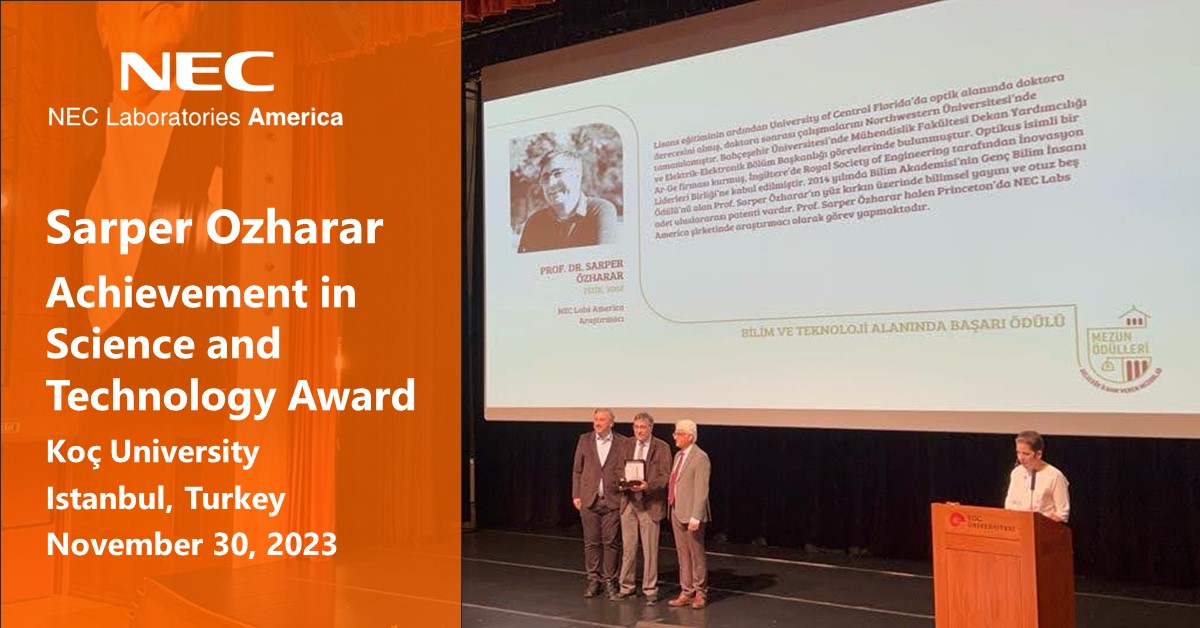 https://www.nec-labs.com/wp-content/uploads/2023/12/Sarper-Ozharar-Achievement-in-Science-and-Technology-Award.jpg
628
1200
NEC Labs America
https://www.nec-labs.com/wp-content/uploads/2025/08/NEC-Laboratories-America-Logo-Aug-2025-2.jpg
NEC Labs America2023-11-30 09:18:112026-06-26 13:03:12Sarper Ozharar Receives Achievement in Science and Technology Award from Koç University
https://www.nec-labs.com/wp-content/uploads/2023/12/Sarper-Ozharar-Achievement-in-Science-and-Technology-Award.jpg
628
1200
NEC Labs America
https://www.nec-labs.com/wp-content/uploads/2025/08/NEC-Laboratories-America-Logo-Aug-2025-2.jpg
NEC Labs America2023-11-30 09:18:112026-06-26 13:03:12Sarper Ozharar Receives Achievement in Science and Technology Award from Koç University https://www.nec-labs.com/wp-content/uploads/2023/09/Meet-the-NEC-Labs-America-Intern-Helping-to-Make-Autonomous-Vehicles-Safer-and-More-Secure-Blog-Post-Graphic.png
628
1200
NEC Labs America
https://www.nec-labs.com/wp-content/uploads/2025/08/NEC-Laboratories-America-Logo-Aug-2025-2.jpg
NEC Labs America2023-09-08 15:38:202026-06-26 11:03:22Meet the NEC Labs America Intern Helping to Make Autonomous Vehicles Safer and More Secure
https://www.nec-labs.com/wp-content/uploads/2023/09/Meet-the-NEC-Labs-America-Intern-Helping-to-Make-Autonomous-Vehicles-Safer-and-More-Secure-Blog-Post-Graphic.png
628
1200
NEC Labs America
https://www.nec-labs.com/wp-content/uploads/2025/08/NEC-Laboratories-America-Logo-Aug-2025-2.jpg
NEC Labs America2023-09-08 15:38:202026-06-26 11:03:22Meet the NEC Labs America Intern Helping to Make Autonomous Vehicles Safer and More Secure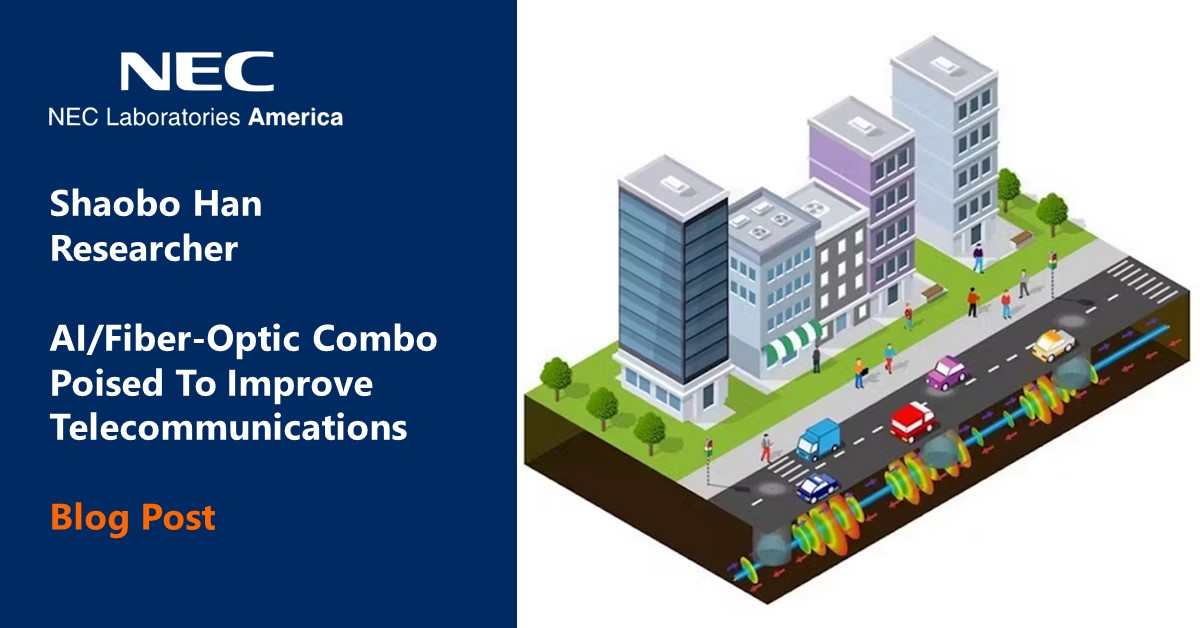 https://www.nec-labs.com/wp-content/uploads/2023/09/AI-Fiber-Optic-Combo-Poised-To-Improve-Telecommunications.jpg
628
1200
NEC Labs America
https://www.nec-labs.com/wp-content/uploads/2025/08/NEC-Laboratories-America-Logo-Aug-2025-2.jpg
NEC Labs America2023-09-07 14:57:352026-06-26 11:04:20AI/Fiber-Optic Combo Poised To Improve Telecommunications
https://www.nec-labs.com/wp-content/uploads/2023/09/AI-Fiber-Optic-Combo-Poised-To-Improve-Telecommunications.jpg
628
1200
NEC Labs America
https://www.nec-labs.com/wp-content/uploads/2025/08/NEC-Laboratories-America-Logo-Aug-2025-2.jpg
NEC Labs America2023-09-07 14:57:352026-06-26 11:04:20AI/Fiber-Optic Combo Poised To Improve Telecommunications