NEC Laboratories America Researchers Win a 2026 Edison Patent Award for Optical Fiber Innovation
NEC Laboratories America will receive a 2026 Edison Patent Award from the Research & Development Council of New Jersey for a patent that lets a single optical fiber carry both data traffic and structural sensing signals at the same time.
The Edison Patent Awards are New Jersey’s highest honor for invention and innovation.

The award, in the Enabling Technologies category, recognizes U.S. Patent No. 10,763,964 B2, “Bidirectional Optical Communication and Sensing WDM Architecture Using Same Fiber Transmission Band,” invented by Yue-Kai Huang, Ezra Ip, Philip Nan Ji, and Ming-Fang Huang from our Optical Networking & Sensing Department.
The 47th Annual Edison Patent Awards Ceremony and Reception, themed “Revolution Through Innovation,” will take place at Bell Works in Holmdel, New Jersey on Thursday, November 19, 2026. The Research & Development Council of New Jersey is honoring 15 patents from 13 organizations this year, alongside five individual awards recognizing eight leaders across the state’s research and innovation community.
Combining Communications and Sensing on One Fiber
Fiber networks carry huge amounts of data using wavelength division multiplexing (WDM). This technique sends many separate signals down one fiber at once, each on its own wavelength of light. Separately, distributed fiber optic sensing (DFOS) systems, use that same kind of fiber to detect vibration, sound, or temperature changes along a cable’s entire length, which is useful for monitoring infrastructure, detecting intrusions, or tracking vehicle traffic near buried cables. Network operators would like to run both systems, communications and sensing, on the same fiber to avoid the cost and complexity of dedicating separate fiber strands to each function.
The Interference Problem
The obstacle is power. DFOS systems interrogate the fiber with optical pulses that are far more powerful, instant to instant, than the steady signals used for data transmission. When those interrogating pulses travel in the same direction as the communications channels, the fiber’s nonlinear optical behavior lets the two interfere with each other, degrading data-link performance. Prior approaches sidestepped the problem by using separate fibers for sensing and communications, which works but consumes a limited resource, since modern fiber routes often already run near capacity and installing new fiber is expensive.
A Counter-Propagating Solution
The patented architecture solves this by sending the communications channels and the sensing interrogation pulses in opposite directions on the same fiber. Because the two signal types counter-propagate rather than travel together, the time and distance over which they can interact through fiber nonlinearity shrinks dramatically, sharply reducing the interference that hobbled earlier designs. The reflected sensing signal that returns toward the receiver still moves in the same direction as the communications channels. Still, its power is so low (million times below original optical sensing pulse), that it has no meaningful effect on data performance.
Validating the Design in the Field
NEC Laboratories America researchers validated the architecture in a field trial across 55 kilometers of installed fiber connecting two sites within a customer network. The trial combined a full C-band dense WDM communications system, transmitting at 400 gigabits per second using a probabilistically shaped 144-point quadrature amplitude modulation (QAM) format, with a distributed acoustic sensing (DAS), system running in the opposite direction. Both systems operated simultaneously without perceptible degradation to the communications link before or after the sensing system was added. The DAS system, meanwhile, captured vibration signatures along the full 55-kilometer span, including traffic patterns and abnormalities due to potholes in the recorded data that corresponded to vehicles moving along roadways next to the buried cable, an indication of the kind of traffic monitoring the combined system can support.
Why It Matters for Network Operators
The invention matters because fiber capacity is a limited and increasingly contested resource. As communications systems adopt multiple wavelength bands to keep up with rising data demand, reserving entire fiber bands or separate fibers exclusively for sensing becomes harder to justify. A design that lets a single fiber, and a single transmission band, carry both functions removes that tradeoff. Utilities, transportation agencies, and network operators that want to monitor infrastructure condition or detect events like traffic, intrusion, or seismic activity along a cable route can do so without sacrificing the communications capacity that same fiber already provides.
2026 Edison Patent Awards
 The 2026 Edison Patent Awards will be presented alongside individual honors including the Science & Technology Medal, awarded this year to CoreWeave co-founders, and the Visionary Award, presented to Audible CEO Bob Carrigan. Other winning organizations include Princeton University, Rutgers, Merck, Siemens, Siemens Healthineers, and Nokia Bell Labs, among others. NEC Laboratories America’s award recognizes work carried out at its Princeton, New Jersey facility, one of the qualifying requirements for every winning patent.
About the Research & Development Council of New Jersey
 The Research & Development Council of New Jersey has been working since 1962 to strengthen the state’s innovation economy by uniting industry, academia, and government. Its mission centers on fostering collaboration among leaders in these sectors, with a vision of advancing innovation to improve the world. The Edison Patent Awards are an annual event held for four decades that celebrates the state’s top inventors and their patented innovations.
About The Authors

Yue-Kai Huang is a Senior Researcher in our Optical Networking and Sensing Department. He received his BS and MS in from National Taiwan University and his PhD from Princeton University. Dr. Huang’s research includes long-distance fiber transmission, optical/RF frontend designs for high-capacity systems, system design for distributed fiber sensing, and optical computation techniques using high-speed photonics.

Ezra Ip is a Senior Researcher in our Optical Networking and Sensing Department. He received a B.E.in electrical and electronics engineering from the University of Canterbury, Christchurch, New Zealand, and his M.S. and Ph.D. in electrical engineering from Stanford University. He plays a key role in designing photonic subsystems for elastic optical networks and next-generation transport layers, scaling optical capacity and improving signal integrity over long-haul fiber links.

Philip Ji is a Senior Researcher in our Optical Networking and Sensing Department. He received his B.E., M.E., and Ph.D. from the University of New South Wales (UNSW). His current research centers on the design and optimization of distributed fiber optic sensors and high-capacity optical networking technologies, with a focus on metro-access integration, network virtualization, and software-defined networking (SDN).

Dr. Ming-Fang “Yvonne” Huang is a Senior Researcher in our Optical Networking & Sensing Department. She leads innovation at the intersection of photonics and intelligent systems. Her work spans distributed fiber-optic sensing, high-capacity optical communications, and AI-driven signal processing technologies, helping to build smarter, more resilient communication and sensing systems for the future.
Read More News
 https://www.nec-labs.com/wp-content/uploads/2024/01/Summer-Intern-2024.jpg
628
1200
NEC Labs America
https://www.nec-labs.com/wp-content/uploads/2025/08/NEC-Laboratories-America-Logo-Aug-2025-2.jpg
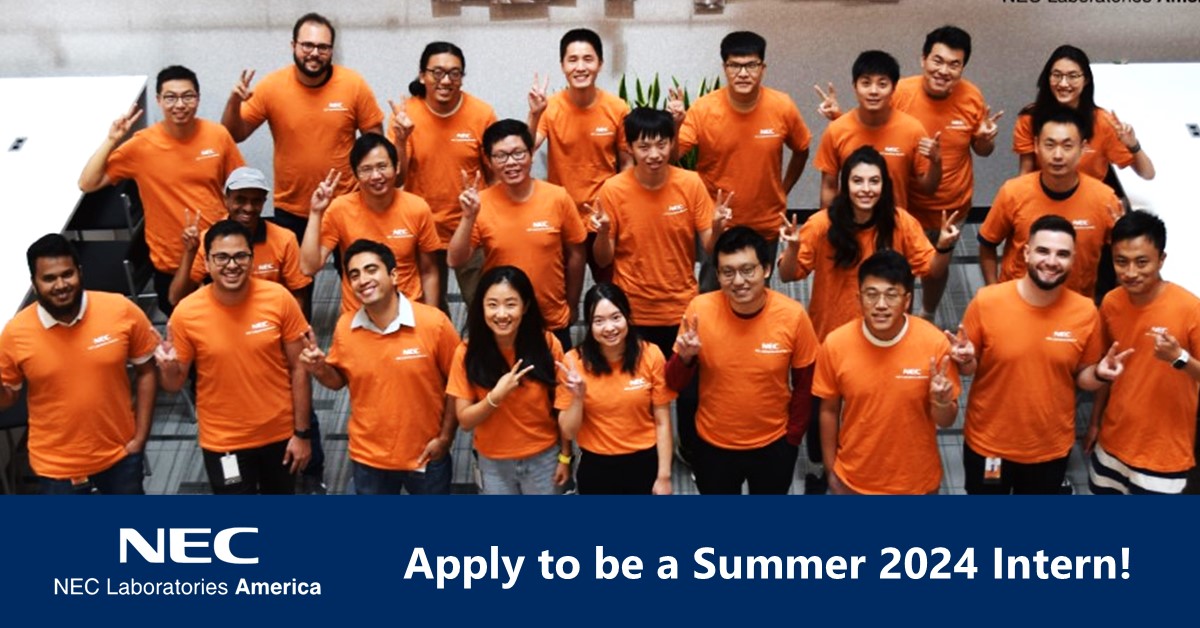
NEC Labs America2024-01-08 19:22:402026-06-26 10:59:27Apply for a Summer 2024 Internship
https://www.nec-labs.com/wp-content/uploads/2024/01/Summer-Intern-2024.jpg
628
1200
NEC Labs America
https://www.nec-labs.com/wp-content/uploads/2025/08/NEC-Laboratories-America-Logo-Aug-2025-2.jpg
NEC Labs America2024-01-08 19:22:402026-06-26 10:59:27Apply for a Summer 2024 Internship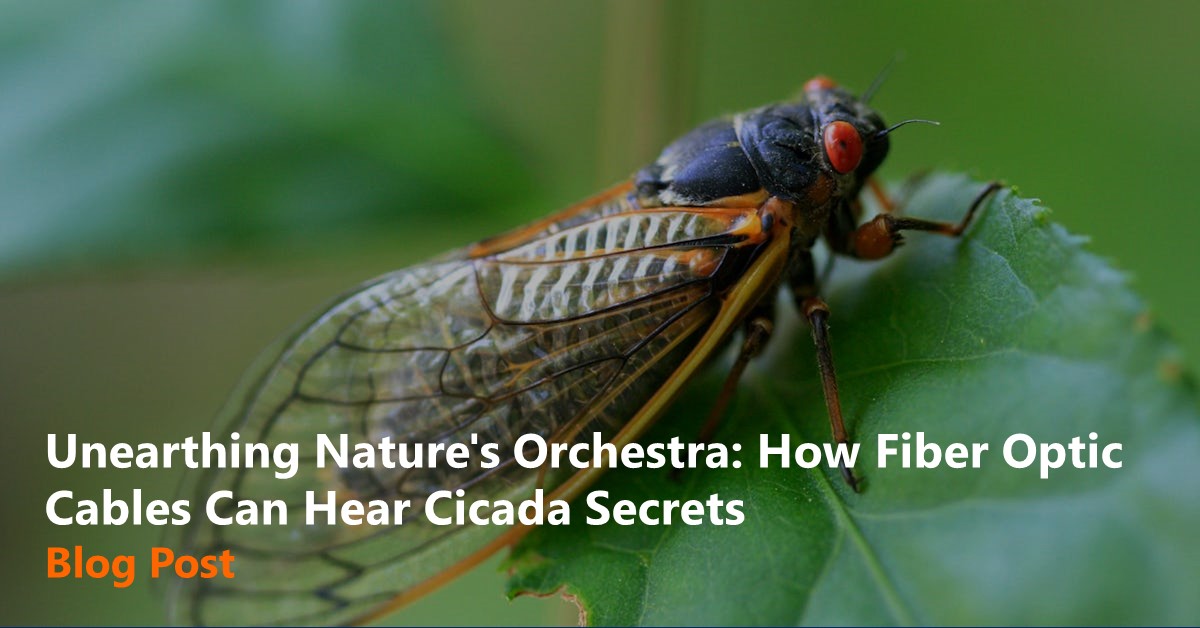 https://www.nec-labs.com/wp-content/uploads/2023/06/Unearthing-Natures-Orchestra-How-Fiber-Optic-Cables-Can-Hear-Cicada-Secrets.jpg
628
1200
NEC Labs America
https://www.nec-labs.com/wp-content/uploads/2025/08/NEC-Laboratories-America-Logo-Aug-2025-2.jpg
NEC Labs America2023-12-11 09:00:532026-06-26 11:00:23Unearthing Nature’s Orchestra – How Fiber Optic Cables Can Hear Cicada Secrets
https://www.nec-labs.com/wp-content/uploads/2023/06/Unearthing-Natures-Orchestra-How-Fiber-Optic-Cables-Can-Hear-Cicada-Secrets.jpg
628
1200
NEC Labs America
https://www.nec-labs.com/wp-content/uploads/2025/08/NEC-Laboratories-America-Logo-Aug-2025-2.jpg
NEC Labs America2023-12-11 09:00:532026-06-26 11:00:23Unearthing Nature’s Orchestra – How Fiber Optic Cables Can Hear Cicada Secrets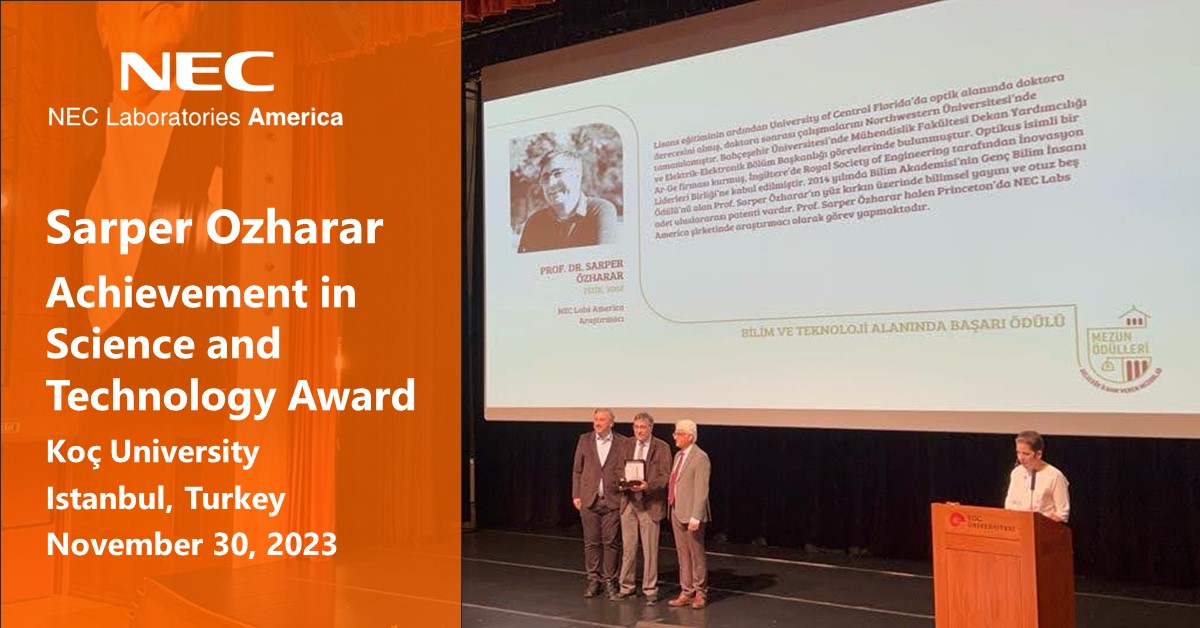 https://www.nec-labs.com/wp-content/uploads/2023/12/Sarper-Ozharar-Achievement-in-Science-and-Technology-Award.jpg
628
1200
NEC Labs America
https://www.nec-labs.com/wp-content/uploads/2025/08/NEC-Laboratories-America-Logo-Aug-2025-2.jpg
NEC Labs America2023-11-30 09:18:112026-06-26 13:03:12Sarper Ozharar Receives Achievement in Science and Technology Award from Koç University
https://www.nec-labs.com/wp-content/uploads/2023/12/Sarper-Ozharar-Achievement-in-Science-and-Technology-Award.jpg
628
1200
NEC Labs America
https://www.nec-labs.com/wp-content/uploads/2025/08/NEC-Laboratories-America-Logo-Aug-2025-2.jpg
NEC Labs America2023-11-30 09:18:112026-06-26 13:03:12Sarper Ozharar Receives Achievement in Science and Technology Award from Koç University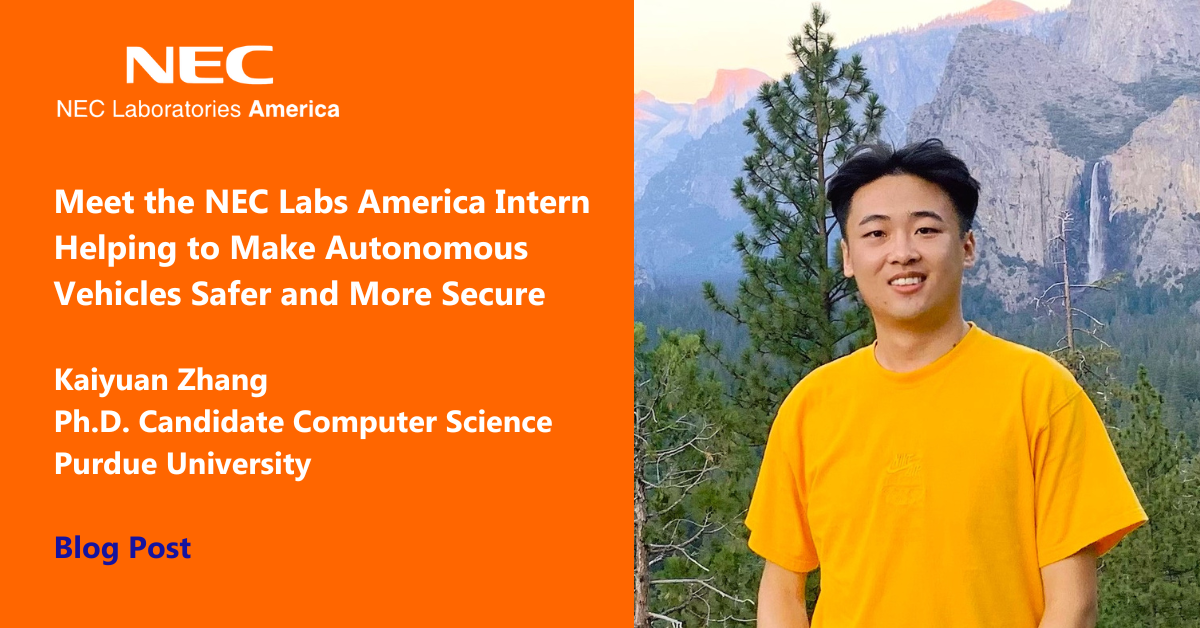 https://www.nec-labs.com/wp-content/uploads/2023/09/Meet-the-NEC-Labs-America-Intern-Helping-to-Make-Autonomous-Vehicles-Safer-and-More-Secure-Blog-Post-Graphic.png
628
1200
NEC Labs America
https://www.nec-labs.com/wp-content/uploads/2025/08/NEC-Laboratories-America-Logo-Aug-2025-2.jpg
NEC Labs America2023-09-08 15:38:202026-06-26 11:03:22Meet the NEC Labs America Intern Helping to Make Autonomous Vehicles Safer and More Secure
https://www.nec-labs.com/wp-content/uploads/2023/09/Meet-the-NEC-Labs-America-Intern-Helping-to-Make-Autonomous-Vehicles-Safer-and-More-Secure-Blog-Post-Graphic.png
628
1200
NEC Labs America
https://www.nec-labs.com/wp-content/uploads/2025/08/NEC-Laboratories-America-Logo-Aug-2025-2.jpg
NEC Labs America2023-09-08 15:38:202026-06-26 11:03:22Meet the NEC Labs America Intern Helping to Make Autonomous Vehicles Safer and More Secure