
NASA’s Artemis program has entered a new era, signaling a major leap forward in deep space exploration.
The successful Artemis II voyage around the moon this month marked the first crewed mission beyond low Earth orbit since Apollo 17 in 1972. Building on the success of Artemis I in 2022, this milestone demonstrates NASA’s readiness to safely send astronauts further.
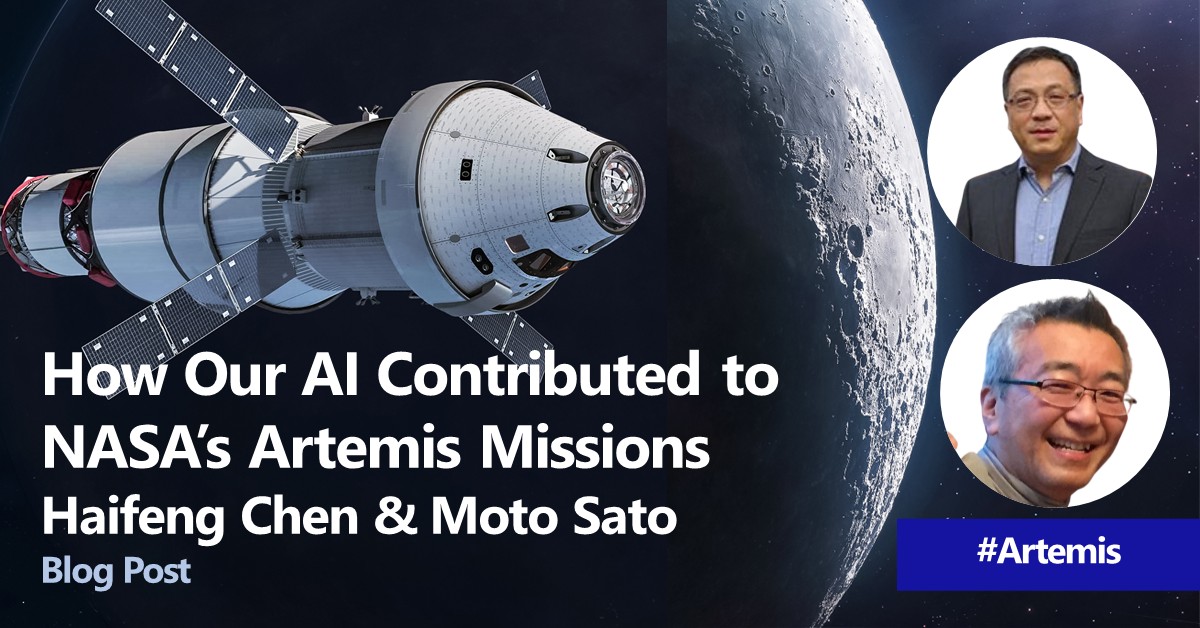
At NEC Laboratories America, we are proud that our AI research contributed to the success of these missions.
During Artemis II, the Orion spacecraft traveled more than 250,000 miles from Earth, setting a record for human distance in space and validating critical systems for deep-space exploration. The mission demonstrated the readiness of the Space Launch System and Orion spacecraft while confirming their ability to safely support human crews on lunar missions. It represents a major step toward returning astronauts to the Moon and building a sustained presence beyond Earth.
Applying AI to a Mission Critical Challenge
Modern spacecraft like Orion generate enormous volumes of telemetry and test data. Understanding how thousands of components interact across mission scenarios is essential for safety and performance, but the scale and complexity often exceed the capabilities of traditional analysis methods. Through our collaboration with Lockheed Martin, our System Invariant Analysis Technology (SIAT) was applied to help analyze this data at scale. SIAT models billions of relationships across system variables, enabling engineers to uncover patterns, dependencies, and anomalies that may otherwise go undetected.
- Read Our AI Research Contributing to NASA’s Artemis Space Program from 2022 to learn more.
Turning Complex Data into Actionable Insight
Analyses that would traditionally take months or years can now be completed in hours, allowing teams to move faster while maintaining safety and reliability. By accelerating how data is analyzed and understood, SIAT helps engineering teams:
- Detect anomalies earlier in testing and validation
- Gain deeper visibility into system-wide behavior
- Improve confidence in mission readiness
- Reduce risk across complex, interdependent systems
Supporting a Historic Crewed Mission
The success of Artemis II highlights the importance of combining advanced engineering with advanced analytics. As the first crewed Artemis mission, it validated spacecraft systems, crew operations, and mission procedures under real conditions. The mission also marked a milestone in representation and global collaboration, featuring a diverse, international crew that captured global attention. Beyond its technical achievements, Artemis II reflects a renewed era of human exploration. AI played a role in supporting this success by helping teams better understand system behavior, identify potential risks earlier, and prepare for the demands of human spaceflight beyond Earth orbit.
Why Artificial Intelligence Is Critical to Artemis
The AI Accelerator Institute says AI is not just enhancing NASA’s Artemis program but fundamentally reshaping it, enabling real-time decision-making, improving system resilience, and allowing spacecraft and astronauts to operate more independently in the harsh, delayed-communication environment of deep space. These missions are far more ambitious and complex than the Apollo program era, extending deeper into space, lasting longer, and generating massive volumes of data. Artemis demands a new level of autonomy that human operators alone cannot provide.
Looking Ahead
With Artemis II completed, NASA is advancing toward future missions that will return astronauts to the lunar surface and support long term exploration, including missions to Mars. As these missions grow more complex, the need for scalable, intelligent data analysis will continue to rise. At NEC Laboratories America, we remain focused on applying AI to high-stakes environments, helping transform complex system data into actionable insight that supports mission success. We are excited to continue contributing to the next phase of Artemis and the future of human space exploration.
About Our Team

Haifeng Chen is the Department Head of the Data Science and System Security Department at NEC Laboratories America. His research focuses on data mining, system security, and industrial AI. His leadership has helped shape the department’s role as a key contributor to NEC’s innovations in fields such as enterprise systems, national defense, and space technology. He received his PhD in Computer Engineering from Rutgers University.

Moto Sato is the Director of Business Development at NEC Laboratories America, where he leads strategic partnerships and growth initiatives to bring advanced research and emerging technologies to market. He works closely with industry partners, government organizations, and internal research teams to identify high-impact opportunities and translate innovation into real-world applications. Moto holds a Bachelor of Science in Electrical Engineering from Tokyo Denki University in Tokyo, Japan.
Read Our News Posts
 https://www.nec-labs.com/wp-content/uploads/2024/11/Summer-2025-Intern-SMM-1.jpg
628
1200
NEC Labs America
https://www.nec-labs.com/wp-content/uploads/2025/08/NEC-Laboratories-America-Logo-Aug-2025-2.jpg
NEC Labs America2024-11-21 14:27:162026-06-26 10:33:52Apply for a Summer 2025 Internship
https://www.nec-labs.com/wp-content/uploads/2024/11/Summer-2025-Intern-SMM-1.jpg
628
1200
NEC Labs America
https://www.nec-labs.com/wp-content/uploads/2025/08/NEC-Laboratories-America-Logo-Aug-2025-2.jpg
NEC Labs America2024-11-21 14:27:162026-06-26 10:33:52Apply for a Summer 2025 Internship https://www.nec-labs.com/wp-content/uploads/2024/10/Princeton-Interns-2024.jpg
628
1200
NEC Labs America
https://www.nec-labs.com/wp-content/uploads/2025/08/NEC-Laboratories-America-Logo-Aug-2025-2.jpg
NEC Labs America2024-10-01 13:32:522026-07-13 11:25:22Summer Interns 2024
https://www.nec-labs.com/wp-content/uploads/2024/10/Princeton-Interns-2024.jpg
628
1200
NEC Labs America
https://www.nec-labs.com/wp-content/uploads/2025/08/NEC-Laboratories-America-Logo-Aug-2025-2.jpg
NEC Labs America2024-10-01 13:32:522026-07-13 11:25:22Summer Interns 2024 https://www.nec-labs.com/wp-content/uploads/2024/08/Introducing-the-Trustworthy-Generative-AI-Project-Pioneering-the-Future-of-Compositional-Generation-and-Reasoning-Blog-Post.jpg
628
1200
NEC Labs America
https://www.nec-labs.com/wp-content/uploads/2025/08/NEC-Laboratories-America-Logo-Aug-2025-2.jpg
NEC Labs America2024-08-19 16:53:452026-06-26 13:06:10Introducing the Trustworthy Generative AI Project: Pioneering the Future of Compositional Generation and Reasoning
https://www.nec-labs.com/wp-content/uploads/2024/08/Introducing-the-Trustworthy-Generative-AI-Project-Pioneering-the-Future-of-Compositional-Generation-and-Reasoning-Blog-Post.jpg
628
1200
NEC Labs America
https://www.nec-labs.com/wp-content/uploads/2025/08/NEC-Laboratories-America-Logo-Aug-2025-2.jpg
NEC Labs America2024-08-19 16:53:452026-06-26 13:06:10Introducing the Trustworthy Generative AI Project: Pioneering the Future of Compositional Generation and Reasoning https://www.nec-labs.com/wp-content/uploads/2024/08/Introducing-Our-New-Project-Time-Series-Language-Model-for-Explainable-AI-Blog-Post.jpg
628
1200
NEC Labs America
https://www.nec-labs.com/wp-content/uploads/2025/08/NEC-Laboratories-America-Logo-Aug-2025-2.jpg
NEC Labs America2024-08-13 15:12:542026-06-26 10:52:12Introducing Our New Project: Time Series Language Model for Explainable AI
https://www.nec-labs.com/wp-content/uploads/2024/08/Introducing-Our-New-Project-Time-Series-Language-Model-for-Explainable-AI-Blog-Post.jpg
628
1200
NEC Labs America
https://www.nec-labs.com/wp-content/uploads/2025/08/NEC-Laboratories-America-Logo-Aug-2025-2.jpg
NEC Labs America2024-08-13 15:12:542026-06-26 10:52:12Introducing Our New Project: Time Series Language Model for Explainable AI https://www.nec-labs.com/wp-content/uploads/2024/08/Agentic-LLMs-for-AI-Orchestration-Project-Revolutionizing-Complex-Workflows-.jpg
628
1200
NEC Labs America
https://www.nec-labs.com/wp-content/uploads/2025/08/NEC-Laboratories-America-Logo-Aug-2025-2.jpg
NEC Labs America2024-08-08 17:48:302026-06-30 08:30:46Agentic LLMs for AI Orchestration Project: Revolutionizing Complex Workflows
https://www.nec-labs.com/wp-content/uploads/2024/08/Agentic-LLMs-for-AI-Orchestration-Project-Revolutionizing-Complex-Workflows-.jpg
628
1200
NEC Labs America
https://www.nec-labs.com/wp-content/uploads/2025/08/NEC-Laboratories-America-Logo-Aug-2025-2.jpg
NEC Labs America2024-08-08 17:48:302026-06-30 08:30:46Agentic LLMs for AI Orchestration Project: Revolutionizing Complex Workflows https://www.nec-labs.com/wp-content/uploads/2024/07/The-Evolution-of-Disciplines-From-Experimental-Roots-to-Theoretical-Frameworks-Blog-Post.jpg
628
1200
Christopher White
https://www.nec-labs.com/wp-content/uploads/2025/08/NEC-Laboratories-America-Logo-Aug-2025-2.jpg
Christopher White2024-07-29 11:10:202026-06-26 10:54:20The Evolution of Disciplines: From Experimental Roots to Theoretical Frameworks
https://www.nec-labs.com/wp-content/uploads/2024/07/The-Evolution-of-Disciplines-From-Experimental-Roots-to-Theoretical-Frameworks-Blog-Post.jpg
628
1200
Christopher White
https://www.nec-labs.com/wp-content/uploads/2025/08/NEC-Laboratories-America-Logo-Aug-2025-2.jpg
Christopher White2024-07-29 11:10:202026-06-26 10:54:20The Evolution of Disciplines: From Experimental Roots to Theoretical Frameworks