Multi-Agent Simulator for Carbon Neutrality: The Technology the World Has Been Waiting For
Note: This article was originally published on NEC’s website. Toshimi Takabe-French interviewed our researchers and wrote the original article.

Every nation, government body, and enterprise must undertake meaningful action against the looming threat of climate change. Despite this collective urgency, identifying an efficient strategy remains a daunting task.
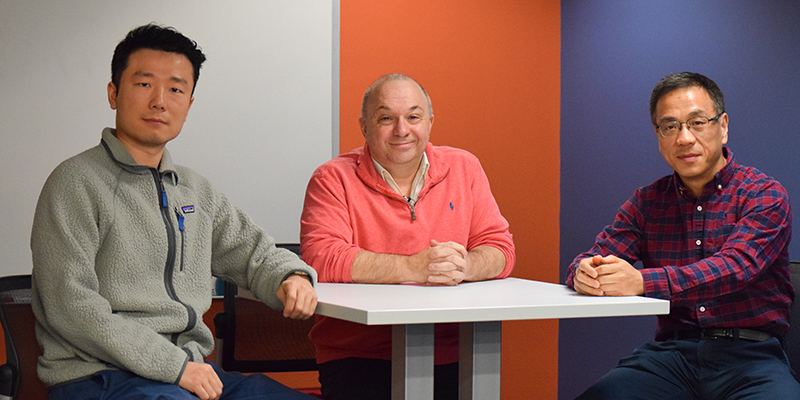
Compounding the challenge is the absence of a reliable method to accurately quantify Scope 3 carbon emissions, a crucial aspect in understanding and mitigating our carbon footprint. However, there is now a glimmer of hope. Our team has developed multi-agent simulator technology, an innovative approach that holds promise as a pivotal tool to meet these global challenges. We sat down with our NEC Labs America President Chris White, Data Science and System Security Department Head Haifeng Chen and Data Science and System Security Researcher Haoyu Wang to discuss this new approach and explore its potential to drive tangible progress in our fight against climate change.
Scope 3 Carbon Emissions, Tough To Capture
What kind of technology is the “multi-agent simulator for carbon neutrality”?
Haifeng: Our primary objective in developing this simulator is to model the supply chain for achieving carbon neutrality and promoting environmental sustainability. We are mainly targeting the simulation of Scope 3 (*) carbon emissions, which represent the largest source of greenhouse gases and are very difficult to estimate. Currently, the market uses the industrial average solution for emission calculation, which is inaccurate or not detailed. Instead, we aim to calculate emissions for each product, company, supplier, or even for an entire supply chain. Our multi-agent simulator makes the simulation more detailed and accurate, with flexible and user-friendly features that are usable by any business domain.
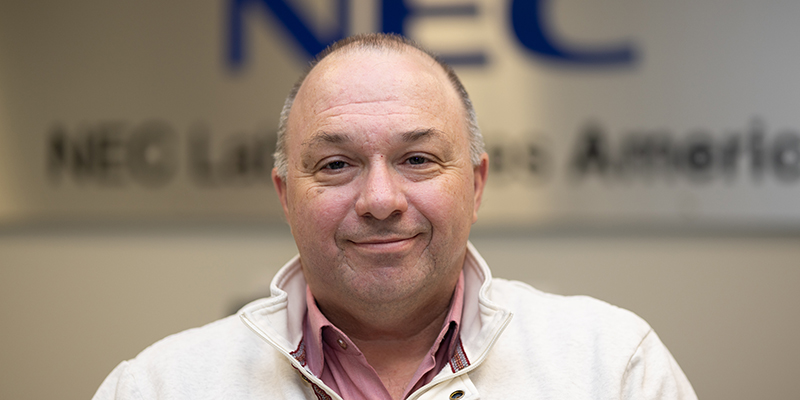
Chris White, President, NEC Laboratories America
Chris: We are targeting the world-scale problems that need large-scale collaborative optimization in the global supply chain. This simulator does not try to be a quantitative digital twin, which requires a lot of information and very detailed models to acquire a high percentage of precision.
You may spend an enormous amount of time trying to build that model. Instead, we use representative information. You ask ‘what-if’ questions and receive answers that are semi-quantitative results with credible reasons. If we need, we can add more data or sophistication.
Haifeng: Three categories of stakeholders can benefit from this multi-agent simulator. The first category is the corporations and businesses, where they must reduce their carbon footprint. For example, a procurement department can include a carbon factor in choosing a supplier in addition to the price and the performance of products according to the CDP (Carbon Disclosure Project). A manufacturer on a cap and a trade program may receive a penalty if they emit carbon beyond the limit. However, using our simulator, they will have choices. They can increase their productivity to create more revenue if they are under the limit. Or they can reduce their productivity to receive more credit to save or to sell their credit to another plant. The second category is governments which can use this simulator to develop evidence-based policies and regulations. The third category is the consulting firms, who can use the simulator as part of their service offerings to advise their clients effectively.
The Features That Make a Difference
What is the “multi-agent simulator” composed of?
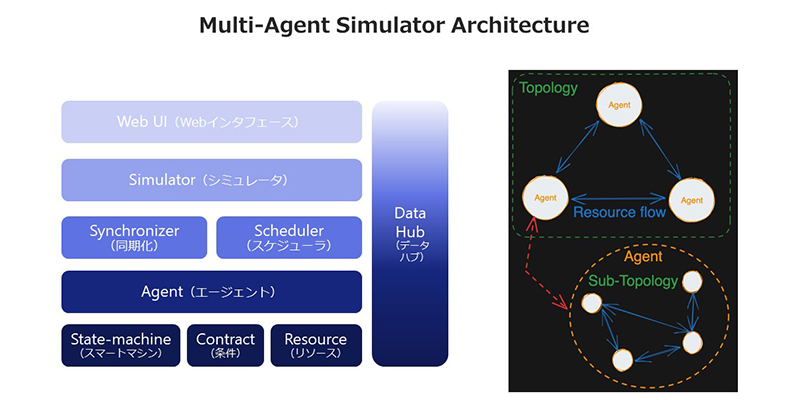
Haoyu: Our simulator has three core components: Agent, Resource, and Topology. An agent is something or someone who needs to make some decisions. For example, agents in the supply chain can be factories, warehouses, suppliers, or consumers, all of whom can make their own decisions. The resources are what agents exchange, which can be money or products. Finally, the topology is the connectivity over which those agents exchange the resources, which can be locations.
By modifying the complexity of the resource and topology, the user can adjust the level of detail the simulator provides. It allows us to start with a simple model and increase the sophistication as we receive more complex questions.
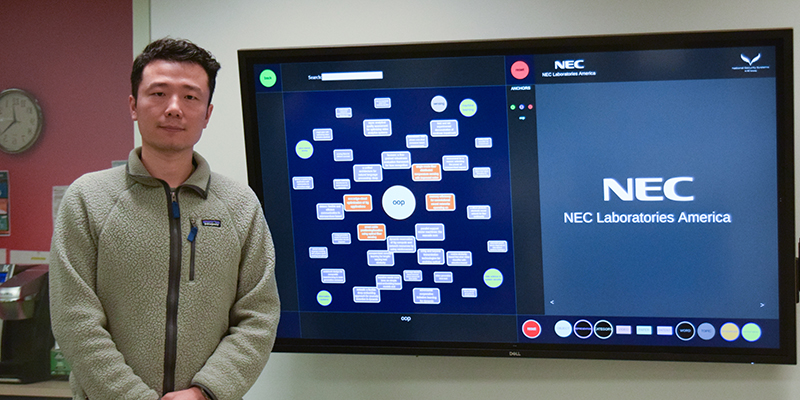
Haoyu Wang, Researcher,
We focus on this because any complex system can be decomposed into these three components, which makes it easier to adjust the fidelity and complexity. We expect that we will be able to apply this tool and this methodology to many other kinds of complex systems.
Our simulator can answer various ‘what-if’ scenarios, the most significant benefit we can acquire from this simulation. You can ask, “How about I change one supplier for one product from supplier A to supplier B?” With this ‘what-if’ scenario, users can change configurations in a controlled and safe virtual environment before implementing these changes in the real world. All that users need to do is to ask questions. Our simulator can simulate actions of multiple entities that are hard even for an expert to calculate using Excel sheets. The more questions you ask, the more sophisticated and accurate the simulator can grow.
Customers’ Challenges are NEC’s Power
Why was it possible for NEC to develop this technology?
Haifeng: The simulation tool contains a core module and a number of semi-core templates, which gives the customer more flexibility. The user can receive proper answers no matter what kind of business scenarios there are. The conversational language model and graphical user interface enable more user-friendly operability. Also, we are currently integrating artificial intelligence (AI) into our simulation to advance and further improve its performance.
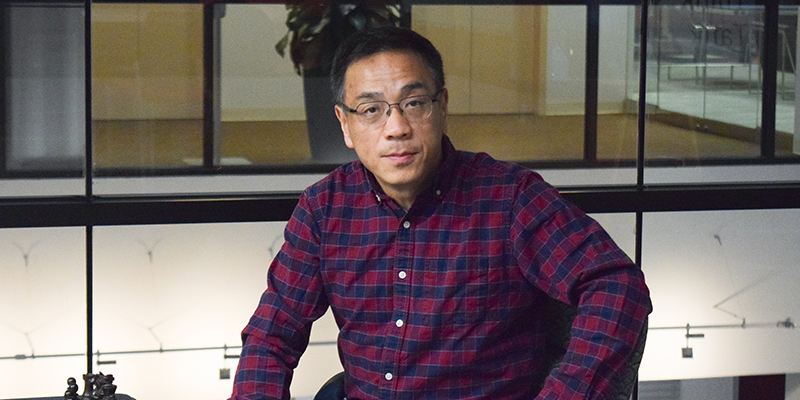
Haifeng Chen, Department Head, NEC Laboratories America
Chris: NEC, as a global corporation, has many different customers that have many other challenges, and NEC’s research labs, which are located worldwide, are solving global-scale supply chain problems every day. You need a multi-agent simulator like this to answer these ‘what-if’ questions inspired by those customers who have already faced the same challenges. Our goal is to take specific customer challenges and solve them not with particular solutions but with general solutions that can be applied often with different customers. That could be a difference that maybe other companies wouldn’t do.
The Tool and the Methodology Can Grow Together
What are the future applications? What are the development directions?
Haifeng: Future applications can be in logistics and transportation, identifying bottlenecks and estimating the cost of those situations. It can help process and organization optimization improve efficiency and reduce risks. We can expand the current Scope 3 carbon emission simulation to Scope 1 and Scope 2 emissions to make a complete portfolio of carbon emission calculations.
Chris: We will sophisticate both the tool and the methodology spontaneously. We are integrating AI into our simulator to enhance its capability and functionality. NEC has strong expertise in AI, and its performance keeps evolving. The simulation we are making with AI is what is creating the data. The AI generates data, and our simulator gives answers based on the most credible output. Through AI, our simulator will accumulate data and continue to improve. Thus, the tool and the methodology have power. We are preparing for small-scale commercial use.
This technology is a multi-agent simulator developed for Scope 3 carbon emissions in the supply chain, featuring well-balanced fidelity and complexity. It is well known that Scope 3 emissions are challenging to calculate, and it would take an enormous number of years to simulate using traditional methods. NEC is making it possible to find the proper solutions regarding carbon emission neutralization for many business activities and policy-making processes.
This simulator has three core components, Agent, Resource, and Topology, which can be applied to many complex systems in any business domain. Its ‘what-if’ scenarios are ready to answer anything from simple questions to more detailed and complicated ones. The more users provide input, the more sophisticated the simulator grows. Its semi-core component architecture, AI enhancement, and user-friendly interface provide flexibility, intelligence, and seamless user experience.
Note: This article was originally published on NEC’s website. Toshimi Takabe-French interviewed our researchers and wrote the original article. The information posted on this page is the information at the time of publication.
(*) Scope 1 emissions are direct greenhouse emissions from sources associated with fuel combustion. Scope 2 emissions are indirect emissions associated with the purchase of electricity or cooling. Scope 3 emissions are indirect greenhouse gases from all sources except 1 and 2.
Our Data Science & System Security Research
We aim to build novel big-data solutions and service platforms to simplify complex systems management. We develop new information technology that supports innovative applications, from big data analytics to the Internet of Things. Our experimental and theoretical research includes many data science and systems research domains. These include but are not limited to time series mining, deep learning, NLP and large language models, graph mining, signal processing, and cloud computing.
Read Our News Posts
 https://www.nec-labs.com/wp-content/uploads/2026/03/Womens-Day-Blog-Post.jpg
628
1200
NEC Labs America
https://www.nec-labs.com/wp-content/uploads/2025/08/NEC-Laboratories-America-Logo-Aug-2025-2.jpg
NEC Labs America2026-03-05 12:36:572026-06-22 21:23:13Celebrating the Women of NEC Laboratories America
https://www.nec-labs.com/wp-content/uploads/2026/03/Womens-Day-Blog-Post.jpg
628
1200
NEC Labs America
https://www.nec-labs.com/wp-content/uploads/2025/08/NEC-Laboratories-America-Logo-Aug-2025-2.jpg
NEC Labs America2026-03-05 12:36:572026-06-22 21:23:13Celebrating the Women of NEC Laboratories America https://www.nec-labs.com/wp-content/uploads/2026/02/Honoring-Black-Innovators-Who-Shaped-Technology.jpg
628
1200
NEC Labs America
https://www.nec-labs.com/wp-content/uploads/2025/08/NEC-Laboratories-America-Logo-Aug-2025-2.jpg
NEC Labs America2026-02-24 08:11:592026-06-23 22:06:56Honoring Black Innovators Who Shaped Technology
https://www.nec-labs.com/wp-content/uploads/2026/02/Honoring-Black-Innovators-Who-Shaped-Technology.jpg
628
1200
NEC Labs America
https://www.nec-labs.com/wp-content/uploads/2025/08/NEC-Laboratories-America-Logo-Aug-2025-2.jpg
NEC Labs America2026-02-24 08:11:592026-06-23 22:06:56Honoring Black Innovators Who Shaped Technology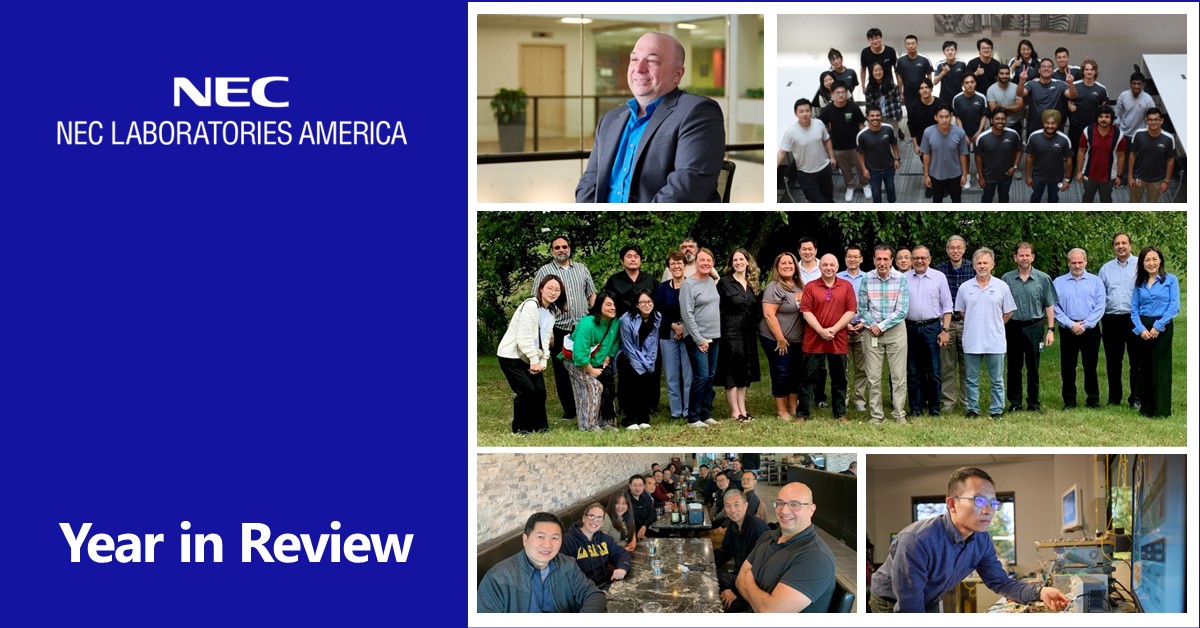 https://www.nec-labs.com/wp-content/uploads/2025/12/2025-Year-in-Review-Blog-Post.jpg
628
1200
NEC Labs America
https://www.nec-labs.com/wp-content/uploads/2025/08/NEC-Laboratories-America-Logo-Aug-2025-2.jpg
NEC Labs America2025-12-18 10:22:482026-06-24 19:23:38NEC Laboratories America 2025: A Year of Disruptive Innovation
https://www.nec-labs.com/wp-content/uploads/2025/12/2025-Year-in-Review-Blog-Post.jpg
628
1200
NEC Labs America
https://www.nec-labs.com/wp-content/uploads/2025/08/NEC-Laboratories-America-Logo-Aug-2025-2.jpg
NEC Labs America2025-12-18 10:22:482026-06-24 19:23:38NEC Laboratories America 2025: A Year of Disruptive Innovation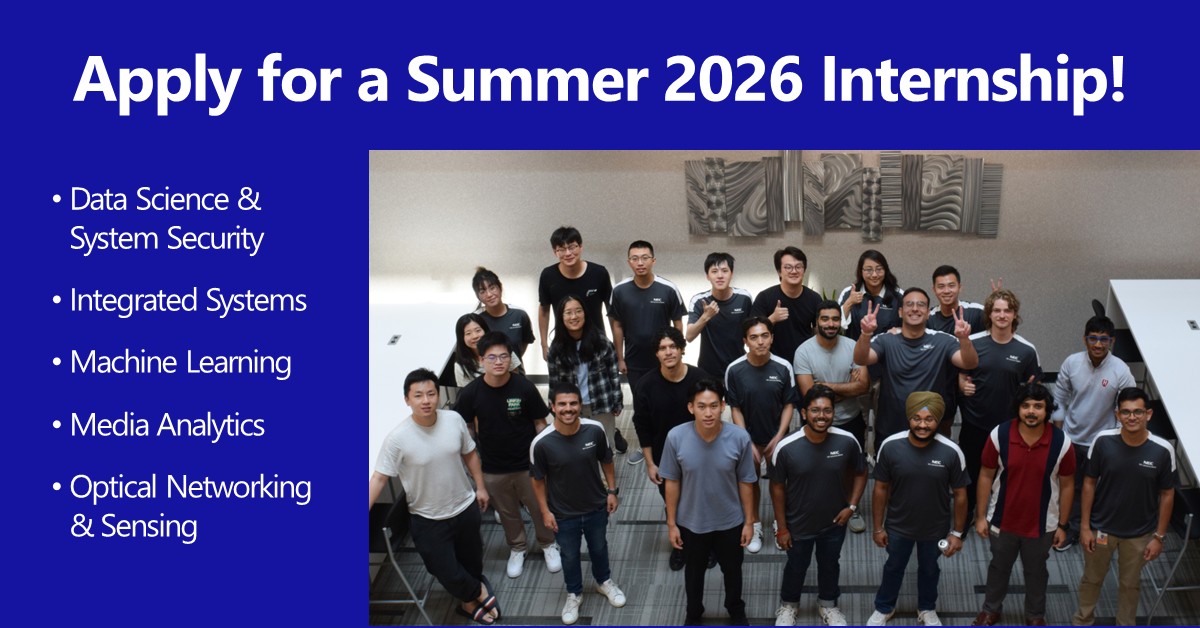 https://www.nec-labs.com/wp-content/uploads/2025/11/Apply-for-Summer-2026-Internship-No-Logo.jpg
628
1200
NEC Labs America
https://www.nec-labs.com/wp-content/uploads/2025/08/NEC-Laboratories-America-Logo-Aug-2025-2.jpg
NEC Labs America2025-11-24 09:43:142026-06-24 19:28:29Apply for a Summer 2026 Internship
https://www.nec-labs.com/wp-content/uploads/2025/11/Apply-for-Summer-2026-Internship-No-Logo.jpg
628
1200
NEC Labs America
https://www.nec-labs.com/wp-content/uploads/2025/08/NEC-Laboratories-America-Logo-Aug-2025-2.jpg
NEC Labs America2025-11-24 09:43:142026-06-24 19:28:29Apply for a Summer 2026 Internship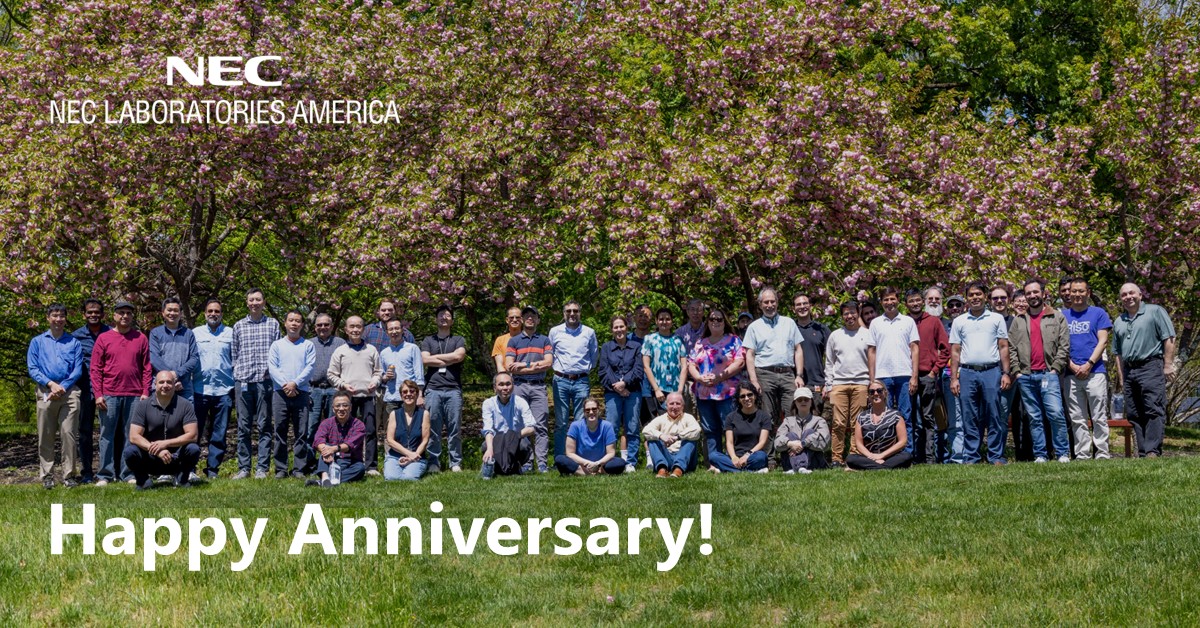 https://www.nec-labs.com/wp-content/uploads/2025/11/Anniversary.jpg
628
1200
NEC Labs America
https://www.nec-labs.com/wp-content/uploads/2025/08/NEC-Laboratories-America-Logo-Aug-2025-2.jpg
NEC Labs America2025-11-01 10:58:072026-06-24 19:29:54NEC Laboratories America: Celebrating 23 Years of Research Innovation!
https://www.nec-labs.com/wp-content/uploads/2025/11/Anniversary.jpg
628
1200
NEC Labs America
https://www.nec-labs.com/wp-content/uploads/2025/08/NEC-Laboratories-America-Logo-Aug-2025-2.jpg
NEC Labs America2025-11-01 10:58:072026-06-24 19:29:54NEC Laboratories America: Celebrating 23 Years of Research Innovation!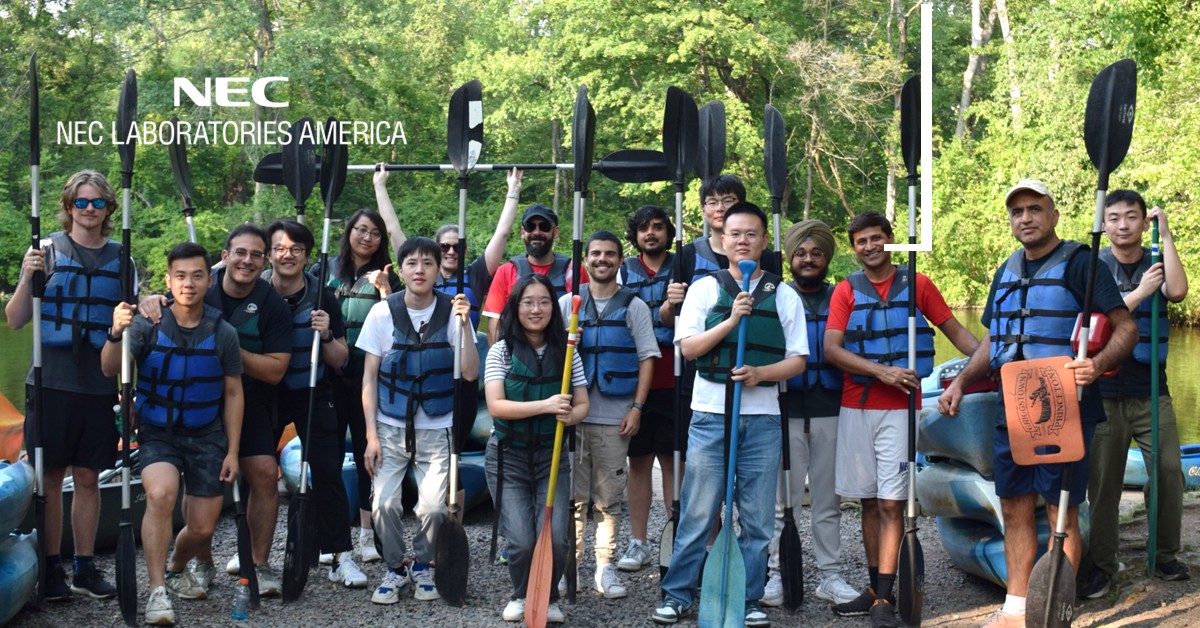 https://www.nec-labs.com/wp-content/uploads/2025/08/Kayaking-2025.jpg
628
1200
NEC Labs America
https://www.nec-labs.com/wp-content/uploads/2025/08/NEC-Laboratories-America-Logo-Aug-2025-2.jpg
NEC Labs America2025-08-22 13:06:572026-06-24 19:32:41Summer Highlights at NEC Labs America: Teamwork, Innovation, and Fun
https://www.nec-labs.com/wp-content/uploads/2025/08/Kayaking-2025.jpg
628
1200
NEC Labs America
https://www.nec-labs.com/wp-content/uploads/2025/08/NEC-Laboratories-America-Logo-Aug-2025-2.jpg
NEC Labs America2025-08-22 13:06:572026-06-24 19:32:41Summer Highlights at NEC Labs America: Teamwork, Innovation, and Fun