NEC Laboratories America (NECLA) is pleased to participate in the 40th Annual Conference on Neural Information Processing Systems (NeurIPS 2026), one of the world’s premier conferences dedicated to artificial intelligence (AI), machine learning, and computational neuroscience.
This year’s conference will take place across three international locations:
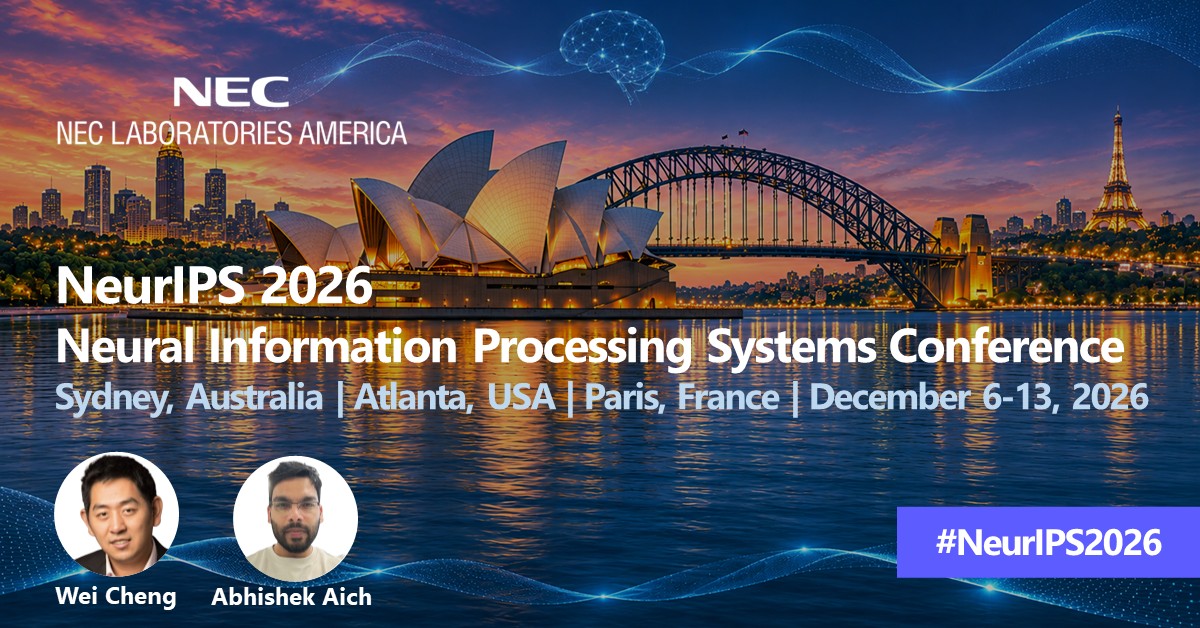
- Sydney, Australia (Main Conference): December 6–12, 2026
- Atlanta, Georgia (Satellite Conference): December 9–13, 2026
- Paris, France (Satellite Conference): December 9–13, 2026
NeurIPS 2026 brings together leading researchers, scientists, engineers, and industry innovators to share groundbreaking discoveries, explore emerging technologies, and advance the frontiers of AI research.
As a global leader in industrial research, NEC Laboratories America is committed to developing innovative AI and machine learning technologies that address complex real-world challenges. Our researchers work across disciplines including deep learning, generative AI, trustworthy AI, computer vision, data science, and optimization, translating scientific advances into practical solutions with meaningful societal and economic impact.
NeurIPS provides an important opportunity for our research teams to engage with the international scientific community, exchange ideas, explore new collaborations, and contribute to discussions shaping the future of artificial intelligence. Through participation in leading scientific conferences such as NeurIPS, NEC Laboratories America reinforces its commitment to advancing cutting-edge research, fostering collaboration between academia and industry, and accelerating the development of next-generation AI technologies. We look forward to connecting with fellow researchers and innovators at NeurIPS 2026.
Presentations
SpecForge: Agent-Oriented Code Documentation Optimization via Multi-Frontier Tree Search

- Wei Cheng pictured, Yutong Cheng (Presenter), Haifeng Chen, Peng Gao
- Poster Presentation
- Thursday, December 10, 2026 • 4:30 PM – 7:30 PM (Atlanta Time)
- Atlanta, USA | Hall C1 #A918
- https://neurips.cc/virtual/2026/loc/atlanta/poster/148372
Abstract: As language models become autonomous software agents, documentation shifts from explanatory prose to a natural-language behavioral specification for code generation. We study agent-oriented documentation generation, where the objective is not readability but the correctness of code synthesized from documentation alone, turning the task into a black-box search over natural-language specifications evaluated only through the generated code and its execution behavior. Its defining difficulty is output coupling: program entities are behaviorally entangled, so a revision that sharpens the specification of one entity may simultaneously destabilize its dependents, inducing the familiar whack-a-mole failure mode in iterative refinement. We introduce SpecForge, a multi-frontier tree search solution that preserves complementary search frontiers through Pareto state management to avoid premature commitment and escape certain frontier-local optima, performs dependency-constrained bandit selection for callee-before-caller refinement, and uses diversified error-conditioned expansion to remain robust to noisy test feedback. On DevEval+, SpecForge attains the best performance across five backbone models, including a 94.9% solve rate with Claude-4.5-Sonnet and a 25.7% average improvement over the leading baseline. We further demonstrate that the resulting specifications improve downstream performance on both cross-language code translation and new-feature implementation.
Driving Video Retrieval for Complex Queries with Structured Grounding

- Manyi Yao (Presenter), Sparsh Garg, Christian Shelton, Amit Roy-Chowdhury, Abhishek Aich (pictured)
- Poster Presentation
- Fri, Dec 11, 2026 | 4:30 PM – 7:30 PM EST (Atlanta time)
- Atlanta, USA | Hall C1 #A608
- https://neurips.cc/virtual/2026/loc/atlanta/poster/152910
Abstract: Video retrieval at scale is central to data curation and safety validation in autonomous driving, where users want to find not only scenes but also dynamic events such as cut-ins and hard braking. Existing vision-language and keyword-based retrieval methods often miss these events because the relevant motion may not be explicitly described in text or captured by lexical overlap. Rule-based retrieval can encode such events more directly, but it is brittle: generated or hand-written rules often fail when their assumptions do not match real driving data. We propose STRIVE-D, a data-calibrated retrieval framework for driving videos. STRIVE-D uses weakly labeled in-domain videos to estimate when a query rule is reliable, adapt rules that mismatch observed data, and fuse calibrated rule scores with vision-language and keyword-based retrieval signals. Across three driving benchmarks, including newly released human annotations for event retrieval on DrivingDojo, STRIVE-D achieves up to a 30.4% relative improvement over state-of-the-art retrieval models.
SkillRL: Evolving Agents via Recursive Skill-Augmented Reinforcement Learning
- Former intern Peng Xia, University of North Carolina at Chapel Hill (presenter), Jianwen Chen, Hanyang Wang, Jiaqi Liu, Kaide Zeng, Yu Wang, Siwei Han, Yiyang Zhou, Xujiang Zhao, Haifeng Chen, Zeyu Zheng, Cihang Xie, Huaxiu Yao
- Poster Presentation
- Thursday, December 10, 2026 |10:00 AM – 1:00 PM
- Atlanta, USA |
- https://neurips.cc/virtual/2026/loc/atlanta/poster/156011
Abstract: Large Language Model (LLM) agents have shown stunning results in complex tasks, yet they often operate in isolation, failing to learn from past experiences. Existing memory-based methods primarily store raw trajectories, which are often redundant and noise-heavy. This prevents agents from extracting high-level, reusable behavioral patterns that are essential for generalization. In this paper, we propose SkillRL, a framework that bridges the gap between raw experience and policy improvement through automatic skill discovery and recursive evolution. Our approach introduces an experience-based distillation mechanism to build a hierarchical skill library SkillBank, an adaptive retrieval strategy for general and task-specific heuristics, and a recursive evolution mechanism that allows the skill library to co-evolve with the agent’s policy during reinforcement learning. These innovations significantly reduce the token footprint while enhancing reasoning utility. Experimental results on ALFWorld, WebShop and seven search-augmented tasks demonstrate that SkillRL achieves state-of-the-art performance, outperforming strong baselines over 15.3% and maintaining robustness as task complexity increases.
HierFlow: Hierarchical Coupled Dual-Space Search for Automatic Agentic Workflow Generation
- Former intern Dong Li, Baylor University, (Presenter), Dong Li, Yanchi Liu, Xujiang Zhao, Wei Cheng, Zhengzhang Chen, Xintao Wu, Zhong Chen, Chen Zhao, Haifeng Chen
- Poster Presentation
- Thu, Dec 10, 2026 | 4:30 PM – 7:30 PM EST (Atlanta)
- Atlanta, USA | Hall C1 #A820
- https://neurips.cc/virtual/2026/loc/atlanta/poster/149679
Abstract: Agentic AI systems enable LLMs to solve non-trivial tasks through structured workflows, but automatically generating such workflows remains challenging due to the discrete and combinatorial search space. Existing methods often rely on offline search or training, limiting query-level adaptability and incurring substantial data and engineering overhead. We formulate workflow generation as a coupled topology–execution search problem, where the upper-level topology induces subtask-specific code-search domains and lower-level execution feedback can revise the topology itself. Based on this formulation, we propose HierFlow, a training-free hierarchical test-time search framework for automatic agentic workflow generation. HierFlow couples feedback-driven topology refinement with an MCTS-inspired lightweight tree search for execution-level sub-workflow optimization, and uses an adaptive gating mechanism to selectively trigger execution-level search based on estimated necessity. We further provide a coupling-aware analysis characterizing when hierarchical decomposition and proxy-based gating are beneficial and when their advantages may degrade under stronger cross-subtask coupling. Experiments across QA, mathematical reasoning, and code generation benchmarks show that HierFlow achieves strong performance and favorable efficiency–quality trade-offs, outperforming competitive baselines without additional training.
Read About Our Future and Past Events
https://www.nec-labs.com/wp-content/uploads/2026/11/NEURIPS-2026-1.jpg
628
1200
NEC Labs America
https://www.nec-labs.com/wp-content/uploads/2025/08/NEC-Laboratories-America-Logo-Aug-2025-2.jpg
NEC Labs America2026-11-16 14:04:512026-11-16 16:50:31NEC Laboratories America Attends NeurIPS 2026, December 6-13th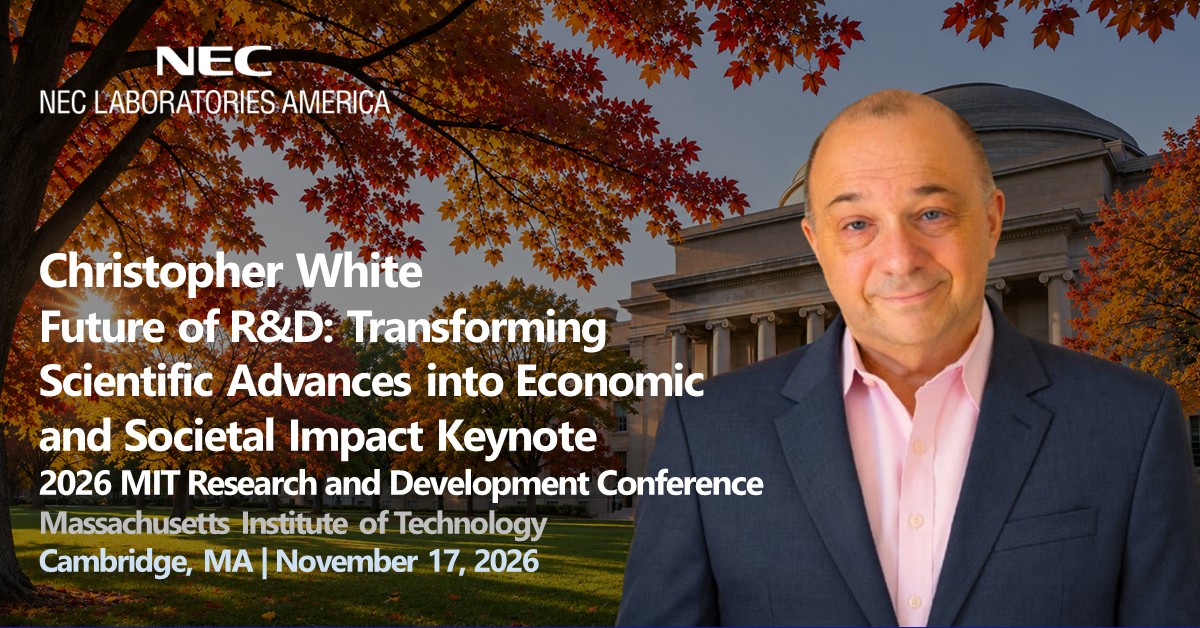 https://www.nec-labs.com/wp-content/uploads/2026/11/Future-of-RD-Transforming-Scientific-Advances-into-Economic-and-Societal-Impact-Keynote-SMM.jpg
628
1200
NEC Labs America
https://www.nec-labs.com/wp-content/uploads/2025/08/NEC-Laboratories-America-Logo-Aug-2025-2.jpg
NEC Labs America2026-11-06 13:07:222026-11-08 11:01:47Christopher White Delivers Keynote at the 2026 MIT Research and Development Conference on November 17th
 https://www.nec-labs.com/wp-content/uploads/2026/10/Haifeng-Boulder-Nov-4th-1.jpg
628
1200
NEC Labs America
https://www.nec-labs.com/wp-content/uploads/2025/08/NEC-Laboratories-America-Logo-Aug-2025-2.jpg
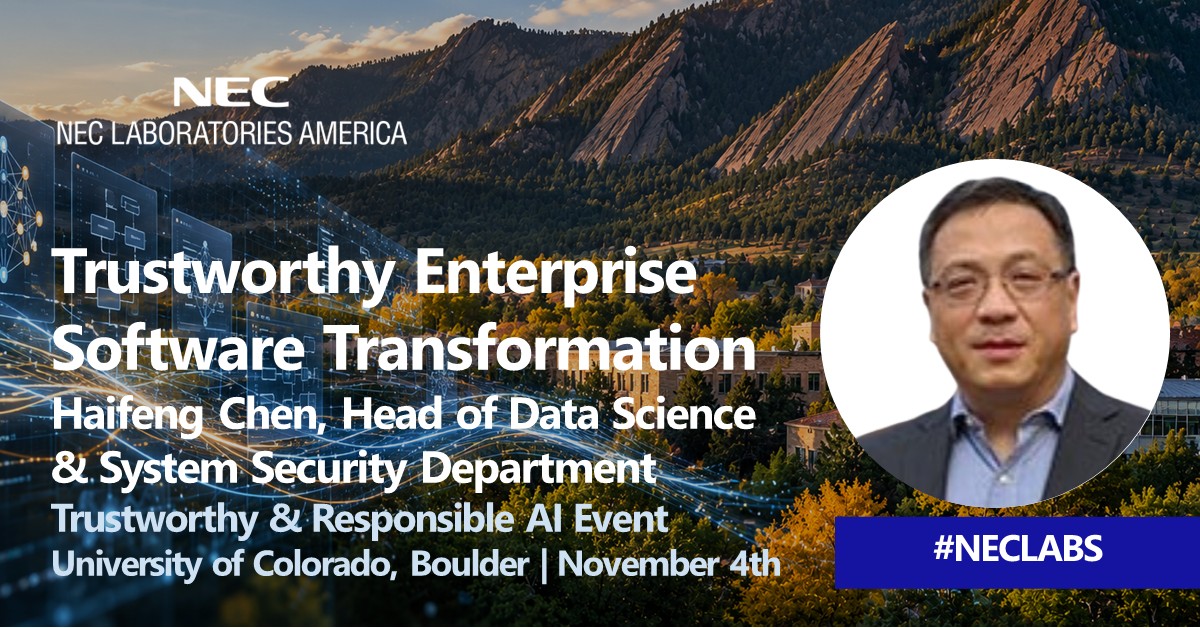
NEC Labs America2026-10-19 14:47:082026-10-20 00:29:36Haifeng Chen Speaks at the Trustworthy & Responsible AI Event at CU Boulder on November 4th
 https://www.nec-labs.com/wp-content/uploads/2026/09/ECOC-2026.jpg
628
1200
NEC Labs America
https://www.nec-labs.com/wp-content/uploads/2025/08/NEC-Laboratories-America-Logo-Aug-2025-2.jpg
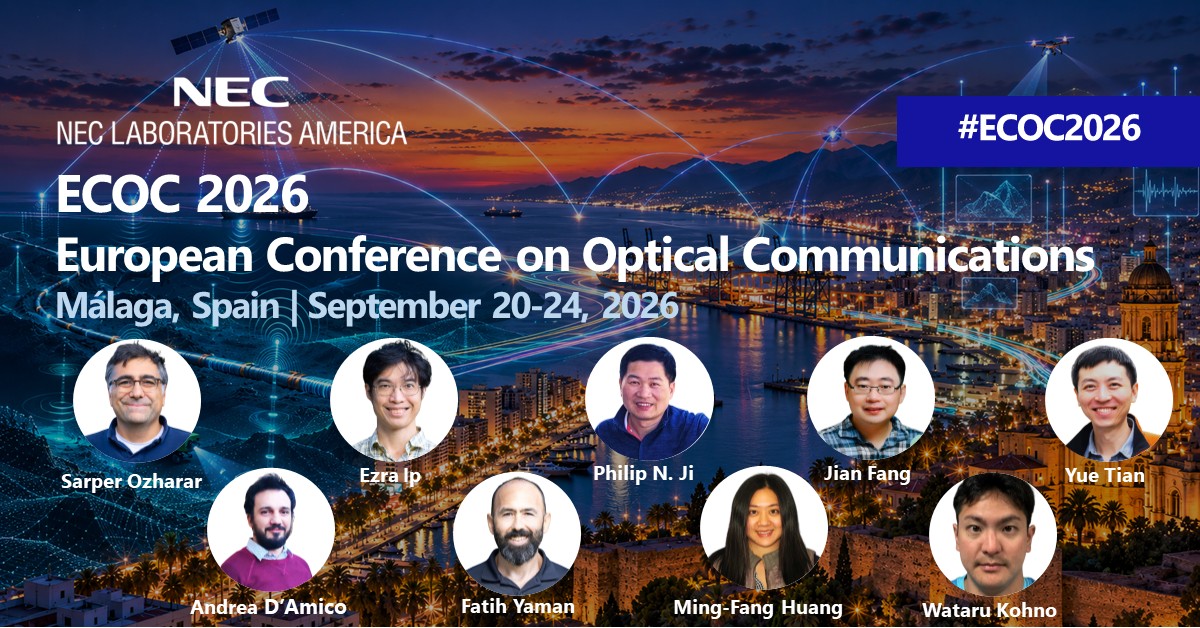
NEC Labs America2026-09-07 14:05:232026-09-07 14:51:52NEC Labs America Presents at ECOC 2026 in Málaga, Spain, September 20-24th
