NEC Provides AI-Based Traffic Monitoring System with Fiber-Optic Sensing Technology for NEXCO CENTRAL
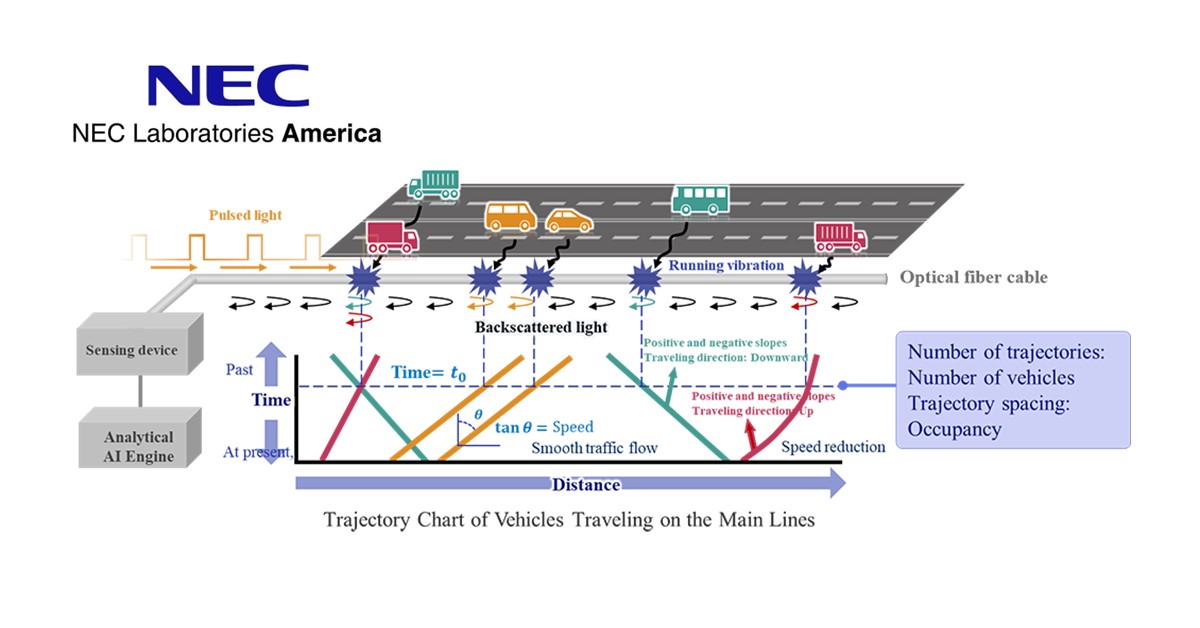
The system includes sensing devices attached to one end of an optical fiber and an analytical AI engine, developed by NEC Laboratories America, that enables continuous monitoring of traffic flow by leveraging existing optical fiber infrastructure laid along highways. NEXCO is the first expressway operator in Japan to continuously monitor traffic conditions using these kinds of technologies.
Highway operators need to monitor traffic flow and detect incidents on expressways to support traffic control. Most sensors used today for this purpose are point sensors or cameras with a limited field of view. A large number of point sensors and/or cameras are needed to perform continuous measurements over a wide area, posing challenges for installation and maintenance and leading to higher system costs.
NEC has a successful track record of conducting joint demonstration projects using optical fiber sensing technology to detect cracks in poles and monitor road traffic (*). Based on these experiences and knowledge, NEC is providing equipment to convert optical fiber cables to sensors. NEC has now developed an analytical AI engine that continuously determines traffic conditions based on the signals from vehicle vibrations. The system can visualize dense traffic conditions with high accuracy. The AI engine converts vibration data into continuous vehicle trajectories along entirely monitored roads. The trajectories can then be used to estimate average speeds at 1-kilometer intervals. The system can record a digital snapshot of traffic conditions across a wide area, enhancing road controls through continuous monitoring of entire roadways and enabling early detection of accidents and congestion.
The newly developed analytical AI engine can extract vehicle trajectories from vibration signals in the presence of multiple environmental noises. Vehicle trajectories are extracted iteratively. First, the clearest vibration signals are used to extract the vehicle trajectory, and then the corresponding signals are masked. Second, the remaining vibration signals are enhanced. The system repeats these two steps until all vehicle trajectories have been extracted.
The AI engine has been trained on synthetic data, including realistic environmental noise, enabling robust extraction of vehicle trajectories even in noisy environments. Then, the system can monitor high-density traffic flow over a wide area with high accuracy.
Going forward, NEC will continue to support the digital transformation (DX) of road operators as part of the “NEC Safer Cities” initiative to contribute to creating safer and more secure cities.
For More Information
Optical Fiber Sensing
Read More Blog Posts
 https://www.nec-labs.com/wp-content/uploads/2024/03/NEC-Laboratories-Advances-Material-Design-with-AI-based-MateriAI-Platform-.jpg
628
1200
NEC Labs America
https://www.nec-labs.com/wp-content/uploads/2025/08/NEC-Laboratories-America-Logo-Aug-2025-2.jpg
NEC Labs America2024-03-14 10:33:082026-06-26 10:58:38NEC Laboratories Advances Material Design with AI-based MateriAI Platform
https://www.nec-labs.com/wp-content/uploads/2024/03/NEC-Laboratories-Advances-Material-Design-with-AI-based-MateriAI-Platform-.jpg
628
1200
NEC Labs America
https://www.nec-labs.com/wp-content/uploads/2025/08/NEC-Laboratories-America-Logo-Aug-2025-2.jpg
NEC Labs America2024-03-14 10:33:082026-06-26 10:58:38NEC Laboratories Advances Material Design with AI-based MateriAI Platform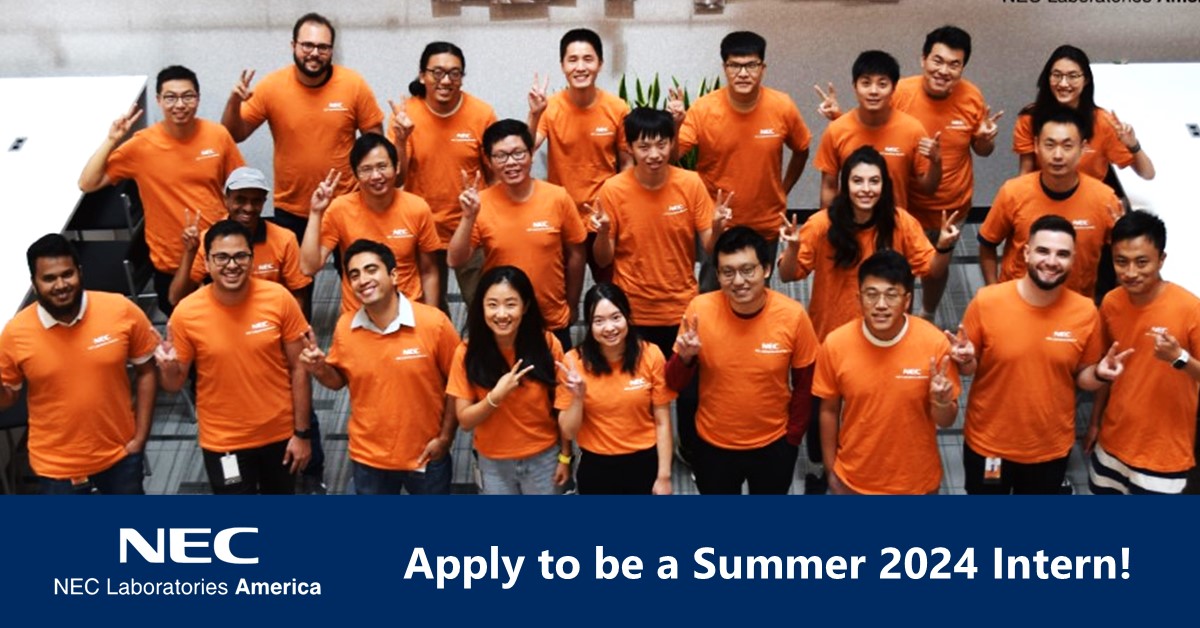 https://www.nec-labs.com/wp-content/uploads/2024/01/Summer-Intern-2024.jpg
628
1200
NEC Labs America
https://www.nec-labs.com/wp-content/uploads/2025/08/NEC-Laboratories-America-Logo-Aug-2025-2.jpg
NEC Labs America2024-01-08 19:22:402026-06-26 10:59:27Apply for a Summer 2024 Internship
https://www.nec-labs.com/wp-content/uploads/2024/01/Summer-Intern-2024.jpg
628
1200
NEC Labs America
https://www.nec-labs.com/wp-content/uploads/2025/08/NEC-Laboratories-America-Logo-Aug-2025-2.jpg
NEC Labs America2024-01-08 19:22:402026-06-26 10:59:27Apply for a Summer 2024 Internship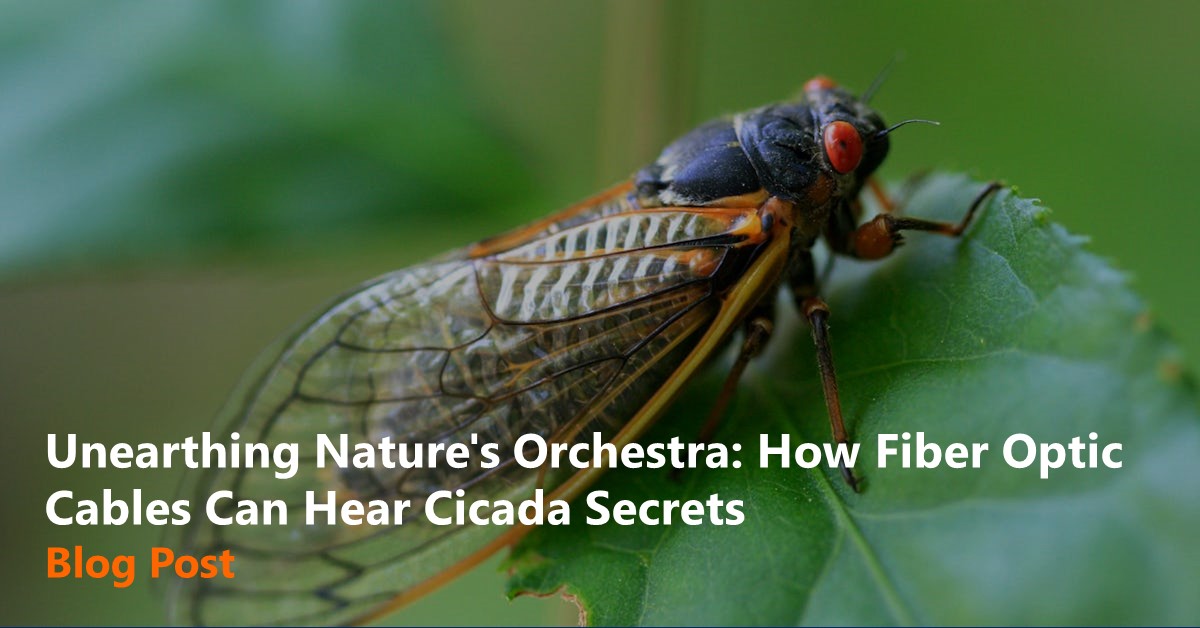 https://www.nec-labs.com/wp-content/uploads/2023/06/Unearthing-Natures-Orchestra-How-Fiber-Optic-Cables-Can-Hear-Cicada-Secrets.jpg
628
1200
NEC Labs America
https://www.nec-labs.com/wp-content/uploads/2025/08/NEC-Laboratories-America-Logo-Aug-2025-2.jpg
NEC Labs America2023-12-11 09:00:532026-06-26 11:00:23Unearthing Nature’s Orchestra – How Fiber Optic Cables Can Hear Cicada Secrets
https://www.nec-labs.com/wp-content/uploads/2023/06/Unearthing-Natures-Orchestra-How-Fiber-Optic-Cables-Can-Hear-Cicada-Secrets.jpg
628
1200
NEC Labs America
https://www.nec-labs.com/wp-content/uploads/2025/08/NEC-Laboratories-America-Logo-Aug-2025-2.jpg
NEC Labs America2023-12-11 09:00:532026-06-26 11:00:23Unearthing Nature’s Orchestra – How Fiber Optic Cables Can Hear Cicada Secrets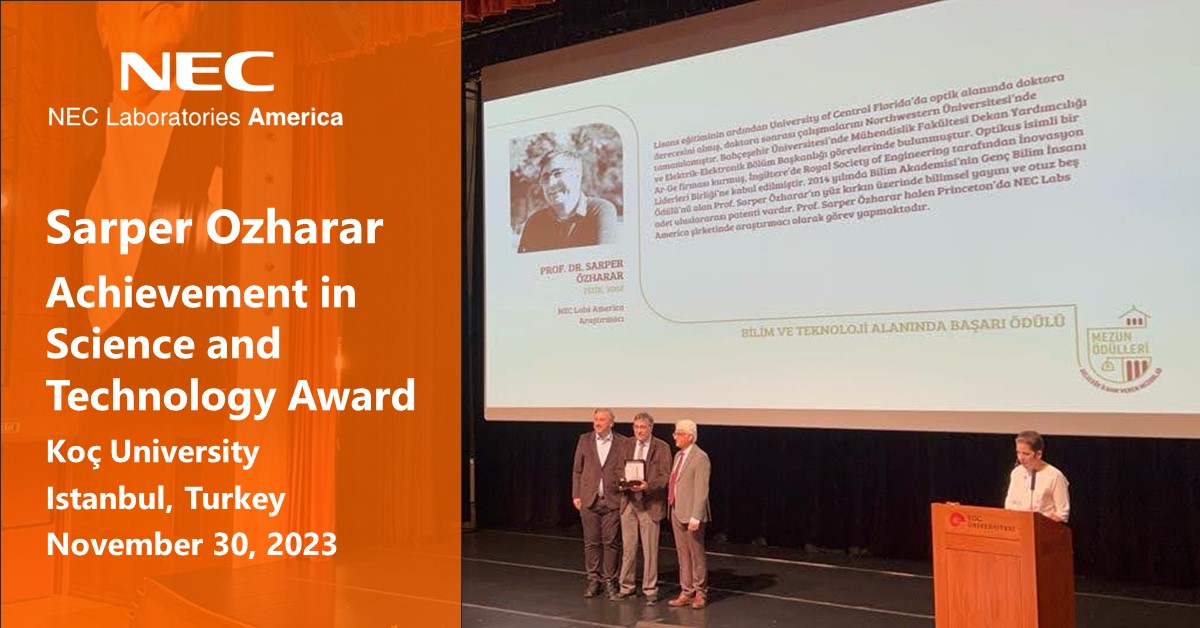 https://www.nec-labs.com/wp-content/uploads/2023/12/Sarper-Ozharar-Achievement-in-Science-and-Technology-Award.jpg
628
1200
NEC Labs America
https://www.nec-labs.com/wp-content/uploads/2025/08/NEC-Laboratories-America-Logo-Aug-2025-2.jpg
NEC Labs America2023-11-30 09:18:112026-06-26 13:03:12Sarper Ozharar Receives Achievement in Science and Technology Award from Koç University
https://www.nec-labs.com/wp-content/uploads/2023/12/Sarper-Ozharar-Achievement-in-Science-and-Technology-Award.jpg
628
1200
NEC Labs America
https://www.nec-labs.com/wp-content/uploads/2025/08/NEC-Laboratories-America-Logo-Aug-2025-2.jpg
NEC Labs America2023-11-30 09:18:112026-06-26 13:03:12Sarper Ozharar Receives Achievement in Science and Technology Award from Koç University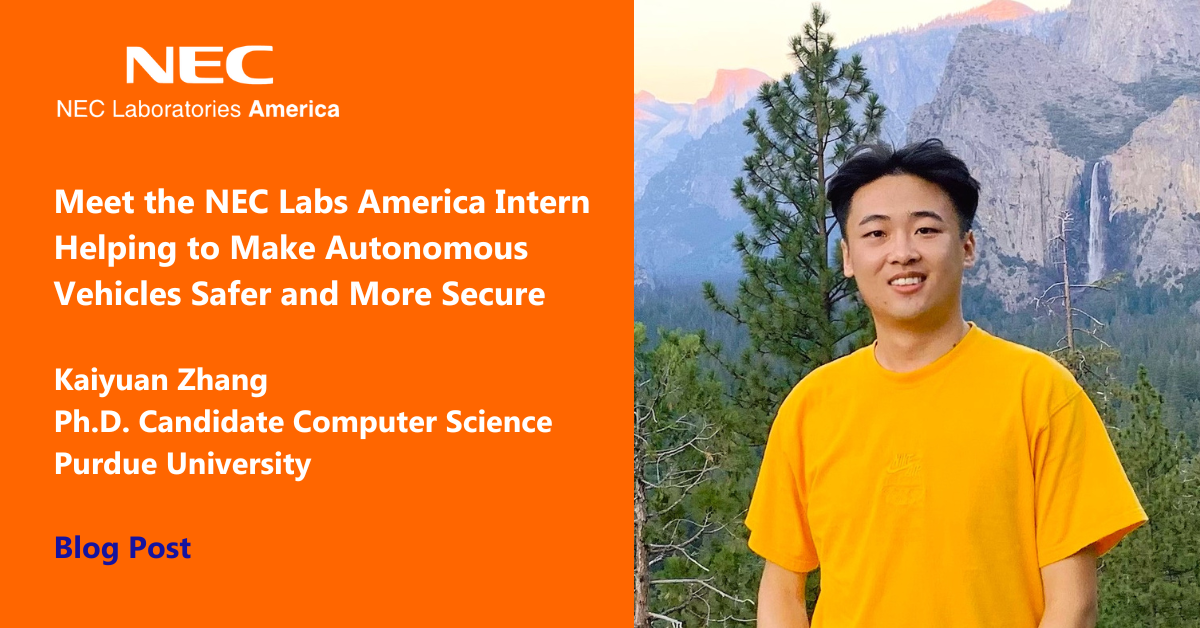 https://www.nec-labs.com/wp-content/uploads/2023/09/Meet-the-NEC-Labs-America-Intern-Helping-to-Make-Autonomous-Vehicles-Safer-and-More-Secure-Blog-Post-Graphic.png
628
1200
NEC Labs America
https://www.nec-labs.com/wp-content/uploads/2025/08/NEC-Laboratories-America-Logo-Aug-2025-2.jpg
NEC Labs America2023-09-08 15:38:202026-06-26 11:03:22Meet the NEC Labs America Intern Helping to Make Autonomous Vehicles Safer and More Secure
https://www.nec-labs.com/wp-content/uploads/2023/09/Meet-the-NEC-Labs-America-Intern-Helping-to-Make-Autonomous-Vehicles-Safer-and-More-Secure-Blog-Post-Graphic.png
628
1200
NEC Labs America
https://www.nec-labs.com/wp-content/uploads/2025/08/NEC-Laboratories-America-Logo-Aug-2025-2.jpg
NEC Labs America2023-09-08 15:38:202026-06-26 11:03:22Meet the NEC Labs America Intern Helping to Make Autonomous Vehicles Safer and More Secure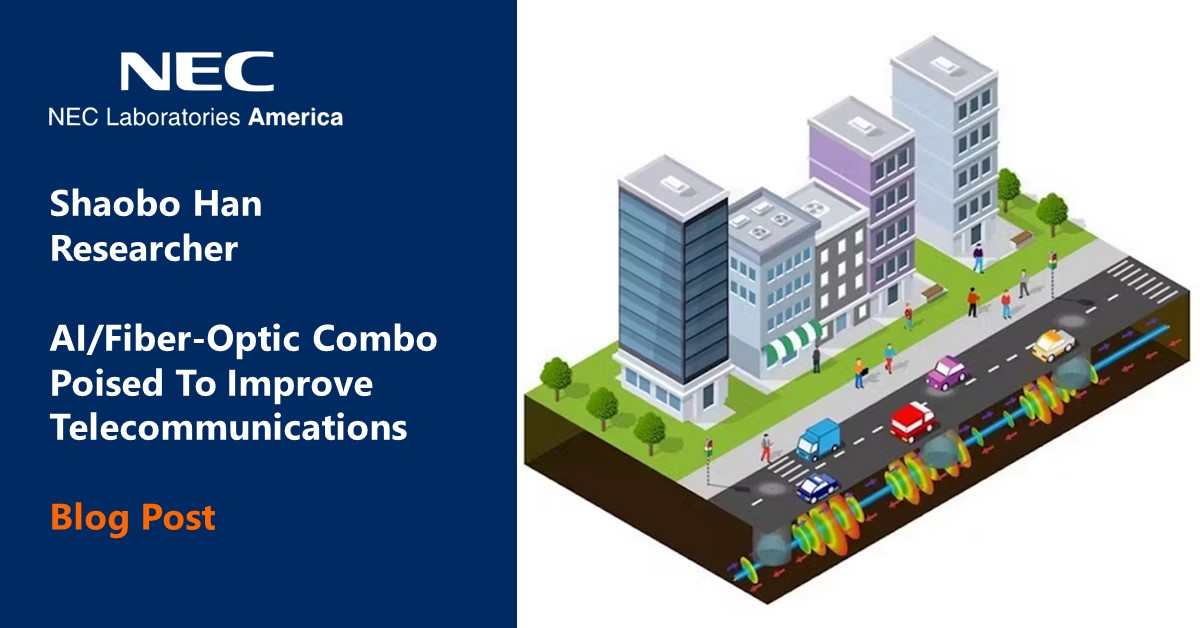 https://www.nec-labs.com/wp-content/uploads/2023/09/AI-Fiber-Optic-Combo-Poised-To-Improve-Telecommunications.jpg
628
1200
NEC Labs America
https://www.nec-labs.com/wp-content/uploads/2025/08/NEC-Laboratories-America-Logo-Aug-2025-2.jpg
NEC Labs America2023-09-07 14:57:352026-06-26 11:04:20AI/Fiber-Optic Combo Poised To Improve Telecommunications
https://www.nec-labs.com/wp-content/uploads/2023/09/AI-Fiber-Optic-Combo-Poised-To-Improve-Telecommunications.jpg
628
1200
NEC Labs America
https://www.nec-labs.com/wp-content/uploads/2025/08/NEC-Laboratories-America-Logo-Aug-2025-2.jpg
NEC Labs America2023-09-07 14:57:352026-06-26 11:04:20AI/Fiber-Optic Combo Poised To Improve Telecommunications